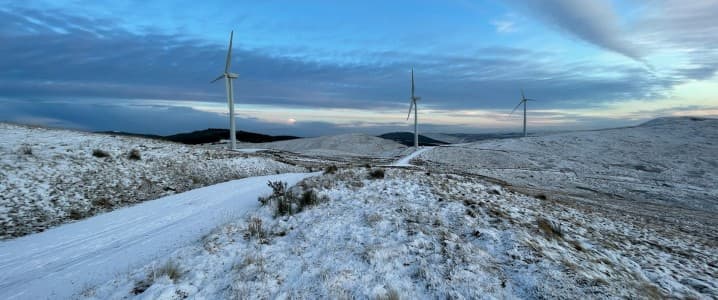
The recent decision by Norway to reject an 800-megawatt wind farm application in its northern Finnmark county sends a clear signal to investors about the escalating complexities and growing regulatory hurdles facing large-scale renewable energy projects. While seemingly a localized environmental dispute, the Norwegian Water Resources and Energy Directorate’s (NVE) refusal of the Davvi wind farm application from Grenselandet AS, citing irreversible impacts on wilderness and indigenous Sami culture, underscores a critical shift in the energy transition narrative. This development, occurring amidst significant volatility in global crude markets, demands a closer look at the evolving risk profile for green investments and its potential implications for traditional oil and gas portfolios.
Norway’s Renewable Roadblock: A Precedent for Scrutiny
The NVE’s firm rejection of the Davvi wind farm project, which would have spanned 63 square kilometers in a vital wilderness area with deep cultural significance for the Sami people, highlights a broadening scope of environmental and social governance (ESG) considerations for energy infrastructure. This isn’t merely about land availability; it’s about the qualitative impact on unique ecosystems and traditional ways of life. Even as Norway remains a major oil and gas producer, its domestic electricity mix is overwhelmingly clean, dominated by hydropower (90%) with wind contributing a modest 10%. The NVE’s statement prioritizing “the best projects” in Finnmark, while still reviewing other proposals, suggests a heightened bar for approval. Investors should recognize this as a potential bellwether for increased scrutiny globally, where large-scale renewable developments may face similar pushback from local communities and environmental groups, slowing down deployment timelines and escalating project costs. The ongoing consultation period, allowing stakeholders to provide input until December 5, provides a window into the depth of these concerns.
Market Volatility Meets Energy Transition Headwinds
This regulatory setback for renewables comes at a time of pronounced turbulence in the global energy markets. As of today, Brent crude trades at $90.38 per barrel, marking a significant daily decline of 9.07%, while WTI crude is at $82.59, down 9.41%. This sharp correction follows a challenging fortnight where Brent has shed $22.4, or nearly 20%, from its $112.78 perch on March 30. Such dramatic price swings, alongside a 5.18% daily drop in gasoline prices to $2.93 per gallon, underscore the inherent volatility and uncertainty in the traditional energy sector. However, the slowing pace of renewable build-out due to regulatory and social hurdles, as exemplified by Norway’s decision, creates a complex dynamic. While it doesn’t directly boost crude prices, it could temper expectations for a rapid displacement of fossil fuels, potentially providing a longer runway for oil and gas investments than some models currently predict. Investors must weigh the immediate market dips against the longer-term implications of a more protracted energy transition, where traditional energy sources may retain a critical role for longer.
Navigating Future Energy Development: Offshore and Policy Nuances
Norway’s strategic shift towards floating offshore wind, rather than fixed-bottom projects, presents an interesting case study in adapting renewable strategies to environmental and social constraints. The Ministry of Energy’s opening of competition for offshore wind project areas in Utsira Nord off the Rogaland coast in May signals a clear intent to pursue less intrusive, albeit more technologically complex and expensive, forms of renewable generation. This pivot suggests that future large-scale renewable projects, especially in developed nations, may increasingly migrate offshore or into less ecologically sensitive zones, driving up capital expenditure and potentially impacting returns. For investors, this implies a need for deeper due diligence into project siting, regulatory frameworks, and technological readiness. The NVE’s commitment to prioritizing “the best projects” in Finnmark underscores a nuanced policy approach, where not all renewable energy is treated equally, and local impacts are increasingly weighed against national energy targets. This selective approach could lead to higher barriers to entry and consolidate opportunities among developers with proven track records in navigating complex permitting environments.
Investor Focus: Price Predictions and OPEC+ Influence
Our proprietary reader intent data reveals a keen focus among investors on future oil price trajectories and the influence of major market players. Questions such as “what do you predict the price of oil per barrel will be by end of 2026?” and “What are OPEC+ current production quotas?” dominate discussions. This strong interest highlights a recognition that despite the push for renewables, crude oil fundamentals remain critical to investment strategies. The upcoming OPEC+ Joint Ministerial Monitoring Committee (JMMC) Meeting on April 19, followed by the full OPEC+ Ministerial Meeting on April 20, will be pivotal events in shaping near-term supply expectations. Any signals regarding production policy could trigger significant market reactions, impacting the current downward trend. Furthermore, the regular cadence of API and EIA Weekly Crude Inventory reports on April 21 and 22, and again on April 28 and 29, provides crucial insights into demand strength and inventory levels. These events, combined with the Baker Hughes Rig Count on April 24 and May 1, offer tangible catalysts that will inform price forecasts and guide capital allocation decisions for the remainder of the year and into 2026. The increasing scrutiny on renewable projects like the Davvi wind farm adds another layer of complexity, indirectly supporting the continued relevance of traditional energy investments in a world still heavily reliant on hydrocarbons.


