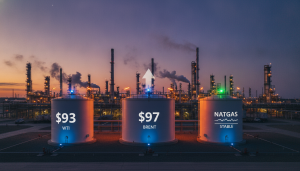
The energy market is currently navigating a period of heightened volatility, particularly evident in the crude oil complex. While traditional benchmarks experience significant downward pressure, our proprietary insights indicate a strategic re-evaluation by investors, with a noticeable shift in focus towards segments exhibiting greater resilience. This dynamic environment demands a nuanced understanding of real-time market movements, upcoming catalysts, and evolving investor sentiment to position effectively within the global energy landscape.
Crude’s Steep Descent and Market Reassessment
As of today, the crude oil market is signaling a significant re-evaluation of its immediate trajectory. Brent crude trades at $90.38 per barrel, marking a substantial 9.07% decline within the day, with its range fluctuating between $86.08 and $98.97. Similarly, WTI crude has experienced a sharp downturn, currently priced at $82.59 per barrel, representing a 9.41% drop, trading within a range of $78.97 to $90.34. This aggressive correction follows a challenging two-week period, during which Brent shed a staggering $22.4, or nearly 20%, from its $112.78 high recorded on March 30. Such a rapid depreciation from recent peaks underscores a profound market reassessment of demand fundamentals against the backdrop of persistent geopolitical uncertainties and evolving supply narratives. The weakness extends to refined products, with gasoline prices reflecting this broader sentiment, currently at $2.93, a 5.18% decrease. This significant volatility in the petroleum complex compels investors to critically assess their exposure and consider where stability, or alternative growth, might be found within the broader energy sector.
Natural Gas Gains Traction Amid Crude’s Woes
While crude oil grapples with substantial downward pressure, our proprietary reader intent data reveals a palpable shift in investor inquiry, suggesting that natural gas is increasingly becoming a focal point. Questions frequently posed by our readers, such as “what do you predict the price of oil per barrel will be by end of 2026?”, indicate a long-term outlook focus for crude, yet the underlying sentiment of current market weakness drives interest towards alternatives. The market’s implied narrative of “Nat Gas Defies Weak Crude” suggests that investors are actively seeking sectors demonstrating greater relative stability or unique demand drivers that insulate them from the prevailing bearish crude sentiment. This divergence highlights a tactical re-allocation of capital and attention, where natural gas assets are being scrutinized for their potential as a defensive play or a value opportunity. This is particularly relevant given ongoing global energy transition narratives and robust demand for liquefied natural gas (LNG), which could underpin sustained interest in the natural gas market, irrespective of immediate crude oil fluctuations.
Navigating Upcoming Catalysts: OPEC+ and Inventory Watch
The immediate future holds several pivotal events that could dictate the next moves for energy markets, and investors are keenly focused on their implications. The upcoming OPEC+ Joint Ministerial Monitoring Committee (JMMC) meeting on April 19, followed swiftly by the full OPEC+ Ministerial Meeting on April 20, will be under intense scrutiny. With crude prices experiencing a significant pullback, the coalition faces renewed pressure to stabilize markets. Our reader questions, particularly those asking about “OPEC+ current production quotas,” underscore the market’s anticipation of any potential adjustments to output policies. Any indication of further supply cuts, or conversely, a steadfast adherence to current policies, will send ripples across trading screens. Beyond the political machinations, the market will also closely monitor crucial inventory data. The API Weekly Crude Inventory reports on April 21 and April 28, along with the EIA Weekly Petroleum Status Reports on April 22 and April 29, will offer vital insights into U.S. supply-demand dynamics. These reports, alongside the Baker Hughes Rig Count on April 24 and May 1, will provide a clearer picture of domestic production trends and storage levels, significantly influencing short-term price direction and guiding investor sentiment.
Strategic Positioning in a Volatile Landscape
The current market environment, characterized by sharp price swings and a clear divergence between segments of the energy complex, demands a strategic and agile approach from investors. The significant decline in crude prices over the past two weeks, pushing Brent below the $91 mark, suggests that long-term oil price predictions are being continuously re-evaluated against a backdrop of immediate bearish sentiment. This heightened volatility also directly impacts the performance of integrated energy companies. Questions about specific company performance, such as “How well do you think Repsol will end in April 2026?”, underscore the granular focus on individual stock resilience within this turbulent period. Companies with diversified portfolios, strong balance sheets, or significant exposure to more resilient sectors like natural gas and renewables might weather the current crude downturn more effectively. Investors should prioritize diligent fundamental analysis, focusing on operational efficiency, debt levels, and strategic capital allocation to navigate this complex period. The shifting dynamics compel a rigorous reassessment of risk-reward profiles across the entire energy value chain, from upstream exploration and production to refining and petrochemicals, favoring those positioned for agility, strategic diversification, and long-term sustainability.