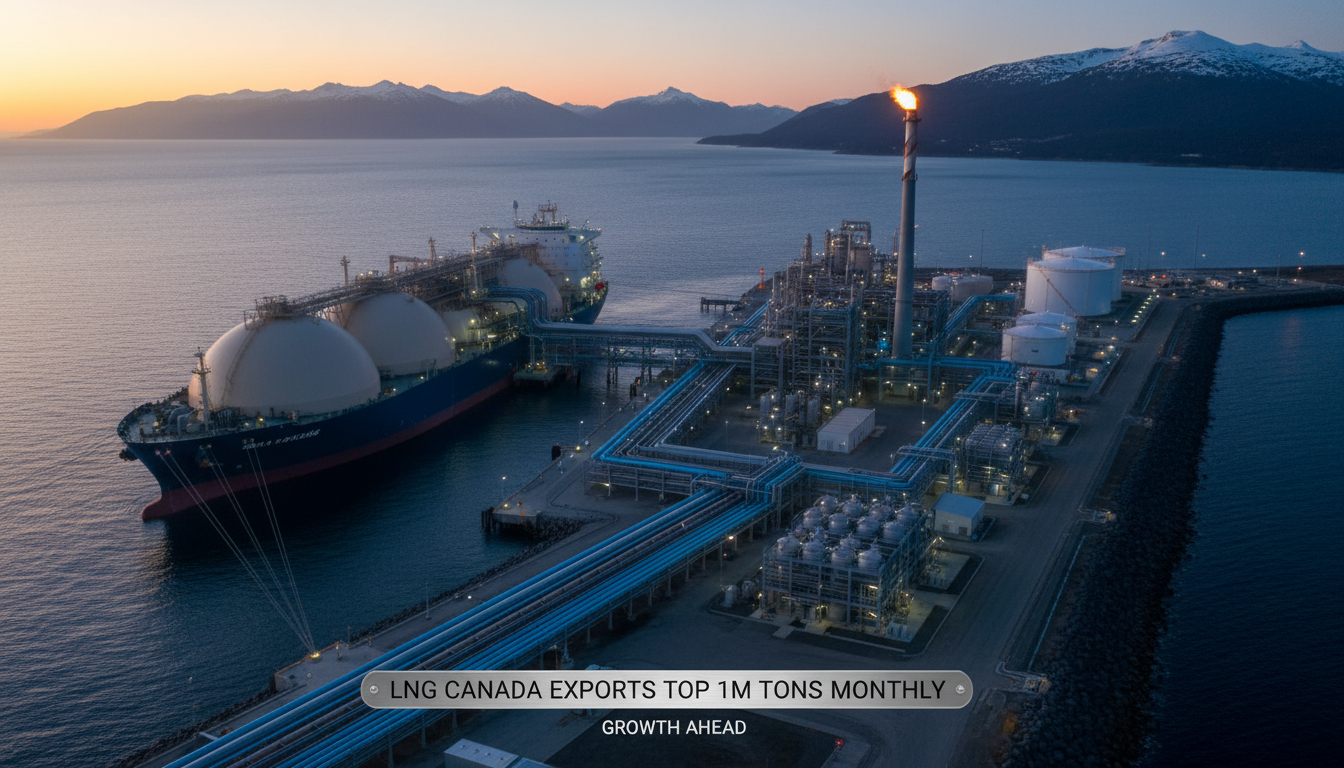
LNG Canada Surpasses One Million Metric Tons in April, Setting New Export Benchmark
Canada’s nascent liquefied natural gas (LNG) export industry marked a significant milestone in April, as the LNG Canada facility recorded an unprecedented outflow of over 1 million metric tons. Data compiled by LSEG confirms this achievement, signaling a robust ramp-up in operations for the nation’s inaugural major LNG export terminal.
This record-setting performance is not merely a quantitative win; it underscores the strategic importance of the LNG Canada project. Positioned on North America’s West Coast, the facility enjoys a distinct logistical advantage, offering direct and efficient maritime routes to Asia. This critical access point connects Canadian natural gas reserves directly to the world’s most dynamic and largest LNG consumption market, fundamentally reshaping global energy supply dynamics and offering investors a prime avenue into a high-demand sector.
Capitalizing on Asian Demand: A Strategic Market Penetration
The strategic siting of LNG Canada directly translates into a competitive edge in serving the Asia-Pacific region. Unlike terminals on the Gulf Coast of the United States, which necessitate longer voyages through the Panama Canal, LNG Canada provides a shorter, more cost-effective transit to key Asian economies. This geographic advantage was vividly demonstrated in April, with all export volumes from the facility directed towards Asian destinations.
South Korea emerged as the primary recipient, absorbing more than half of the month’s exported LNG. This highlights the deepening energy ties between Canada and a crucial industrial power in Northeast Asia. Furthermore, a noteworthy single cargo made its way directly to China, signaling evolving trade patterns and potentially new market opportunities for Canadian energy producers in a nation with complex LNG procurement strategies.
Navigating Geopolitical Currents: China’s Evolving LNG Import Dynamics
China’s energy import landscape has been shaped by geopolitical considerations, particularly its relationship with the United States. Since the imposition of sanctions during the Trump administration, Beijing has refrained from directly importing U.S.-sourced LNG. Instead, Chinese entities have engaged in an arbitrage strategy, reselling U.S.-sourced LNG to other nations to capitalize on higher spot market prices, often contrasting with the lower, long-term contract rates secured with American producers.
In this context, the direct delivery of Canadian LNG to China represents a pivotal development. On April 24, the tanker Qingcheng discharged its precious cargo at China’s Dongjiakou terminal, concluding an approximate three-week journey from the Canadian coast. This shipment underscores China’s quest for diverse and stable energy sources, providing Canadian LNG a distinct pathway into a market that has previously exhibited complex import behaviors due to international trade tensions. For investors, this development signifies a broadening of market access and a potential de-risking of future export revenue streams.
Ramping Up to Full Potential: Operational Progress and Future Outlook
The journey for LNG Canada commenced with the initiation of LNG production in June. While the April export figures are encouraging, the facility is still in its commissioning and ramp-up phase, not yet operating at its maximum design capacity. The plant’s full operational capability is projected to reach an impressive 14 million metric tons annually, translating to approximately 1.16 million metric tons each month.
The incremental increase in export volumes, culminating in the April record, demonstrates a steady progression towards achieving full throughput. As the facility continues to optimize its operations, refine its processes, and enhance its efficiency, investors can anticipate further growth in export capabilities. Reaching full capacity will unlock the plant’s complete economic potential, contributing substantially to its profitability and solidifying Canada’s standing as a reliable global LNG supplier.
A Coalition of Global Energy Leaders Drives the Venture
The formidable success and ongoing development of LNG Canada are a testament to the robust partnership behind the project. This ambitious venture is a joint undertaking by some of the world’s most prominent energy companies: Shell, Malaysia’s Petronas, PetroChina, Japan’s Mitsubishi Corp, and South Korea’s KOGAS. This powerful consortium brings together unparalleled financial strength, extensive operational expertise, and diversified market access.
Each partner contributes unique strengths, from Shell’s global leadership in LNG and integrated gas to PetroChina’s deep understanding of the Asian market and KOGAS’s role as a major LNG importer. This multi-national collaboration not only de-risks the investment but also ensures the project benefits from a wealth of experience across the entire LNG value chain, from upstream gas production to liquefaction, shipping, and market distribution. For investors, the presence of such established players lends significant credibility and long-term stability to the project, underscoring its strategic importance on a global scale.
Investment Implications: Canada’s Growing Footprint in Global Energy Security
The record-breaking performance by LNG Canada holds profound implications for the broader investment landscape in the energy sector. It underscores the growing importance of Canadian natural gas as a reliable, responsibly sourced energy commodity. As global energy markets continue to grapple with supply security concerns and the imperative of decarbonization, natural gas serves as a crucial transition fuel, offering a cleaner alternative to coal and a vital complement to renewable energy sources.
For investors focused on oil and gas, LNG Canada represents a diversification of Canadian energy exports beyond traditional crude oil, opening new avenues for growth and revenue generation linked to global gas prices. The project’s success is likely to spur further interest and investment in Canada’s vast natural gas resources and associated infrastructure, solidifying the nation’s role as a significant player in the international energy arena. This sustained trajectory points to promising returns for those positioned to capitalize on Canada’s expanding capacity for global energy supply.