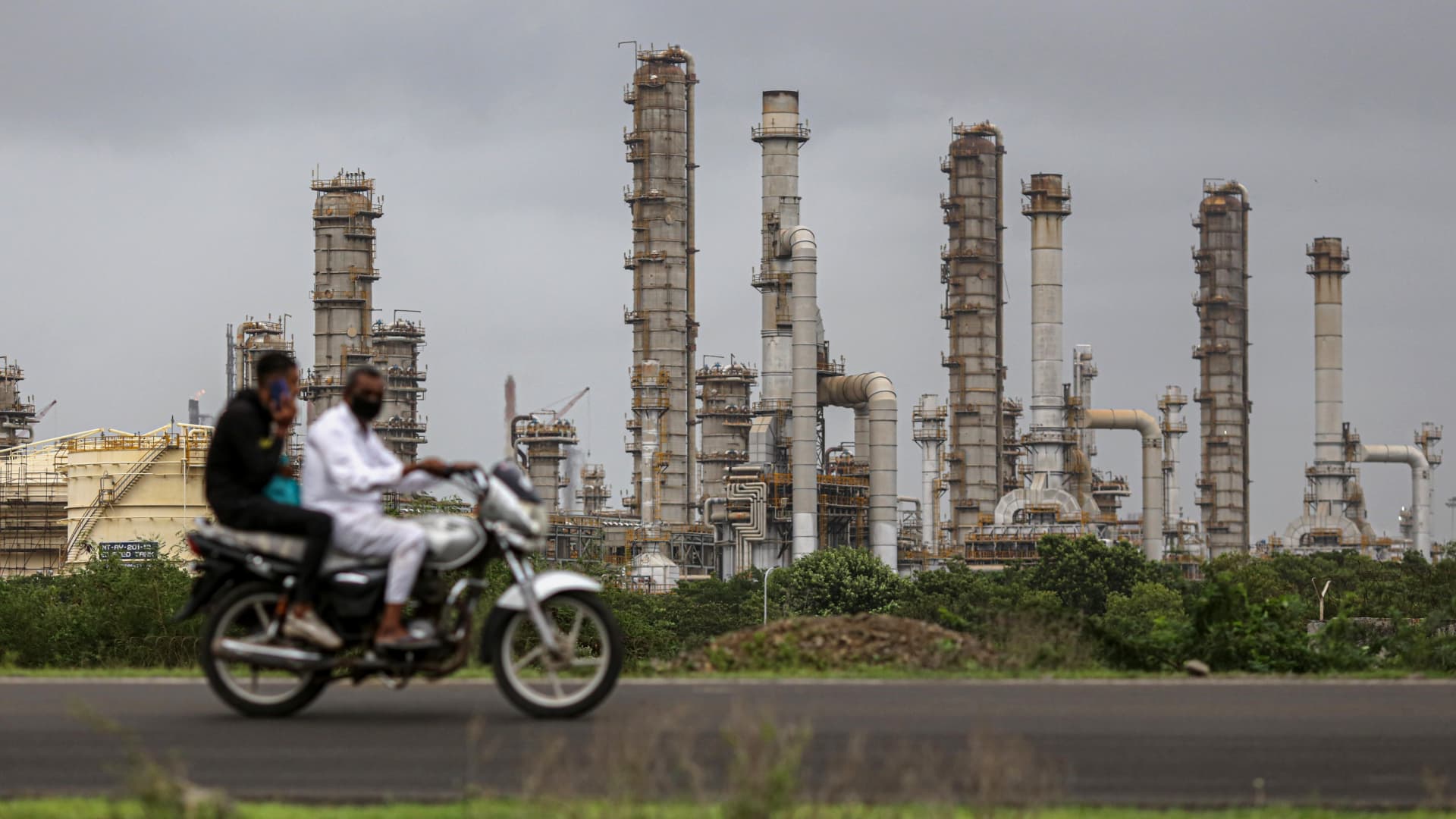
India, the world’s third-largest energy consumer, finds itself at a critical juncture, balancing its insatiable demand for affordable crude with escalating geopolitical pressures. The nation’s strategic pivot towards Russian oil in the wake of the Ukraine conflict has been a masterclass in energy pragmatism, yet it now faces a potential reversal of US policy, threatening to disrupt global oil flows and introduce significant volatility for investors. As New Delhi navigates this complex landscape, the implications for refining margins, global supply chains, and crude benchmarks are profound.
The Geopolitical Chessboard: India’s Energy Security vs. Sanctions Risk
India’s energy calculus has fundamentally shifted over the past two years, transforming Russia into its dominant oil supplier. Prior to the full-scale invasion of Ukraine in February 2022, Russian crude constituted a mere 2.5% of India’s total oil imports, equating to less than 100,000 barrels per day. By 2023, this figure had surged dramatically to over 1.8 million barrels per day, capturing a staggering 39% share of India’s total imports. Furthermore, the International Energy Agency reports that in 2024, approximately 70% of Russia’s total crude exports found their way to Indian refineries. This monumental shift was driven by the availability of heavily discounted Russian crude, a boon for India’s price-sensitive economy and its burgeoning refining sector. New Delhi’s stance, articulated by its foreign ministry, has consistently been that energy sourcing decisions are based on international market prices and prevailing global conditions. This pragmatic approach was, by some accounts, even implicitly encouraged by the previous US administration to stabilize global prices, preventing a spike to $130 per barrel. However, the recent threat of a “penalty” and a 25% tariff from a potential future US administration, beginning August 1st, signals a significant policy pivot. This introduces considerable uncertainty for Indian policymakers and, by extension, for the global energy market, as India’s officials have reportedly shown no immediate inclination to alter their long-term contracts with Russian suppliers.
Market Dynamics and the Enduring Allure of Discounted Crude
The global crude market remains highly sensitive to supply disruptions and demand signals, and India’s purchasing decisions are a major determinant. As of today, Brent crude trades at $99 per barrel, marking a +4.29% increase for the session, with a daily range between $94.42 and $99.23. Similarly, WTI crude is priced at $90.83, up +3.06%, fluctuating between $87.32 and $90.97. Gasoline prices have also seen an uptick, currently at $3.07, a +2.33% rise. This current upward momentum comes after a period of significant volatility, with Brent having declined from $108.01 on March 26th to $94.58 on April 15th, representing a -12.4% drop over 14 days. Despite this recent downtrend, the current price levels for benchmark crudes remain elevated, underscoring the persistent incentive for India to procure discounted Russian oil. For Indian refiners like Reliance Industries, access to cheaper feedstock directly translates into enhanced profitability and competitive advantage in refined product markets. Any policy measure that forces India to pivot away from its current sourcing strategy would inevitably increase its input costs, potentially affecting domestic fuel prices and regional product markets. This economic reality is a powerful counterweight to external political pressure, suggesting India will continue to prioritize affordability and supply security as long as viable alternatives are not equally competitive.
Investor Focus: Navigating Policy Uncertainty and Price Forecasts
Investors are keenly focused on building a base-case Brent price forecast for the next quarter and assessing the consensus 2026 Brent outlook, recognizing that geopolitical tensions and supply stability are paramount. The evolving situation with India’s Russian oil imports introduces a significant, unquantified risk premium into these forecasts. If the threatened US penalties materialize, the global oil market could face several scenarios, each with distinct implications for price and volatility. Firstly, if India is compelled to significantly reduce its Russian oil intake, the destination of that displaced crude becomes a critical question. It could flood other markets at even deeper discounts, further distorting global price mechanisms, or it could lead to an overall reduction in Russian exports if logistics become too challenging. Secondly, India, as a major refining hub, processing much of this crude into products for export, could see its refining margins squeezed if it’s forced to buy more expensive alternative crudes. This would impact the profitability of key players in the sector. Investors are weighing the potential for increased market fragmentation, higher shipping costs due to altered trade routes, and the overall impact on the delicate supply-demand balance. The uncertainty surrounding India’s energy future under a more assertive US policy stance demands careful consideration in any long-term oil market projection.
Forward Outlook: Key Events Shaping India’s Next Moves
The coming weeks and months will be crucial in shaping India’s energy strategy and the broader global oil market. Investors should closely monitor several upcoming events that could influence price dynamics and policy decisions. The OPEC+ Joint Ministerial Monitoring Committee (JMMC) meeting on April 18th, followed by the Full Ministerial meeting on April 20th, will be paramount. Any decisions by OPEC+ regarding production levels will directly impact global supply and, consequently, the attractiveness of discounted Russian crude. Should OPEC+ opt for deeper cuts, pushing benchmark prices higher, India’s incentive to continue importing Russian oil would only intensify, potentially exacerbating the US policy dilemma. Conversely, an increase in OPEC+ output could soften prices and offer India more competitive alternatives, albeit likely still at a premium to existing Russian deals. Beyond OPEC+, the consistent flow of inventory data from the API Weekly Crude Inventory reports (April 21st and 28th) and the EIA Weekly Petroleum Status Reports (April 22nd and 29th) will provide critical snapshots of the US market’s health and global supply overhang. These reports, alongside the Baker Hughes Rig Count on April 17th and 24th, contribute to the overall market sentiment that India will be observing closely. The threatened August 1st deadline for potential US tariffs and penalties looms large, forcing New Delhi to strategize its response to ensure continued energy security while navigating complex geopolitical waters. India’s ability to maintain its pragmatic energy policy will heavily depend on the interplay of these market forces and the evolving international political climate.


