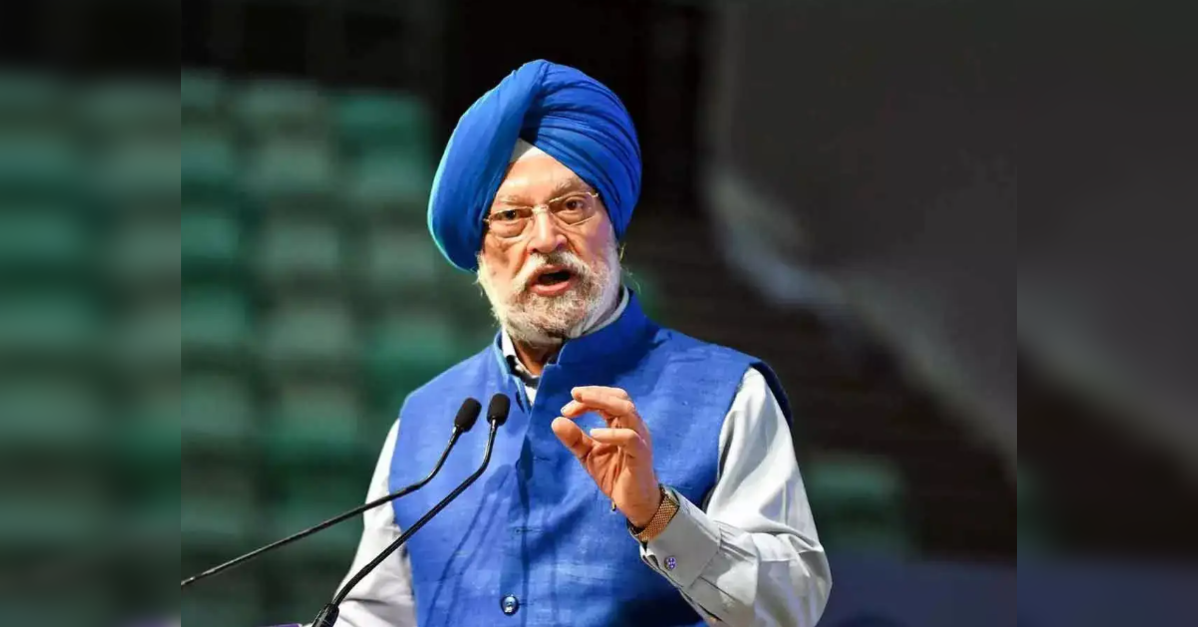
Union Minister for Petroleum and Natural Gas Hardeep Singh Puri on Tuesday said India is set to account for as much as 35 per cent of the incremental growth in global energy demand over the next two decades, underscoring the country’s central role in shaping the future global energy order amid rising geopolitical and structural challenges.
Addressing the opening day of India Energy Week (IEW) 2026 in Goa, Puri said the global energy sector is at the centre of unprecedented turmoil, but platforms such as IEW demonstrate that producers, consumers, technology providers and service companies can come together to chart predictable and collaborative pathways through uncertainty.
Highlighting the broader global context, Puri said nearly 80 per cent of incremental global energy demand now comes from emerging and developing economies, with close to 60 per cent originating in developing Asia. At the same time, around 730 million people worldwide still lack access to electricity, while nearly two billion continue to rely on harmful cooking methods, making universal access to affordable and clean energy a pressing global equity challenge.
India’s energy trilemma
Against this backdrop, Puri said India’s large population and rising energy needs place it at the heart of the global transition. He pointed to India’s progress in diversifying its energy mix, including achieving 20 per cent biofuel blending and advancing initiatives in green hydrogen, compressed biogas, CNG and LNG.
However, he cautioned against the assumption that new energy sources can immediately replace conventional fuels.“If investment in existing oil and gas production were to stop today, global oil output would decline by around 8 per cent annually over the next decade,” he said, adding that the history of energy transitions has always been about addition rather than replacement. For India, the core energy trilemma remains consistent availability, affordability and sustainability.
Puri said India has ensured uninterrupted energy availability across the country, while affordability remains central to policy-making. He highlighted that India has among the lowest energy prices globally, reflecting the government’s focus on energy as a matter of survival rather than just security.
Clean cooking fuel access
Citing the expansion of clean cooking fuel access, he said LPG connections have increased from 14 crore in 2014 to 33 crore today. Under the Ujjwala scheme, beneficiary households receive clean cooking gas at a cost of just ₹5–6 per day, while non-beneficiaries pay around ₹12–13 per day, keeping energy well within affordable limits for households.
Oil and gas sector reforms
On the upstream side, the minister said India has opened up large parts of its 3.5 million square kilometre sedimentary basin, including unlocking nearly one million square kilometres that were earlier designated as no-go areas. He outlined recent reforms aimed at boosting energy security and attracting investment, including the launch of the 10th Open Acreage Licensing Policy (OALP) round, a special coal bed methane bidding round in 2025 and the Discovered Small Fields (DSF-4) bid round.Puri added that exploration activity is already progressing in deep and ultra-deepwater blocks awarded under OALP-9, with 2D seismic acquisition completed and 3D seismic surveys around 30 per cent complete. He assured that reforms would continue to strengthen India’s position as a preferred destination for global energy investment.
The minister also highlighted India’s emergence as a hub for global capability centres (GCCs), with over 1,700 GCCs currently operating in the country. Their combined revenue has grown from $40 billion in FY19 to $64 billion in FY24 and is projected to reach $105 billion by 2030, supported by nearly 2,400 GCCs employing over 2.8 million professionals.
Puri said India stands ready to work with global partners to build an energy future that is secure, resilient and inclusive. He added that India Energy Week 2026 will serve as a catalyst for cooperation, partnerships and actionable outcomes, helping convert dialogue into delivery for the benefit of economies and societies worldwide.