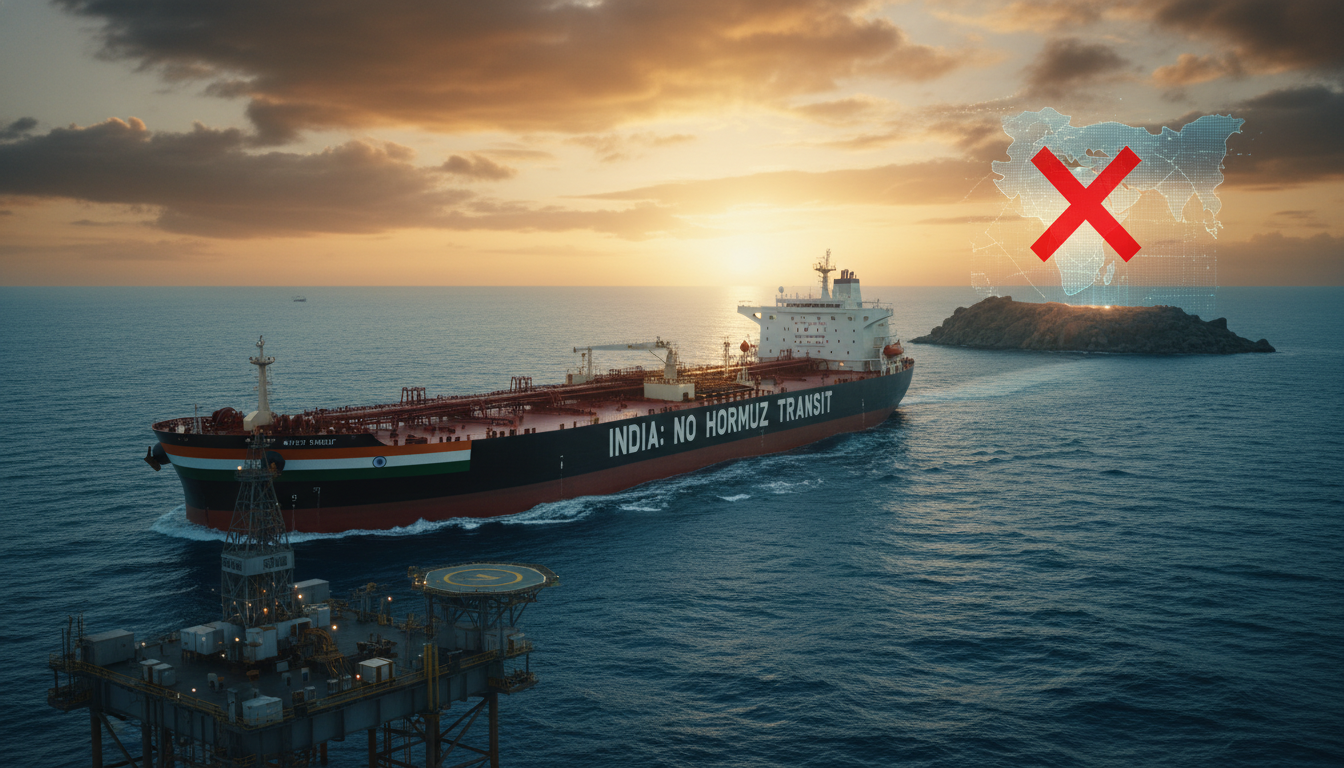
The Strait of Hormuz, an indispensable conduit for global energy, once again finds itself at the epicenter of geopolitical discussion, prompting a critical re-evaluation of oil supply risk. India, a significant global energy consumer, has unequivocally affirmed that no prior authorization is required for vessels transiting this vital international strait. This firm stance, articulated by New Delhi’s Ministry of Ports, Shipping, and Waterways, serves as a crucial signal for energy investors navigating an increasingly complex maritime landscape. With approximately 20% of the world’s total petroleum consumption and a substantial 30% of global liquefied natural gas (LNG) trade flowing through Hormuz, any perceived ambiguity in transit protocols immediately translates into market volatility, impacting crude oil benchmarks, shipping insurance premiums, and the broader hydrocarbon supply chain.
India’s Unwavering Stance on International Maritime Law
India’s clarification, delivered by Special Secretary Rajesh Kumar Sinha, emphatically underscores the principle of unimpeded navigation through international straits. Sinha explicitly stated, “No permission is needed,” reaffirming a historically upheld right that remains unchanged. This position also highlights that international regulations strictly prohibit the imposition of any levies on ships merely transiting the strait. While acknowledging what he termed the “current special situation,” Sinha indicated a pragmatic approach of judiciously assessing movements for safety and optimal timing. This declaration comes against the backdrop of recent statements from Iran’s foreign ministry, which indicated that navigation safety initiatives within the Strait of Hormuz must be executed with deference to the rights and interests of the Islamic Republic of Iran and in coordination with its competent authorities. This subtle yet significant divergence in articulation between New Delhi and Tehran creates potential areas of interpretational friction regarding maritime jurisdiction and transit protocols, a dynamic closely monitored by oil and gas investors for its capacity to introduce market uncertainty.
Hormuz Risk and Current Market Dynamics
The geopolitical undercurrents surrounding the Strait of Hormuz invariably inject a “risk premium” into global crude prices. As of today, Brent crude trades at $92.46 per barrel, reflecting a -0.84% dip from its previous close, with a day range between $91.39 and $94.21. Similarly, WTI crude stands at $88.72 per barrel, down -1.06%, fluctuating between $87.64 and $90.71. These modest intraday declines, while seemingly stable, mask an underlying sensitivity. Over the past 14 days, Brent crude has seen a more significant retraction, decreasing by $7.07, or 7%, from $101.16 on April 1st to $94.09 on April 21st. This trend indicates that the market has been pricing in various supply and demand signals, and any renewed or intensified concerns regarding Hormuz transit could swiftly reverse current trajectories. The fact that four Indian-flagged LPG carriers have successfully traversed the Strait in recent days offers a degree of reassurance, yet the ongoing diplomatic tension maintains a palpable, if currently latent, risk to energy flows and subsequent pricing across the crude and refined products spectrum, including gasoline, which today trades at $3.1, down 0.96%.
Navigating Forward: Key Events for Energy Investors
For discerning oil and gas investors, understanding the interplay between geopolitical events and fundamental market data is paramount. Looking ahead, the immediate horizon presents several critical data releases that could either amplify or mitigate the impact of Hormuz-related anxieties. The EIA Weekly Petroleum Status Reports, scheduled for April 22nd, April 29th, and May 6th, will provide crucial insights into U.S. crude oil and product inventories, refining activity, and demand indicators. These reports are often market movers, and any unexpected shifts could be exacerbated by lingering geopolitical risk. Complementing these are the API Weekly Crude Inventory reports on April 28th and May 5th, offering an early glimpse into U.S. stock levels. Furthermore, the Baker Hughes Rig Counts on April 24th and May 1st will shed light on North American drilling activity, influencing future supply expectations. Perhaps the most significant forward-looking event is the EIA Short-Term Energy Outlook (STEO) on May 2nd, which will offer updated supply, demand, and price forecasts for crude oil, natural gas, and other fuels. These events, particularly the STEO, will be scrutinized for how they integrate global supply chain stability – or lack thereof – into their projections, making the ongoing Hormuz situation a significant qualitative factor in quantitative models.
Addressing Investor Concerns Amidst Geopolitical Flux
The persistent questions from investors, such as “is WTI going up or down” and predictions for “the price of oil per barrel by end of 2026,” underscore the intense desire for market clarity amidst current geopolitical flux. While no analyst possesses a crystal ball, these queries highlight the pervasive uncertainty driven by factors like the Strait of Hormuz. India’s assertion of unimpeded navigation, while legally sound, does not entirely negate the underlying tension with Iran’s nuanced position. This diplomatic tightrope walk directly influences the risk assessment for global energy supplies. The question of WTI’s direction, for instance, is inherently tied to the perceived security of Middle Eastern crude flows. Any escalation in the Strait of Hormuz could quickly push prices higher, regardless of current inventory levels or U.S. production forecasts. Conversely, sustained diplomatic calm could allow fundamental supply-demand dynamics to exert greater influence. For those seeking long-term price outlooks, the stability of critical chokepoints like Hormuz remains a foundational assumption. Investors should continue to monitor not just the immediate market data, but also the diplomatic rhetoric and practical measures taken by key regional and global players to ensure the uninterrupted flow of energy through these vital arteries.


