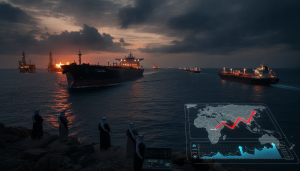
The critical Strait of Hormuz has experienced a dramatic reduction in commercial maritime traffic, reflecting a palpable increase in geopolitical tensions and raising significant concerns across global energy markets. As Thursday dawned, the vital chokepoint appeared virtually empty of commercial vessels, a stark indicator of escalating military activities in the region.
This near-total cessation of activity follows a sluggish Wednesday, which saw only six commercial passages in both directions. Among these limited movements was a Suezmax tanker flagged to Turkey, which navigated into the Persian Gulf region, presumably to load crude or refined products. These observations are based on detailed ship-tracking data compiled by industry analytics.
Geopolitical Flashpoint: US Actions & Iranian Assertions
The current shipping paralysis coincides with a second series of military engagements by the United States targeting Iranian military installations within the span of a week. This aggressive posture has undoubtedly heightened the perceived risk for commercial operators traversing one of the world’s most strategic waterways.
Adding to the climate of uncertainty, Tehran has reportedly claimed that several vessels attempted unauthorized entry into the Persian Gulf last night. While some ships purportedly retreated, Iranian authorities asserted they intercepted and halted two. These declarations, however, remain uncorroborated by independent sources, largely due to widespread signal jamming and the disabling of standard navigation systems, which severely obscure real-time transit information. Iran also stated that 26 vessels navigated the strait over the past day, a count that might encompass smaller, localized coastal traffic.
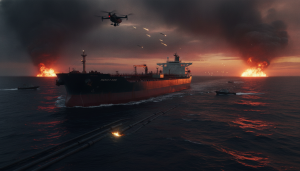
Against this backdrop, President Donald Trump reiterated a resolute stance that no single nation would be permitted to exert unilateral control over the Strait of Hormuz. These comments were made in the wake of American forces successfully intercepting Iranian drones reportedly targeting a commercial ship and subsequently neutralizing an adjacent launch platform. Further compounding pressure on the Islamic Republic, the US Treasury Department imposed sanctions on Iran’s Persian Gulf Strait Authority. The US government accused the agency of engaging in extortionate practices against shipping operators, leveraging regional instability for illicit financial gain.
Industry Leaders Voice Alarm Amid Operational Challenges
The ripple effects of this instability are already being felt at the highest levels of the energy sector. Patrick Pouyanne, the Chief Executive Officer of TotalEnergies SE, issued a dire warning, articulating that a sustained blockade of the Strait of Hormuz poses a significant threat to the stability of the global economy. In an interview, Pouyanne conveyed his pessimism regarding a swift return to free navigation, indicating that he anticipates the current difficulties to persist for some time. While TotalEnergies recently managed to secure the release of three out of its eleven vessels that had been stranded in the Persian Gulf, Pouyanne affirmed the company’s intent to pursue alternative legal and compensatory avenues rather than accede to any demands for Iranian-imposed tolls.
Specific vessel movements on Wednesday, though limited, illustrate the prevailing risks. An oil product tanker of Chinese registry departed the Gulf on a course toward China, shadowed by an Iranian fuel carrier and a bulker linked to Greek interests. Inbound traffic for the day included the Turkish Suezmax, *Ottoman Equity*, notably entering after its transponder systems were deactivated, alongside two container ships making their way into the Gulf.
Obscured Waters: The Challenge of Real-Time Tracking
For investors and market analysts, gaining a clear, verifiable picture of commercial activity through Hormuz remains a significant challenge. Widespread interference with Automatic Identification System (AIS) signals, the industry’s standard for vessel tracking, continues to cloud independent verification efforts. This digital fog means that initial counts of transit activity are frequently subject to upward revision as vessels eventually reactivate their transponders once they move beyond the immediate high-risk zones.
The substantial US naval presence in the vicinity may also be contributing to these distorted observations. Vessels with known or suspected ties to Iran are increasingly opting to switch off their AIS signals upon entering or exiting the Gulf, a tactic designed to evade detection and making real-time flow monitoring significantly more complex.
This practice of “going dark” by Iran-linked vessels is not new; it was a common tactic even prior to the US restrictions on movements to and from Iranian ports. Historically, these ships would often cease broadcasting signals when approaching Hormuz, frequently not restoring them until they reached as far as the Strait of Malacca – a journey of approximately 13 days’ sailing from Iran’s primary oil terminal at Kharg Island. This strategic blackout denies transparent insight into their movements and cargo. Modern tracking methodologies attempt to circumvent this by compiling automated positioning signals over expansive areas, including the Gulf of Oman, the Arabian Sea, and the Red Sea, to identify vessels that may have entered or departed the Persian Gulf without transmitting their precise location.
Analysts rigorously examine signal histories to differentiate between genuine vessel movements and potential “spoofing” – electronic interference used to falsify a ship’s apparent position. Nevertheless, certain transits may still elude detection if vessels’ transponders remain intentionally inactive. For instance, Iran-linked oil tankers are known to steam from the Persian Gulf without broadcasting signals until they are roughly 10 days past Fujairah in the UAE, placing them near the Strait of Malacca. Other commercial operators, increasingly wary of the current climate, may be adopting similar stealth tactics, rendering their movements invisible on tracking screens for extended periods.
Investor Outlook: Navigating Uncertainty in Energy Supply Chains
For energy investors, the current situation in the Strait of Hormuz underscores profound risks to global crude oil supply chains and elevates geopolitical risk premiums. The lack of transparency in shipping movements, coupled with direct military confrontations and economic sanctions, introduces substantial volatility into oil prices and increases operational overhead for maritime logistics. Companies with significant exposure to Middle Eastern crude or shipping lanes will need to re-evaluate their risk matrices and potentially factor in higher insurance costs and longer transit times. The ongoing disruptions demand vigilant monitoring and a proactive approach to portfolio management in a rapidly evolving energy landscape.