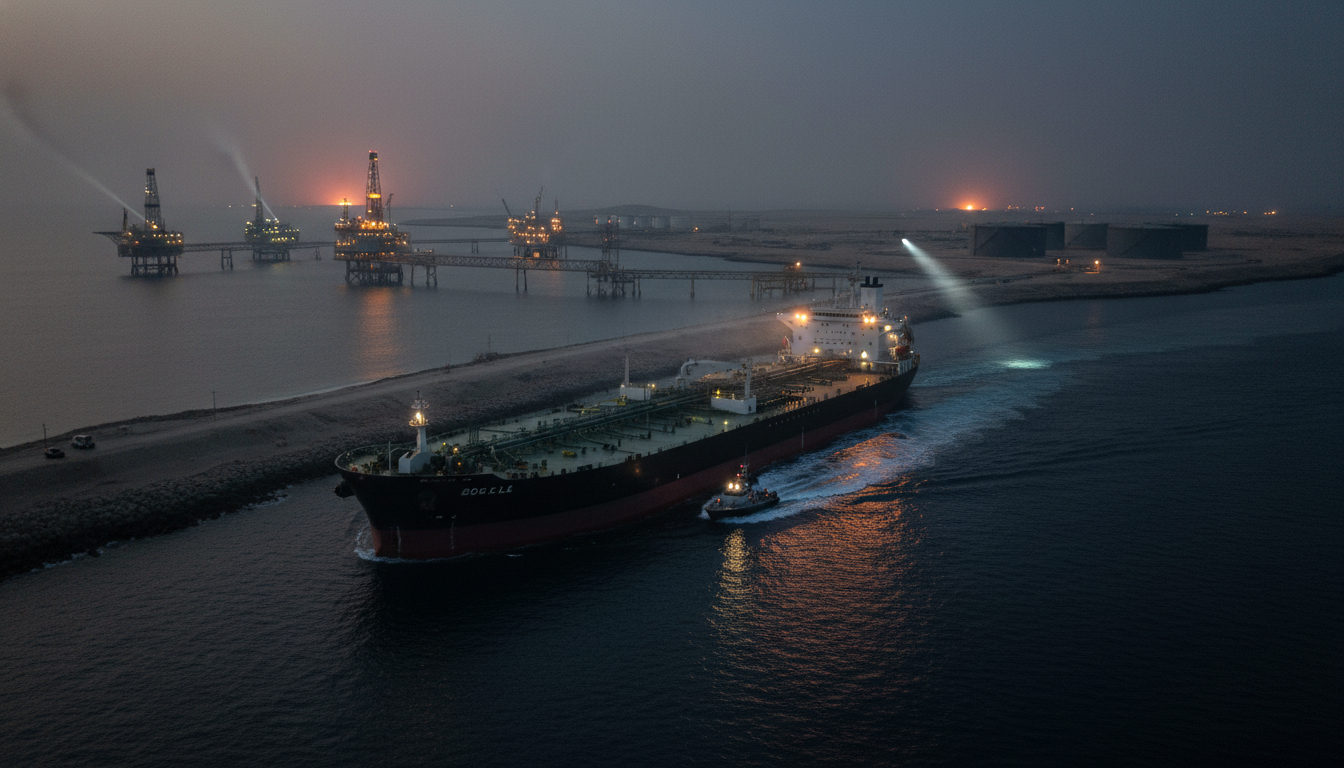
The Strait of Hormuz, a narrow maritime gateway connecting the Persian Gulf with the open ocean, has long been recognized as the world’s most critical energy chokepoint. Through its waters flows an estimated one-fifth of global oil consumption and a third of the world’s liquefied natural gas (LNG), making its transparent operation fundamental to global energy security and price stability. For years, investors and analysts have relied heavily on publicly available maritime tracking data to gauge supply flows and predict market movements. However, a significant new intelligence report has cast a shadow over this foundational assumption, revealing that a substantial portion of this vital traffic may be operating entirely outside conventional monitoring systems, ushering in an unprecedented era of market opaqueness.
The Invisible Fleet: Challenging Foundational Market Data
New intelligence suggests a disconcerting reality for energy investors: as much as 50 percent of actual vessel traffic navigating the Strait of Hormuz could be entirely absent from standard monitoring systems on any given day. This groundbreaking finding, derived from direct, on-the-ground intelligence gathering rather than typical remote sensing, fundamentally challenges the very foundation of market analysis and macroeconomic forecasting. For decades, financial professionals and commodity traders have meticulously modeled global energy supply and demand, commodity price trajectories, and even broader economic health based on Automatic Identification System (AIS) data, which broadcasts a vessel’s identity, position, course, and speed. The emergence of this “ghost fleet,” comprising vessels deliberately obscuring their movements by disabling AIS transponders or submitting misleading identification, introduces a profound new layer of uncertainty that demands immediate attention from anyone invested in the global energy complex.
Current Market Dynamics Amidst Heightened Opaque Supply
The revelation of widespread untracked shipping in the Strait of Hormuz adds a potent layer of risk to an already volatile market. As of today, Brent crude trades at $93.89 per barrel, showing a modest 0.7% gain within a day range of $91.39 to $94.86. Similarly, WTI crude stands at $90.31, also up 0.71%, fluctuating between $87.64 and $91.41. While these figures indicate some intra-day stability, they follow a notable decline in Brent prices, which have fallen approximately 7% from $101.16 on April 1st to $94.09 on April 21st. For investors asking if “WTI is going up or down,” this new data on untracked supply complicates the answer significantly. The market’s perceived supply-demand balance, which heavily influences these price movements, may be based on fundamentally incomplete information. If half of the world’s most critical energy chokepoint operates in the shadows, the true supply picture could be far different than what traditional models suggest, potentially leading to sharper, more unpredictable price swings as hidden supply or demand shifts become apparent.
Geopolitical Drivers and Escalating Supply Chain Vulnerability
The motivations behind this burgeoning “ghost fleet” phenomenon are multifaceted but largely coalesce around geopolitical tensions and sanctions evasion. Nations facing international restrictions on their energy exports, such as Iran, frequently utilize these tactics to bypass monitoring and sustain trade. This strategic opacity not only facilitates illicit trade but also dramatically heightens the risk of miscalculation and escalation in an already sensitive region. With such a significant portion of global oil and LNG transit potentially operating outside regulatory oversight, the Strait of Hormuz transforms from a mere chokepoint into a potential flashpoint with even greater global repercussions. Any disruption, whether accidental or intentional, to this unseen traffic could have a far more significant and immediate impact on global supply than current transparent data suggests, leading to sudden shortages and sharp price spikes that current analytical frameworks might fail to anticipate.
Navigating the Future: Investor Strategies in an Era of Reduced Transparency
For discerning energy investors, this new intelligence necessitates a re-evaluation of how supply risk is assessed and how market signals are interpreted. While traditional data points remain crucial, their predictive power is now challenged by the knowledge of significant unseen flows. Looking ahead, the coming weeks bring several key energy events, including the EIA Weekly Petroleum Status Reports on April 22nd, April 29th, and May 6th, the Baker Hughes Rig Counts on April 24th and May 1st, and the EIA Short-Term Energy Outlook on May 2nd. These reports will still provide valuable insights into reported inventory levels, production trends, and demand forecasts in key markets. However, investors must now consider that these figures represent only a partial picture of the global supply matrix. Reader questions, such as those regarding the data sources powering market analysis, underscore a growing investor desire for deeper, more reliable insights. In this environment, relying solely on conventional data streams might prove insufficient. Investors should consider building greater flexibility into their portfolios, hedging against potential supply shocks, and diversifying across energy assets less directly exposed to the immediate risks of the Strait of Hormuz. The era of complete transparency in global oil and gas flows through critical chokepoints appears to be over, demanding a more nuanced, risk-aware approach to energy investing.


