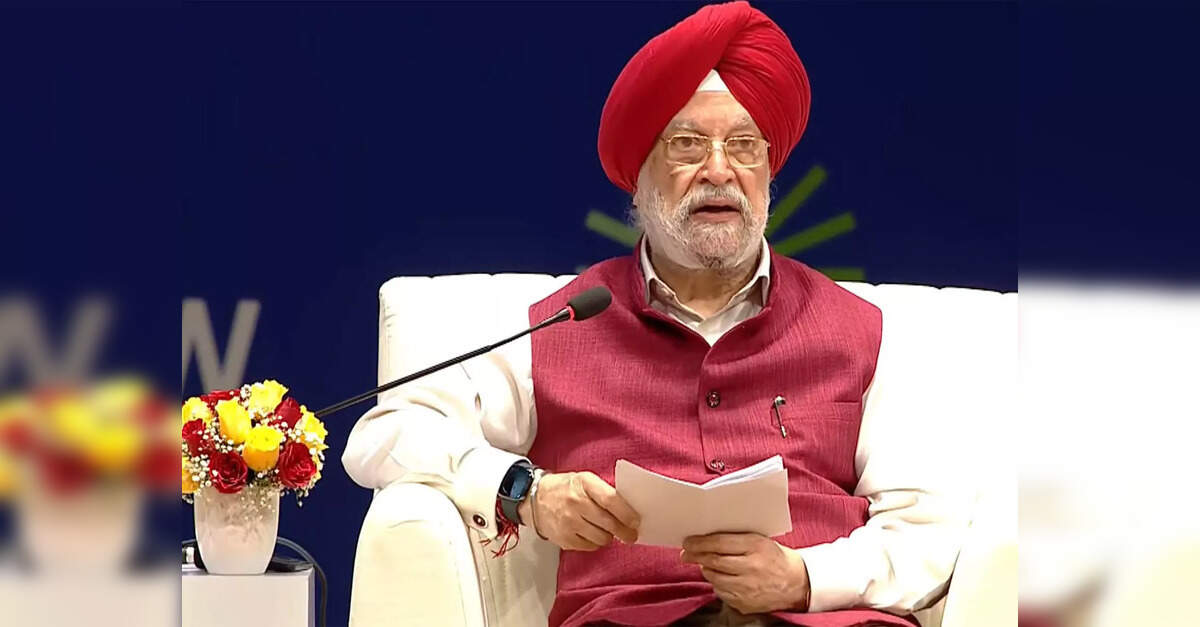
New Delhi: Energy is the “lifeline of survival” for a rapidly growing economy and said global turbulence presents both challenges and opportunities for strategic realignment, Union Minister for Petroleum and Natural Gas Hardeep Singh Puri said on Tuesday.
He was speaking at the ministerial panel on the opening day of India Energy Week 2026, titled “Charting a Course through Uncertainty: Securing Affordable, Accessible and Sustainable Energy in a Turbulent World”.
Highlighting India’s growing energy demand, the minister noted that daily oil consumption has risen from around 5 million barrels to over 5.6 million barrels in just five years, with sourcing diversified from 27 to 41 countries. This diversification, he said, has helped India maintain supply stability even amid geopolitical disruptions.
Puri acknowledged that while India’s ambition to raise natural gas’s share in the energy mix from 6 per cent to 15 per cent remains a work in progress, steady efforts are underway. He stressed that a stable global energy market is in the interest of both producers and consumers, rejecting the notion of a zero-sum energy game.
Beyond fossil fuels, the minister highlighted India’s accelerating push into green hydrogen, bioenergy, sustainable aviation fuel, critical minerals, and small modular reactors.
He pointed to India’s success in advancing ethanol blending targets well ahead of schedule and lowering green hydrogen costs through competitive tenders. Looking ahead to 2030, Puri expressed confidence that energy transition pathways will become clearer and more cooperative, with India emerging as both a major consumer and producer in a diversified, multi-energy world.
Framing energy security as the defining challenge of the current decade, Canada’s Minister of Energy and Natural Resources Tim Hodgson said that the global energy system is undergoing a “rupture” rather than a gradual transition, as geopolitical tensions strain the rules-based multilateral trading order.
Hodgson, in the same panel discussion, said that the growing fragmentation of global markets has made trusted and non-coercive energy partnerships more critical than ever.
He said that the country’s vast resource base—ranging from oil and LNG to uranium and critical minerals essential for the energy transition.
Canada, he said, holds nearly 100 years of proven and probable energy reserves, compared to far shorter horizons elsewhere. He underscored Canada’s commitment to diversifying its export markets, noting the development of new pipelines to the West Coast and the launch of LNG export terminals.
With LNG capacity set to expand from 12 million tonnes per annum to as much as 50 million tonnes in the coming years, Hodgson identified India as a natural long-term partner given its rapidly growing energy demand. Beyond hydrocarbons, Hodgson emphasised collaboration on critical minerals, vital for renewables, electric vehicles, and advanced manufacturing.
He reiterated Canada’s belief that middle powers must work together to strengthen supply chains, support free trade, and resist the weaponisation of energy.
According to Jassim Al Shirawi, Secretary-General of the International Energy Forum (IEF), energy security has moved decisively to the top of national policy agendas as global energy systems grapple with rising demand, geopolitical risks and accelerating technological change.
At the ministerial panel he said that energy security, affordability, equity and sustainability form the four foundational pillars guiding policymaking, though priorities vary widely across countries and over time.
He said that energy security has moved decisively to the top of national agendas, driven by rising demand linked to population growth, urbanisation, digitalisation, artificial intelligence, and improving living standards. Energy, he said, remains the engine of economic and social development, making an “all energies, all technologies” approach unavoidable.