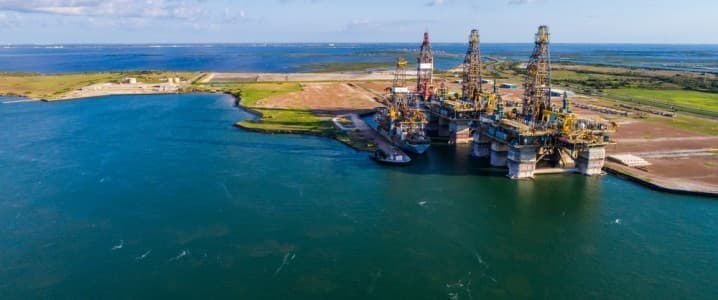
In a significant strategic maneuver that underscores the ongoing recalibration within the global energy sector, Harbour Energy has announced its definitive agreement to acquire Louisiana-based LLOG Exploration Company for $3.2 billion. This transaction, comprising $2.7 billion in cash and $500 million in Harbour’s ordinary shares, marks a pivotal entry for the UK-headquartered independent into the lucrative deepwater U.S. Gulf of Mexico (GoM). For investors monitoring the evolving landscape of oil and gas assets, this deal offers a compelling case study in geographic diversification and the pursuit of fiscal stability amidst a dynamic market.
Harbour’s Strategic Pivot to the US Gulf of Mexico
Harbour Energy’s acquisition of LLOG is more than just an asset purchase; it represents a calculated strategic pivot towards a more favorable operating environment. The company has been actively consolidating its UK North Sea presence, but this has occurred against the backdrop of a challenging fiscal regime, specifically the UK’s high windfall tax, which pushes the total tax on UK oil and gas production to an onerous 78%. In stark contrast, the LLOG portfolio in the U.S. GoM boasts a blended federal and state tax rate of approximately 23%. This disparity in taxation is a powerful driver for international expansion.
The LLOG assets are set to immediately enhance Harbour’s production profile by an estimated 34,000 barrels of oil equivalent per day (boepd) with remarkably low operating costs of just $12 per barrel of oil equivalent. This combination of significant production, low breakevens, and a supportive fiscal and regulatory framework is expected to extend Harbour’s reserve life and materially improve its margins. The deal is projected to close by the end of the first quarter of 2026, firmly establishing Harbour as a leading player in the region and adding another core business unit alongside its existing operations in Norway, the UK, Argentina, and Mexico.
Navigating Volatility: The GoM Advantage in a Fluctuating Market
The timing of such a strategic move is particularly relevant given the inherent volatility of global crude markets. As of today, Brent Crude trades at $90.38, marking a significant intraday dip of 9.07%, while WTI Crude stands at $82.59, down 9.41%. This sharp decline comes after a period of sustained pressure, with Brent having fallen from $112.78 on March 30, 2026, to $91.87 just yesterday, representing an 18.5% drop over the past 14 days. Such fluctuations underscore the critical need for energy producers to possess resilient asset bases.
Harbour’s decision to invest in low-cost, oil-weighted deepwater assets in the GoM directly addresses this market reality. With operating costs of $12/boe, the LLOG portfolio offers a substantial margin of safety, making it highly resilient to price downturns. This positions Harbour to better withstand periods of market uncertainty, such as the current sharp correction, while still capitalizing on future price upside. For investors, the ability of a company to generate strong cash flows even at lower price points is a key indicator of long-term stability and value.
Upcoming Events and the Long-Term Outlook for Deepwater Investment
The broader market context, heavily influenced by upcoming industry events, further highlights the strategic foresight behind this acquisition. Investors are keenly watching the horizon for signals that could dictate future oil price trajectories. This weekend, the OPEC+ Joint Ministerial Monitoring Committee (JMMC) and the full Ministerial meeting on April 18th and 19th, 2026, respectively, are critical. Any decisions regarding production quotas will have immediate ramifications for global supply and prices. Following this, the API and EIA Weekly Crude Inventory reports on April 21st and 22nd will provide crucial insights into demand dynamics, with further updates on April 28th and 29th. The Baker Hughes Rig Count reports on April 24th and May 1st will offer a pulse check on North American drilling activity.
Harbour Energy’s long-term deepwater investment in the GoM is designed to thrive through these cycles. While short-term events influence daily trading, the multi-year development timelines of deepwater projects necessitate a focus on basins with predictable regulatory and fiscal environments. The GoM’s established infrastructure and supportive stance on oil and gas exploration provide a stable foundation, making it an attractive destination for capital even as global energy policy debates evolve. The acquisition’s completion by Q1 2026 means Harbour will be well-positioned to leverage these GoM advantages as the market reacts to the outcomes of these upcoming events and beyond.
Addressing Investor Concerns: Future Oil Prices and Global Supply Dynamics
Our proprietary reader intent data reveals a consistent theme among investors: a strong focus on future oil prices and the influence of major producers. Questions such as “what do you predict the price of oil per barrel will be by end of 2026?” and “What are OPEC+ current production quotas?” are frequently posed to our AI assistant. This investor sentiment underscores the pervasive uncertainty surrounding long-term price stability and supply management.
Harbour Energy’s expansion into the U.S. GoM directly addresses these concerns by diversifying its risk profile. By securing assets in a basin known for its robust infrastructure, operational control, and a predictable regulatory and fiscal environment, Harbour is building a more resilient portfolio. This move reduces its dependency on any single geopolitical region or specific policy framework, such as the challenging tax regime in the UK. The GoM’s status as a stable, non-OPEC producing region further insulates Harbour from the direct impacts of OPEC+ quota decisions, offering a degree of strategic independence that is highly valued by investors seeking long-term growth and stability in the energy sector.


