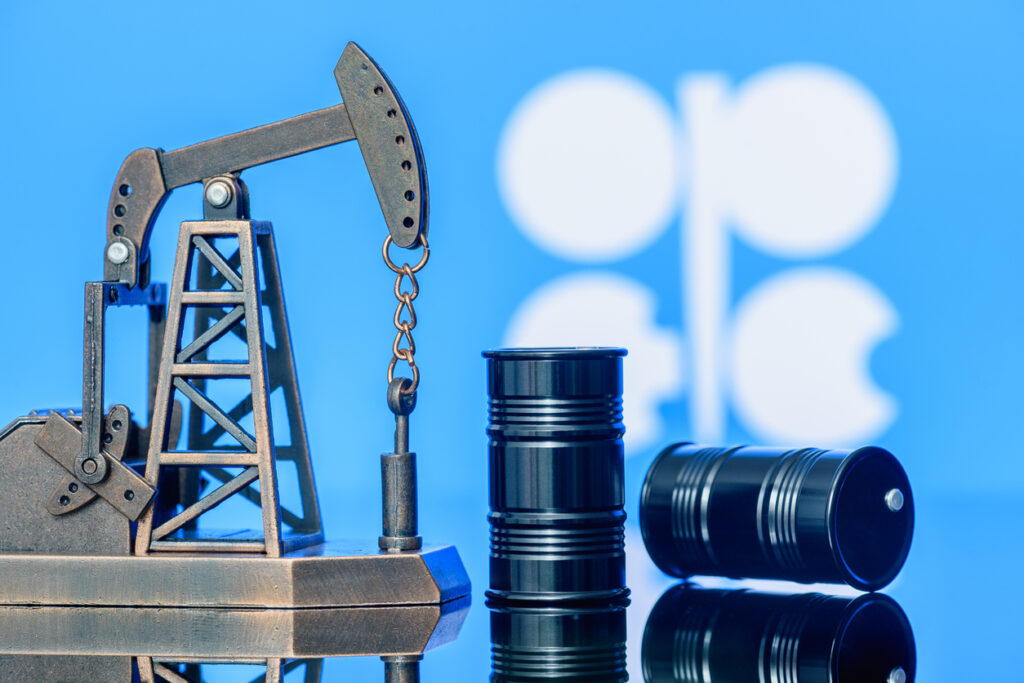
As the global oil market navigates a period of heightened volatility, all eyes are on the Organization of the Petroleum Exporting Countries and its allies (OPEC+) as they convene for a full ministerial meeting today, April 19th. This crucial gathering comes amidst significant price corrections and an uncertain demand outlook, prompting investors to closely scrutinize any signals regarding future production adjustments. Leading financial institutions, including Goldman Sachs, have weighed in with their expectations, forecasting a modest production quota increase, specifically a 140,000 barrels per day (bpd) hike slated for November. However, the current market dynamics and underlying supply-demand fundamentals suggest that the path ahead for OPEC+ and crude prices is far from straightforward.
Market Correction Intensifies Pressure Ahead of OPEC+ Meeting
The urgency surrounding today’s OPEC+ decision is amplified by the dramatic shifts in crude oil prices over recent weeks. As of today, Brent Crude trades at $90.38 per barrel, marking a significant 9.07% decline within the day, having ranged between $86.08 and $98.97. Similarly, WTI Crude has fallen to $82.59, down 9.41% today, fluctuating between $78.97 and $90.34. This daily slump is part of a broader, more impactful trend: Brent has shed $22.4 per barrel, or nearly 20%, in just the last 14 days, plummeting from $112.78 on March 30th. This sharp correction, alongside a 5.18% drop in gasoline prices to $2.93 today, signals a potential easing of demand concerns or a reassessment of supply tightness by the market. Such profound volatility places immense pressure on OPEC+ members to deliver a decision that can stabilize markets without inadvertently tipping the balance towards oversupply or exacerbating existing deficits. Investors are keenly asking about current OPEC+ production quotas, and today’s meeting is expected to provide clarity on the group’s strategy to manage output in this challenging environment.
Inventory Levels and Demand Trends Justify Potential Hikes
Despite the recent price declines, underlying market fundamentals still present a compelling case for OPEC+ to consider a production increase. Analyst reports, including those from Goldman Sachs, highlight several factors supporting a cautious hike. OECD commercial stocks in Europe and Asia have shown only a modest increase, indicating that the market is not yet awash with surplus crude. Furthermore, total global inventories remain slightly below year-ago levels, while U.S. crude inventories are currently at an eight-month low, suggesting underlying tightness in key regions. On the demand side, robust consumption from Asia continues to provide a solid foundation for global oil demand, counterbalancing some of the concerns emanating from other economies. These factors lend credence to the Reuters report suggesting that an increase of at least 137,000 bpd is likely to be approved. This figure closely aligns with Goldman’s 140,000 bpd forecast for November, indicating a consensus view among market observers that some level of additional supply is warranted, even if the timing of its implementation remains a point of investor focus.
Geopolitical Risks and Production Realities Frame the Outlook
Beyond the immediate supply-demand metrics, geopolitical considerations continue to cast a long shadow over global oil markets, adding another layer of complexity to OPEC+’s decision-making process. Concerns about Russian oil production, in particular, remain salient, with recent data indicating that output has fallen below previous analyst forecasts. The persistent “downside risks” to Russian supply mean that any planned OPEC+ quota increase might not translate directly into an equivalent boost in effective global supply. This dynamic could compel the alliance to adopt a more flexible approach, echoing past precedents where OPEC+ has demonstrated a willingness to adjust its strategy. For instance, after the market effectively absorbed its initial production hike following a 2.2 million bpd cut unwind, the group reportedly tripled the pace of its monthly increases. This historical context suggests that if market conditions, particularly robust demand and persistent supply challenges from non-OPEC+ members, necessitate a larger or faster adjustment, the alliance has the capacity and precedent to respond. This flexibility is critical for investors trying to understand how the group will manage the balance between market stability and optimizing revenue.
Investor Outlook: Navigating Uncertainty and Forecasting 2026 Prices
For investors, the outcomes of today’s OPEC+ meeting and subsequent market reactions will be pivotal in shaping their strategies for the remainder of 2026. A key question on the minds of many OilMarketCap readers is: “What do you predict the price of oil per barrel will be by end of 2026?” The answer will heavily depend on how effectively OPEC+ manages its production, the true trajectory of global demand, and the evolution of geopolitical risks. A measured increase today, coupled with continued vigilance over market conditions, could help stabilize prices after the recent sharp declines. However, an overly cautious approach might risk exacerbating supply tightness if demand proves more resilient than anticipated, while an aggressive hike could further depress prices. Beyond today’s meeting, investors must also closely monitor upcoming data releases. The API Weekly Crude Inventory report on April 21st, followed by the EIA Weekly Petroleum Status Report on April 22nd, will offer fresh insights into U.S. inventory levels. Subsequent reports on April 28th and 29th, alongside the Baker Hughes Rig Count on April 24th and May 1st, will provide crucial indicators of future supply and demand dynamics, all of which will play a critical role in determining the price trajectory of crude oil through the end of the year.