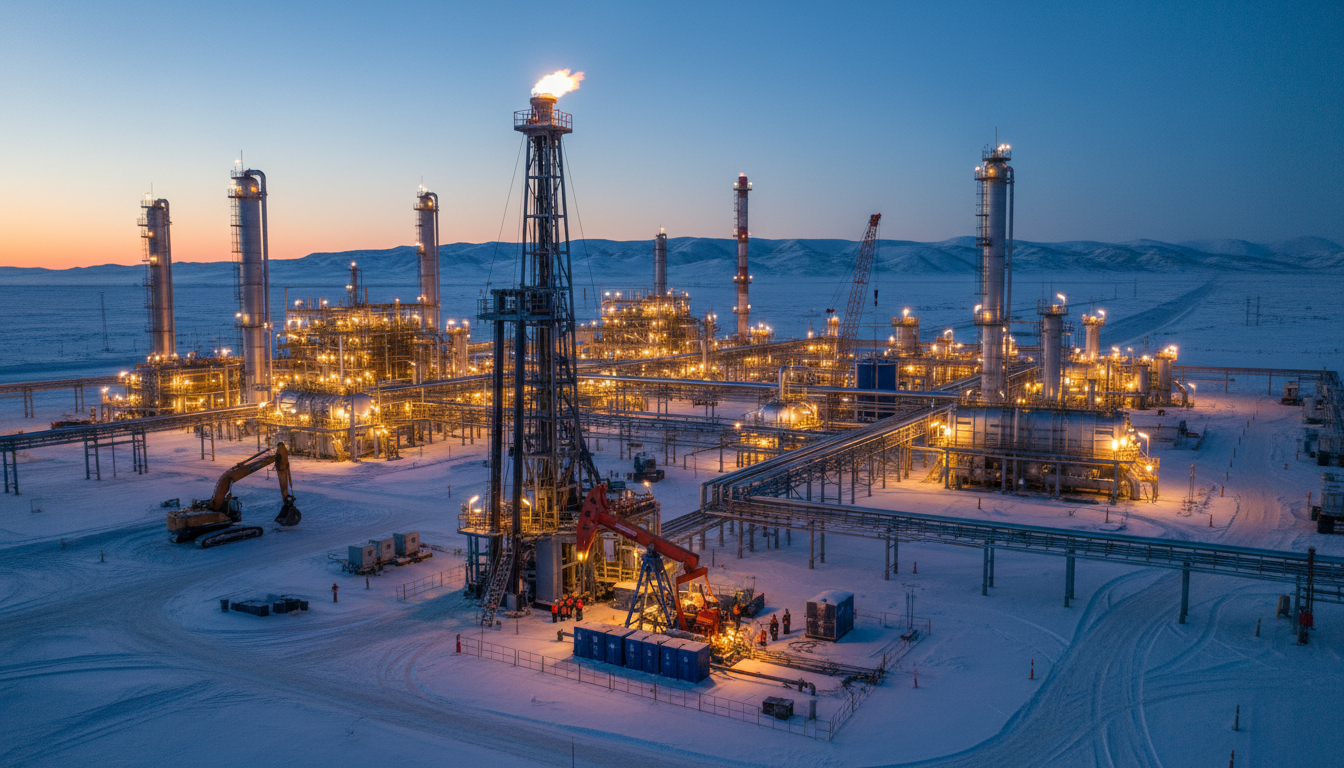
Gazprom, traditionally a titan of the natural gas sector, is making a significant strategic pivot, deepening its footprint in the crude oil market with the successful launch of commercial production from the Achimov Block 6A within Russia’s expansive Urengoyskoye field. This move represents a calculated effort to diversify its hydrocarbon portfolio, reducing reliance on natural gas revenues and unlocking value from complex, deep-lying reserves in the prolific West Siberian basin. For energy investors, this development signals Gazprom’s long-term commitment to oil output and its technological prowess in conquering challenging geological formations, adding a new dimension to the global supply picture.
Conquering Extreme Depths with Advanced Technology
The Achimov deposits are notoriously difficult, presenting some of the most formidable geological hurdles in the global energy landscape. These reservoirs are situated at extraordinary depths, typically ranging from 3,400 to 3,700 meters below the surface. Characterized by intricate geological structures, significant rock formation heterogeneity, and inherently low permeability, these formations demand cutting-edge technological solutions for viable extraction. Operators also contend with exceptionally high temperatures and abnormally high formation pressures, adding layers of complexity to drilling and production operations.
To overcome these substantial challenges and enable cost-effective hydrocarbon production, Gazprom has deployed advanced technological innovations. Key among these are sophisticated 3D formation models, which provide invaluable support during the precision drilling of horizontal wells that extend for considerable lengths. Additionally, the widespread application of multi-stage hydraulic fracturing plays a critical role in enhancing reservoir connectivity and maximizing hydrocarbon flow, transforming previously inaccessible resources into economically viable assets. This initial phase has brought four oil wells online, supported by two mobile oil treatment units, with ambitious plans for over 40 additional wells. This commitment underscores the significant capital expenditure required but also signals a robust long-term growth trajectory for Russian oil output.
New Supply Amidst a Volatile Market Backdrop
Gazprom’s strategic expansion into complex oil reserves arrives at a particularly dynamic time for global energy markets. As of today, Brent Crude trades at $95.09 per barrel, demonstrating a robust 5.21% gain for the session, while WTI Crude stands at $86.96, up 5.29%. This recent upward movement, however, follows a period of significant volatility. Our proprietary data shows Brent crude plummeting from $112.78 on March 30th to $90.38 by April 17th, a dramatic -19.9% decline over just two weeks. Such swings underscore the market’s sensitivity to both perceived supply stability and demand forecasts.
The addition of new Russian oil supply, even from technically challenging fields, plays into this complex narrative. While the initial output from Achimov Block 6A may be modest in the grand scheme of global production, the long-term potential from over 40 planned wells represents a meaningful increment. In a market constantly balancing geopolitical factors, OPEC+ decisions, and economic indicators, any new source of supply contributes to the overall supply-demand equation. This steady, technologically driven expansion from a non-OPEC+ producer like Gazprom adds another layer of complexity for investors assessing future price trajectories and market stability.
Addressing Investor Concerns: Long-Term Supply and Diversification
Our first-party intent data from OilMarketCap.com readers reveals a clear focus on future price movements and the reliability of energy supply. Investors are keenly asking about the future trajectory of crude prices, with questions like “what do you predict the price of oil per barrel will be by end of 2026?” circulating. The launch of Achimov Block 6A directly addresses the long-term supply component of this equation. While immediate global price impacts are unlikely, Gazprom’s move signifies a commitment to bolstering Russia’s crude output for years to come, providing a counter-narrative to concerns about potential supply deficits in the mid-to-long term.
Furthermore, this diversification into oil provides Gazprom with a crucial hedge against the inherent volatility and geopolitical pressures often associated with natural gas markets. For investors, this translates into a more balanced hydrocarbon portfolio, potentially offering greater resilience against market-specific shocks. The ability to monetize complex reserves also showcases a forward-thinking approach to resource development, suggesting that previously uneconomic assets can become viable through technological innovation. This long-term strategy provides a fundamental underpinning for Russia’s energy sector, irrespective of short-term price fluctuations or geopolitical maneuvering.
Upcoming Market Catalysts and the Geopolitical Chessboard
The strategic timing of Gazprom’s production ramp-up also positions Russia strongly ahead of several critical upcoming energy events. The OPEC+ Joint Ministerial Monitoring Committee (JMMC) meeting is scheduled for April 20th, followed by the full OPEC+ Ministerial Meeting on April 25th. These gatherings will be crucial for determining collective production levels and market management strategies. Additional Russian output, even from challenging fields, signals a robust national production strategy that could influence OPEC+’s considerations regarding supply quotas and market rebalancing efforts.
Beyond OPEC+, investors will be closely monitoring weekly data releases for immediate market insights. The API Weekly Crude Inventory reports on April 21st and April 28th, alongside the EIA Weekly Petroleum Status Reports on April 22nd and April 29th, will provide vital snapshots of U.S. supply and demand dynamics. Additionally, the Baker Hughes Rig Count on April 24th and May 1st will offer an indication of North American drilling activity. Gazprom’s long-term commitment to developing technically demanding oil fields, underscored by the planned expansion of over 40 wells, reinforces Russia’s position as a resilient and technologically capable energy producer. This ongoing development will be a key factor in the global energy supply equation, shaping discussions and decisions at upcoming international energy forums and influencing investor sentiment throughout 2026 and beyond.


