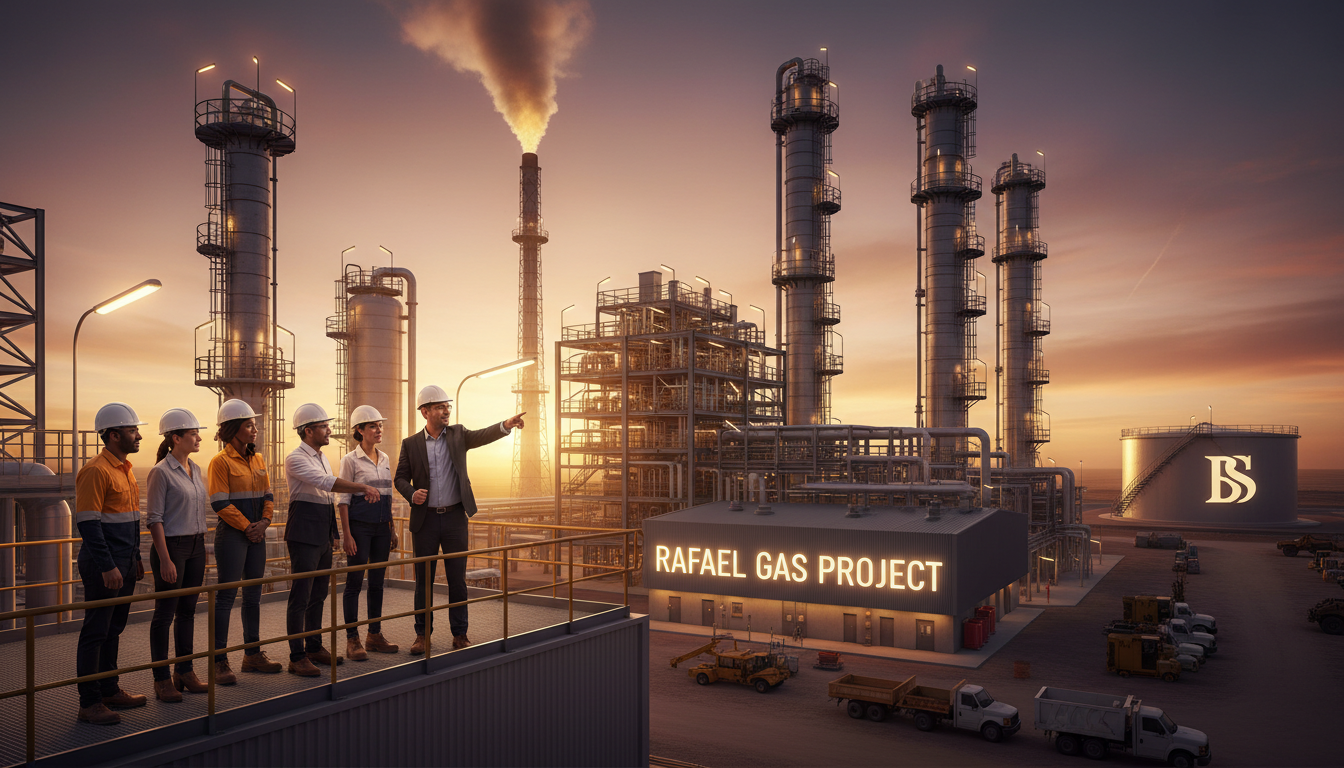
The Australian energy landscape continues to draw significant investor attention, particularly with strategic developments in key basins. A recent capital injection for the Rafael Gas Project in Western Australia’s prolific Canning Basin signals robust confidence in its long-term potential. Through a successfully executed institutional share offering, the project has secured approximately $3.8 million USD (AUD 5.3 million) in commitments, providing crucial funding for its ongoing development. This financial milestone underscores the project’s strategic importance and its substantial resource base, positioning it as a pivotal asset for future energy supply and a compelling opportunity for investors seeking exposure to diversified hydrocarbon production by its anticipated production start in 2029.
Rafael’s Strategic Significance and Resource Potential
The Rafael Gas Project stands out as a cornerstone asset, poised to become a long-term producer of vital hydrocarbons in Western Australia. Its high-confidence estimated resource volume is impressive, comprising approximately 85 billion cubic feet of natural gas complemented by a significant 1.8 million stock tank barrels of associated liquids. This substantial and diverse resource base enables Rafael to generate a multi-faceted product stream, including liquefied natural gas (LNG), valuable condensate, and liquefied petroleum gas (LPG). Such a diversified output enhances the project’s revenue potential, offering resilience against single commodity market fluctuations and maximizing value extraction. With a projected operational lifespan of around two decades, Rafael promises to be a stable, long-term asset, making a substantial contribution to regional energy supply and generating sustained returns for its stakeholders.
Investor Confidence Amidst Market Dynamics
The recent capital raise, securing AUD 5.3 million through a two-tranche placement, reflects strong investor conviction in Rafael’s long-term value proposition. Both existing shareholders and a carefully selected group of domestic and global institutional investors enthusiastically participated, subscribing to roughly 355 million new shares. This dual-phase funding approach, with an initial AUD 2.3 million tranche followed by an additional AUD 3 million, provides financial flexibility, allowing the company to align inflows with key project milestones. Such institutional backing, especially in the current volatile market, underscores a strong belief in the project’s robust fundamentals and its ability to deliver returns. As of today, Brent crude trades at $101.68, representing a robust 3.25% gain for the day, while WTI sits at $92.73, up 3.41%. However, this recent upswing follows a notable decline in Brent over the past two weeks, falling from $101.16 on April 1st to $94.09 on April 21st, a drop of over 7%. This inherent market volatility highlights the strategic advantage of Rafael’s diversified product streams, where the value of associated liquids like condensate and LPG can provide a hedge and enhanced revenue in periods of elevated crude prices.
Optimizing Value for Long-Term Returns
Recent engineering studies have significantly advanced the optimization of the Rafael Gas Project, yielding highly positive insights that substantially improve its overall economics. These analyses have identified clear pathways to unlock greater value than initially modeled, primarily through the discovery of additional liquids and LPG product streams. This strategic enhancement is crucial for maximizing shareholder returns, as it promises a more robust revenue profile and a stronger return on investment. For energy sector investors, the ability to diversify product offerings beyond natural gas alone, capturing the higher value of associated liquids, directly translates into improved project economics and increased resilience against market shifts. This proactive approach to value optimization solidifies Rafael’s appeal as a long-term investment in a dynamic global energy market.
Navigating Future Market Headwinds and Opportunities
Investors are consistently seeking clarity on the trajectory of hydrocarbon prices, with many asking about the future direction of WTI and specific predictions for oil prices per barrel by the end of 2026. This focus on price outlook underscores the need for projects like Rafael to demonstrate long-term viability and resilience. The project’s diversified output, encompassing natural gas, LNG, condensate, and LPG, strategically positions it to mitigate the risks associated with single-commodity price fluctuations. Securing significant funding now, well in advance of its 2029 production target, reflects a forward-thinking approach that accounts for future market conditions. Looking ahead, investors will closely monitor several upcoming events that could influence broader market sentiment. The EIA Short-Term Energy Outlook, due on May 2nd, will offer critical forecasts for supply, demand, and prices, providing a crucial backdrop for assessing the long-term prospects of projects like Rafael. Additionally, weekly updates such as the EIA Weekly Petroleum Status Reports on April 22nd, April 29th, and May 6th, alongside the Baker Hughes Rig Counts on April 24th and May 1st, will offer real-time insights into market fundamentals. These data points collectively inform investor confidence and strategic planning, underscoring the importance of projects with robust, diversified profiles designed for sustained operation over two decades.


