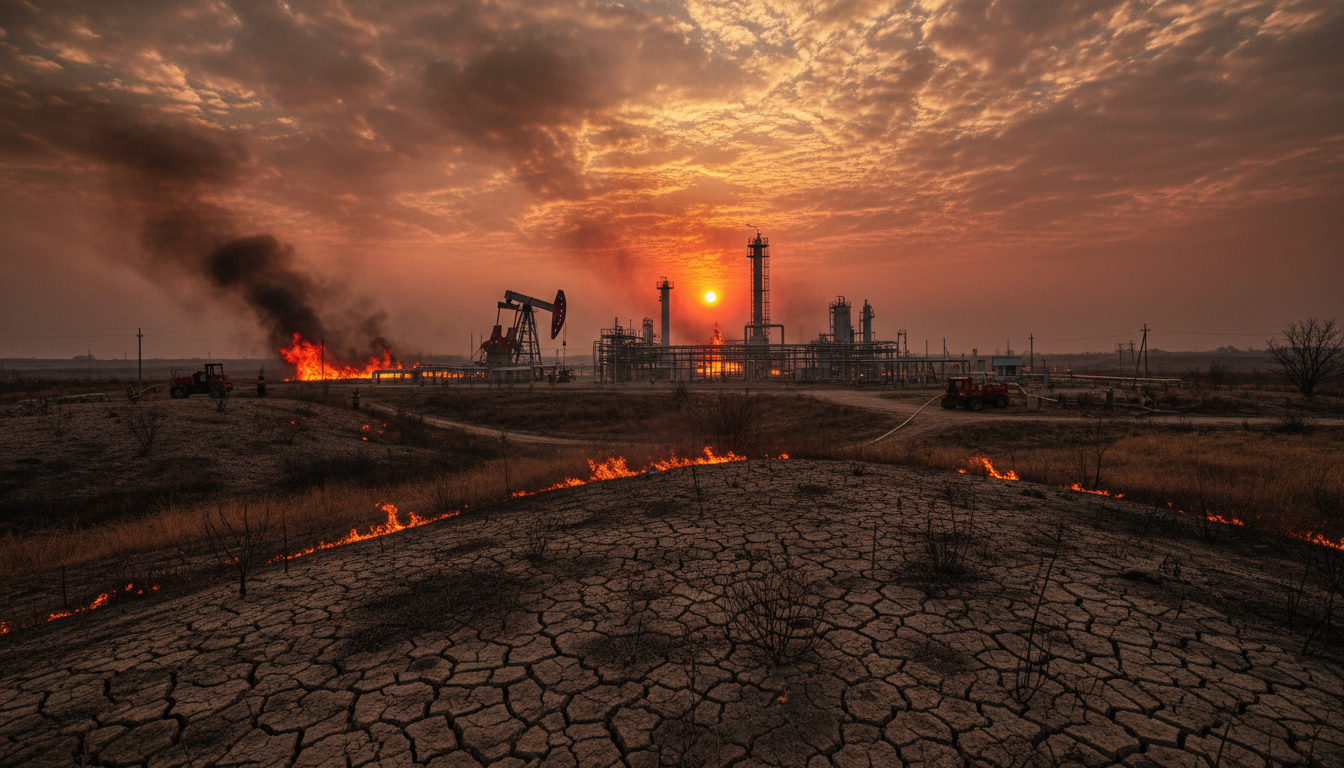
The intensifying wildfire situation across southern Georgia, fueled by persistent drought conditions and exacerbated by prior weather events, demands immediate and thorough scrutiny from energy sector investors. While the immediate impact is regional, the incidents underscore a growing vulnerability within critical energy supply chains and infrastructure to extreme weather phenomena. As the frequency and intensity of such events rise, the investment community must integrate these non-traditional risks into their valuation models and portfolio strategies, moving beyond conventional supply-demand dynamics to assess true operational resilience and long-term asset viability.
The Burn Zone: Operational Risks and Infrastructure Resilience Under Fire
Georgia’s drought-stricken landscape is currently battling two significant blazes, the Pineland Road Fire and the Highway 82 Blaze, both posing substantial challenges. The Pineland Road Fire, which has consumed over 50 square miles and destroyed at least 35 homes, highlights the destructive potential. Its rapid spread is largely attributable to an abundance of dry, combustible vegetation, a direct consequence of Hurricane Helene’s path in September 2024. This layering of natural disasters – a hurricane creating fuel for subsequent wildfires – introduces a complex risk factor for energy companies, demanding a re-evaluation of asset assessments and insurance strategies.
Approximately 60 miles northeast, the Highway 82 Fire has scorched more than 35 square miles, claiming at least 87 homes, with containment efforts standing at a mere 6% as of Monday. The uncontrolled expansion, influenced heavily by wind conditions, creates immediate logistical nightmares for emergency services and presents significant operational challenges for any energy infrastructure in the vicinity. For investors, this translates into a heightened need for operators to demonstrate robust risk mitigation frameworks, capable of safeguarding personnel, protecting critical infrastructure like pipelines and storage facilities, and ensuring the uninterrupted distribution of fuel across the region. The sheer scale and dynamic nature of these fires serve as a real-world stress test for regional energy resilience.
Market Response: Navigating Volatility Amidst Supply Concerns
While the Georgia fires are localized, their implications for supply chain stability resonate in an already sensitive market. As of today, Brent crude trades at $110.72, showing a modest +0.29% gain after opening the day at $110.49. This comes against a backdrop of significant upward momentum, with Brent having climbed an impressive $12.34, or 12.4%, from $99.36 on April 13th to $111.70 by April 30th. WTI crude, currently at $104.59, is down 0.46% today, moving within a daily range of $104.38 to $106.65. Gasoline prices also reflect underlying concerns, trading at $3.63, up 0.55% today.
This upward trend in crude prices underscores a market already on edge, where any threat to supply or distribution, even regional, can amplify volatility. Investors are keenly aware that disruptions, particularly in a key transit region like the Southeast, could impact refined product availability and transportation costs, potentially widening crack spreads and influencing regional gasoline prices. The fires, by posing a clear and present danger to logistical stability, add another layer of uncertainty to a market grappling with geopolitical tensions and evolving demand dynamics. Maintaining vigilance on how these localized incidents could cascade into broader market impacts is paramount for portfolio managers.
Forward Outlook: Upcoming Data and Strategic Planning
Looking ahead, the broader supply picture will be refined by several key data releases over the next two weeks, offering crucial context for energy investors. The Baker Hughes Rig Count, scheduled for May 1st and May 8th, will provide fresh insights into North American drilling activity, a critical leading indicator for future production volumes. The EIA’s Short-Term Energy Outlook on May 2nd will offer updated forecasts on global supply and demand, potentially highlighting how localized disruptions like the Georgia fires could impact regional balances.
Furthermore, the weekly API and EIA inventory reports, slated for May 5th/6th and May 12th/13th, will give investors a near real-time pulse on crude and product stocks, which could be particularly sensitive to any perceived or actual logistical bottlenecks in the Southeast. Finally, the IEA Oil Market Report on May 12th will offer a comprehensive global perspective, integrating these regional risks into the larger geopolitical and supply matrix. These upcoming events are not just data points; they are critical catalysts that will inform investor decisions regarding the durability of current crude price levels and the long-term resilience of energy supply chains in the face of escalating environmental challenges.
Addressing Investor Concerns: Risk Mitigation and Portfolio Strategy
Our proprietary intent data reveals that OilMarketCap.com readers are intensely focused on understanding the weekly trend for crude oil and building a robust base-case Brent price forecast for the next quarter. While questions about OPEC+ compliance and broader geopolitical events remain pertinent, the immediate operational stability in key transit regions, exemplified by the Georgia wildfires, is equally critical for investor confidence. These localized events directly complicate price forecasting by introducing unpredictable supply chain vulnerabilities that traditional models might underestimate.
Investors must broaden their analysis to include climate-related risks as a fundamental component of energy asset valuation. This means scrutinizing company strategies for infrastructure hardening, diversification of transportation routes, and robust emergency response plans. The destruction of over a hundred homes in Georgia serves as a stark reminder of the escalating physical risks. For those seeking to build a resilient energy portfolio, understanding how companies are adapting to these evolving environmental threats is just as important as analyzing production volumes or geopolitical shifts. The capacity of operators to protect personnel, safeguard assets, and ensure uninterrupted distribution in the face of such challenges will increasingly differentiate strong performers in the investment landscape, impacting everything from WTI-Brent differentials to regional gasoline price stability.


