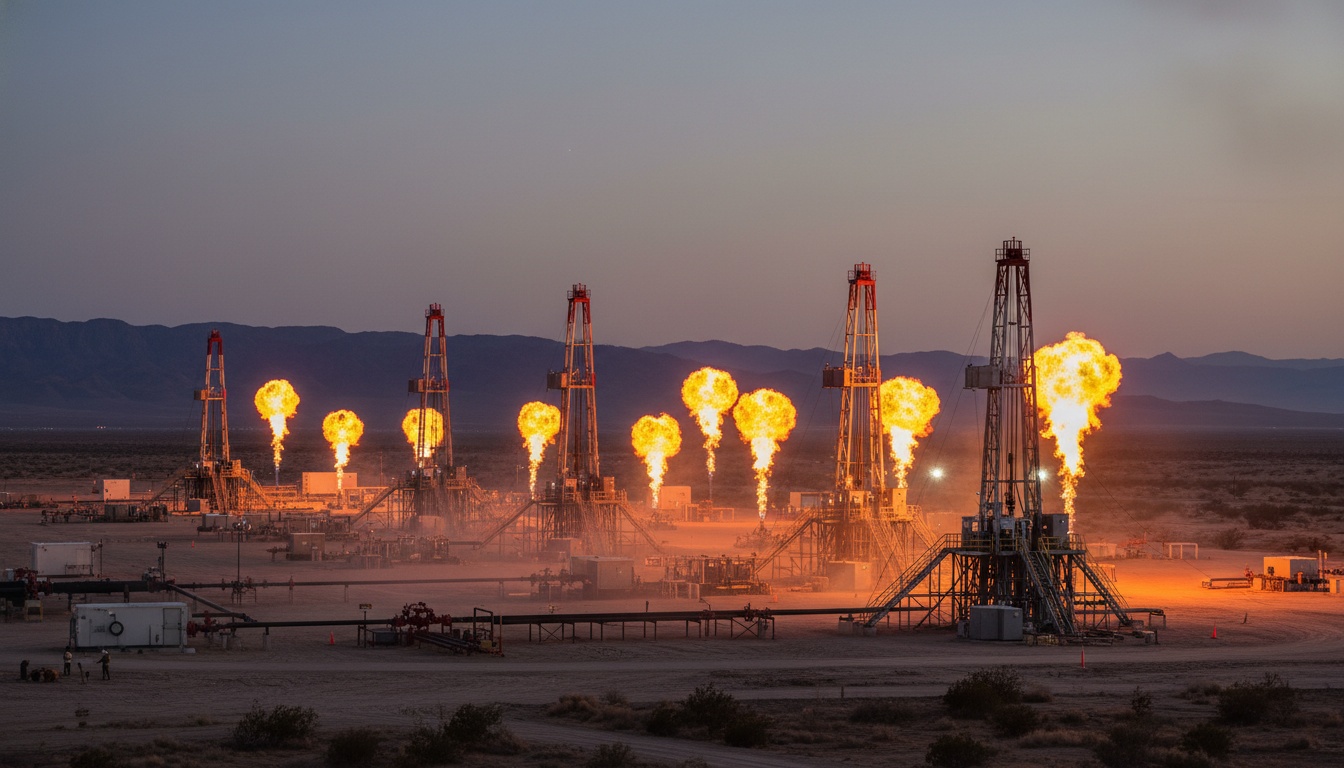
EPA Clarification Offers Critical Flaring Flexibility, Reshaping Investment Dynamics for New U.S. Oil Wells
The United States Environmental Protection Agency (EPA) recently issued a pivotal clarification regarding federal regulations on associated gas management, a move with significant implications for investors in the upstream oil and gas sector. This update specifically allows for the limited, routine flaring of associated gas at newly constructed oil wells under certain conditions, extending beyond the previously established 2026 phaseout deadline.
For wells whose construction commenced after May 7, 2024, this regulatory adjustment introduces much-needed operational flexibility for producers navigating regions with inadequate gas takeaway capacity or existing infrastructure bottlenecks. This pragmatic approach acknowledges the on-the-ground realities of drilling economics and midstream development timelines, potentially de-risking new drilling programs and influencing capital allocation decisions across key U.S. basins.
Navigating Regulatory Headwinds: A Strategic Pivot for Producers
The industry has largely welcomed the EPA’s guidance, emphasizing its role in providing clarity amidst an evolving regulatory landscape. Dan Naatz, Executive Vice President and Chief Policy Officer at the Independent Petroleum Association of America (IPAA), highlighted that this announcement furnishes essential regulatory insight for independent producers. Such clarity ensures that companies can continue their operations effectively while adhering to the agency’s overarching regulatory framework. For investors, this translates into reduced regulatory uncertainty, a factor that can significantly influence project viability and financial forecasting.
Historically, the challenge of managing associated gas – natural gas produced concurrently with crude oil – has been a persistent hurdle for oil producers. In areas lacking sufficient pipeline infrastructure to gather, process, and transport this gas to market, flaring (the controlled burning of gas) has often been the only immediate solution to allow oil production to proceed. Without such flexibility, operators could face the costly dilemma of shutting in wells, delaying production, or incurring penalties for non-compliance, all of which directly impact cash flow and return on investment.
Impact on New Developments: Beyond the 2026 Horizon
The specific application of this revised policy to oil and natural gas wells initiating construction after May 7, 2024, is crucial. It signals a recognition that new projects, especially in rapidly developing or geographically challenging areas, may encounter unforeseen infrastructure constraints. By providing a conditional allowance for flaring beyond the stringent 2026 deadline, the EPA implicitly offers a buffer for these investments. This could encourage continued drilling activity in prolific basins like the Permian, where takeaway capacity has historically struggled to keep pace with oil production growth, leading to periods of significant flaring or price dislocations for natural gas.
For investors, this flexibility can be a game-changer. It potentially improves the economics of new wells by mitigating the risk of stranded gas, enhancing predictability in revenue streams, and allowing producers to bring oil production online more swiftly. This, in turn, can positively impact internal rates of return (IRRs) and payback periods for capital-intensive drilling projects, making new ventures more attractive for equity and debt financing.
Broader Context: Methane Emissions and ESG Imperatives
This policy adjustment arrives amidst broader federal initiatives aimed at regulating methane emissions and enhancing associated gas handling practices across upstream oil and gas operations. While allowing limited flaring might seem counter-intuitive to methane reduction goals, it represents a pragmatic acknowledgement of current infrastructure limitations. The long-term trajectory for the industry remains firmly focused on minimizing emissions through robust gas gathering, processing, and transportation infrastructure.
Major U.S. producing regions, notably the Permian Basin, have witnessed significant investments in midstream infrastructure dedicated to reducing flaring intensity. Operators continue to expand pipelines, compression facilities, and processing plants, demonstrating an ongoing commitment to responsible environmental stewardship. This EPA clarification should not be interpreted as a rollback of environmental ambitions, but rather as a calibrated measure to ensure operational continuity and energy supply while the necessary infrastructure evolves. It provides a bridge, not a permanent solution, allowing for strategic development while the industry continues its transition towards ultra-low emission operations.
Investment Outlook: De-Risking Upstream Capital and Midstream Opportunities
From an investor perspective, this development carries several key takeaways:
- Reduced Operational Risk for Upstream Players: For exploration and production (E&P) companies, especially independent producers, the clarity on flaring offers a critical safety valve. It reduces the risk of project delays or mandated shut-ins due to gas infrastructure shortfalls, making new drilling programs in constrained areas more viable.
- Strategic Capital Allocation: Companies might find greater confidence in allocating capital to new drilling projects, knowing that a temporary, regulated flaring option exists. This doesn’t negate the need for midstream investment but provides flexibility in timing and sequencing.
- Continued Midstream Development: While the immediate pressure may be eased, the long-term imperative for robust gas gathering and processing infrastructure remains. This clarification might slightly rebalance the urgency but doesn’t diminish the underlying need, ensuring continued investment opportunities in the midstream sector.
- ESG Considerations: Investors increasingly prioritize environmental, social, and governance (ESG) factors. While “limited routine flaring” is still flaring, the regulatory clarity surrounding it can be framed as a step towards predictable compliance within a defined framework, rather than unregulated emissions. Companies demonstrating proactive infrastructure build-out and adherence to these new guidelines will likely be viewed more favorably.
In essence, the EPA’s nuanced clarification serves to de-risk upstream capital deployment for new oil wells by providing a controlled pathway for associated gas management where infrastructure lags. This regulatory flexibility is a pragmatic response to the complex interplay of energy demand, infrastructure development timelines, and environmental stewardship, ultimately shaping where and how capital flows into the U.S. oil and gas sector in the years to come.