The global oil and gas markets are navigating a complex landscape, with crude benchmarks holding critical support levels even as persistent geopolitical risks, particularly those emanating from Eastern Europe, continue to exert downward pressure. Investors are closely monitoring price action, supply-demand fundamentals, and key upcoming events that could dictate the market’s trajectory in the coming weeks. Our proprietary data pipelines reveal a cautious sentiment, but also an underlying resilience as market participants weigh short-term volatility against longer-term energy demand projections.
Crude Benchmarks Test Support Amidst Volatility
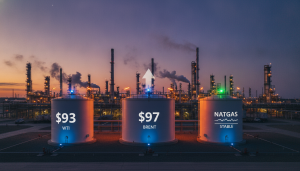
As of today, Brent Crude trades at $90.38, marking a significant daily decline of 9.07%, with its intraday range spanning from $86.08 to $98.97. Similarly, WTI Crude stands at $82.59, down 9.41% for the day, having traded between $78.97 and $90.34. These sharp daily retreats follow a broader trend, with Brent having shed $22.4, or nearly 20%, since March 30th’s peak of $112.78. This sustained downtrend underscores the market’s sensitivity to both demand concerns and geopolitical developments. Gasoline prices have also felt the pinch, currently at $2.93, a 5.18% drop today, demonstrating the cascading effect across refined products. While these price points represent a notable correction from recent highs, the fact that both Brent and WTI are finding support above their respective daily lows suggests a baseline level of investor confidence, preventing a complete capitulation. Investors are clearly looking for definitive signals that could either confirm a bottom or indicate further downside.
Geopolitical Risks and Investor Outlooks
The specter of geopolitical instability continues to cast a long shadow over energy markets, with ongoing tensions in Ukraine serving as a primary source of uncertainty. This dynamic is directly impacting investor sentiment, as evidenced by the questions our readers are posing. Many are asking “what do you predict the price of oil per barrel will be by end of 2026?”, highlighting a desire for long-term clarity in a short-term volatile environment. The inherent unpredictability of these conflicts makes accurate forecasting challenging, yet the market is constantly trying to price in potential supply disruptions or shifts in global trade flows. Beyond the immediate crisis, broader questions about global economic growth and central bank policies also intertwine with geopolitical risks, influencing demand outlooks. This confluence of factors means that any significant escalation or de-escalation could trigger rapid price movements, requiring investors to maintain agile strategies.
Upcoming Events to Shape Market Direction
The next two weeks are packed with critical energy events that will undoubtedly influence crude and gas prices. Kicking off the action, the OPEC+ Joint Ministerial Monitoring Committee (JMMC) is scheduled for Sunday, April 19th, immediately followed by the full OPEC+ Ministerial Meeting on Monday, April 20th. These meetings are paramount, as investors are keenly asking “What are OPEC+ current production quotas?” and will be looking for any signals regarding potential shifts in production policy. Given the recent price declines, the cartel’s stance on current output levels will be a key determinant of market sentiment and future supply. Following these, the market will turn its attention to inventory data, with the API Weekly Crude Inventory reports on April 21st and April 28th, and the official EIA Weekly Petroleum Status Reports on April 22nd and April 29th. These reports provide crucial insights into U.S. supply-demand balances, refining activity, and storage levels. Finally, the Baker Hughes Rig Count on April 24th and May 1st will offer a snapshot of drilling activity, indicating future production trends in the North American market. Each of these events presents a potential catalyst for significant price movement, making the next fortnight particularly critical for energy investors.
Navigating the Data Landscape for Strategic Decisions
In an environment characterized by rapid shifts and heightened uncertainty, access to reliable, real-time data and robust analytical tools is more crucial than ever. Our reader intent data shows investors are increasingly sophisticated, asking questions such as “What data sources does EnerGPT use? What APIs or feeds power your market data?” This underscores a growing demand for transparency and depth in market intelligence. For instance, while some investors are focused on specific company performance, such as queries about “How well do you think Repsol will end in April 2026,” the broader market trend requires a comprehensive understanding of macro factors, geopolitical nuances, and supply-demand fundamentals. The ability to integrate live market prices, an up-to-date event calendar, and granular insights into investor sentiment allows for a more informed and proactive investment approach. As we look ahead, discerning genuine market signals from noise, particularly in relation to the ongoing Ukraine crisis and OPEC+’s evolving strategy, will be key to identifying opportunities and managing risk in the dynamic oil and gas sector.