Crude Volatility Surges: Unpacking the Market’s Next Moves
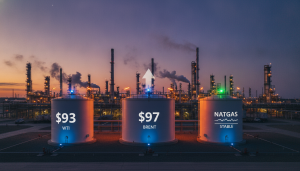
The global crude oil market is experiencing a significant reset, with futures prices seeing a notable retreat today. After weeks of relative strength, Brent crude has plunged to $90.38, marking a sharp 9.07% decline within the trading session, with WTI crude mirroring this sentiment, dropping 9.41% to $82.59. This recent downturn, which has seen Brent shed nearly 20% from its March 30th high of $112.78, is driven by a confluence of factors, primarily renewed supply expectations and shifting geopolitical dynamics. However, beneath the immediate price action lies a complex web of geopolitical risks, demand signals, and impending policy decisions that demand careful consideration from discerning energy investors. This analysis leverages OilMarketCap’s proprietary data to cut through the noise, offering an informed perspective on where the market might be headed.
Immediate Market Reaction and Technical Crossroads
Today’s dramatic price action is undeniably a wake-up call for many in the energy sector. Brent crude, trading within a wide daily range of $86.08 to $98.97 before settling at $90.38, reflects extreme intraday volatility. Similarly, WTI crude’s range of $78.97 to $90.34 underscores the broad market uncertainty. While the immediate focus is on halting this downward momentum, it’s crucial to consider the broader technical picture. Despite this sharp retreat, some market observers note that the overarching uptrend, characterized by a pattern of higher highs and higher lows, could theoretically remain intact if key support levels hold. Traders are currently scrutinizing potential technical floors, with a long-term 50% retracement level around $64.21, followed by the 50-day moving average at $63.73, and the more robust 200-day moving average at $63.09, representing distant but critical support zones. A sustained break above the recent $66.42 peak, which now seems like a distant memory given current prices, was previously seen as a trigger for a push toward a major resistance zone between $68.35 and $69.34. However, with Brent firmly in the $90s, the immediate challenge is to establish a new, higher support base following this significant correction. The sheer magnitude of the recent sell-off, with Brent down $22.40 (-19.9%) in just 14 days, suggests that previous short-term technical indicators may need re-evaluation in the context of this new price paradigm.
Persistent Geopolitical Risks and Supply Disruptions
Despite the current narrative of increased supply weighing on prices, persistent geopolitical risks continue to add a significant upside bias to crude markets. The conflict in Eastern Europe, for instance, has already disrupted a substantial portion of Russia’s refining capacity, reportedly up to 25% in recent weeks due to drone attacks. This has led to a partial diesel export ban from Russia, tightening refined product markets and indirectly supporting crude demand as refiners elsewhere step up. Simultaneously, the recent reinstatement of United Nations sanctions on Iran injects another layer of uncertainty, raising concerns over potential future supply constraints from the Middle Eastern producer. While the immediate impact of these sanctions on crude exports may take time to materialize, the threat of reduced Iranian supply remains a potent factor for investors to monitor. These geopolitical flashpoints serve as a constant reminder that the global oil supply chain remains fragile and susceptible to sudden shocks, capable of quickly reversing bearish sentiment.
Demand Resilience and Strategic Stockpiling
On the demand side, strategic actions by major consumers continue to offer a crucial floor for crude prices. China, a perennial driver of global oil demand, has consistently engaged in substantial crude stockpiling. Analysis suggests that through the first eight months of the year, China imported approximately 990,000 barrels per day above its domestic consumption needs. This sustained level of buying indicates significant underlying demand capacity and a strategic effort to build reserves, providing a buffer against future supply disruptions. Furthermore, the pricing actions of major producers reflect underlying market strength despite today’s dip. Saudi Aramco, for instance, is anticipated to increase its November official selling prices (OSPs) for Asian customers by 20-40 cents per barrel across its crude grades. This adjustment reflects the recent robustness in Middle East benchmark prices. While rising supply expectations and higher freight costs are expected to temper the magnitude of these OSP hikes, the very fact of an increase underscores a producer’s confidence in regional demand. The cash Dubai premium, which recently hit a six-month high of $3.63 per barrel before easing on news of potential Kurdistan exports, further illustrates this underlying strength in key Asian markets.
Navigating Upcoming Events and Investor Questions
The coming weeks are packed with critical events that will shape the trajectory of crude markets, and investors are keenly focused on gaining clarity amidst the current volatility. Our proprietary reader intent data reveals a strong interest in “what OPEC+ current production quotas are,” clearly indicating that the market is looking for signals from the cartel. This makes the upcoming OPEC+ Ministerial Meeting on April 19th a pivotal event. Any pronouncements regarding production levels, especially in light of the current price decline and the potential return of Kurdistan oil to the market, will significantly influence sentiment. Beyond OPEC+, the market will closely watch the weekly inventory reports. The API Weekly Crude Inventory (April 21st, April 28th) and the EIA Weekly Petroleum Status Report (April 22nd, April 29th) will provide crucial insights into the immediate supply-demand balance in the United States, a key indicator for short-term price movements. Additionally, the Baker Hughes Rig Count on April 24th and May 1st will offer a glimpse into future U.S. production trends. As investors grapple with today’s sharp price corrections, our data shows a strong forward-looking bias, with questions like “what do you predict the price of oil per barrel will be by end of 2026?” and “How well do you think Repsol will end in April 2026” dominating inquiries. These questions highlight a desire for long-term price forecasts and insights into how individual energy companies, such as Repsol, are positioned to weather market fluctuations. The performance of companies like Repsol will undoubtedly be tied to the broader crude market’s stability and the success of their hedging strategies against such significant price swings.
Investment Implications and Outlook
The current market environment, characterized by significant intraday swings and a sharp correction in the short term, presents both challenges and opportunities for energy investors. While the immediate dip on renewed supply expectations is noteworthy, underlying geopolitical risks and robust demand from strategic players like China suggest that the downside may be limited in the medium to long term. Investors should closely monitor the OPEC+ meeting for any shifts in supply policy, as well as the weekly inventory data for real-time supply-demand signals. The significant decline in Brent crude from its recent highs could present an attractive entry point for long-term investors who believe in the enduring fundamentals of oil demand and the persistent fragility of global supply chains. However, the extreme volatility, as evidenced by today’s dramatic price action, necessitates a disciplined approach and a thorough understanding of one’s risk tolerance. The market is clearly seeking direction, and the upcoming events will provide critical cues for navigating the path ahead.