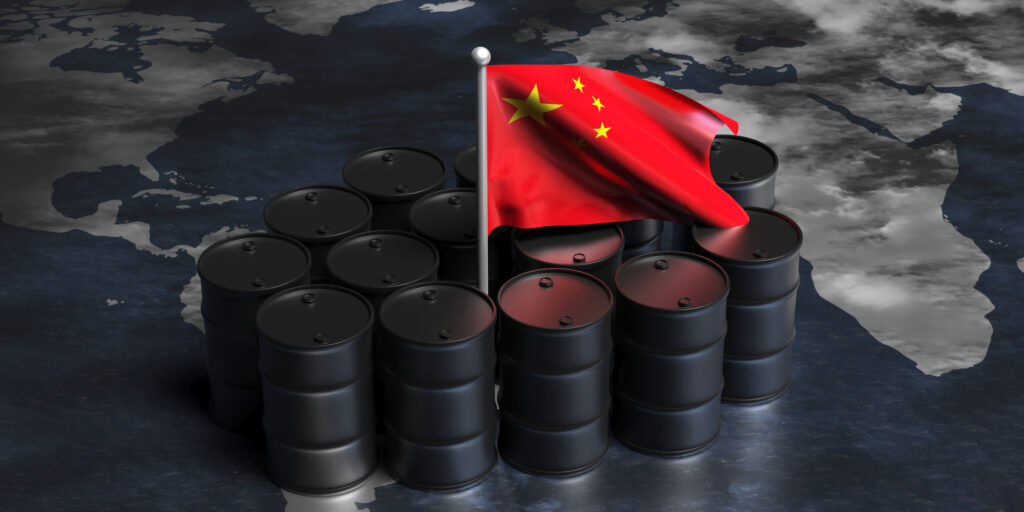
The global oil market is once again grappling with the intricate dance between geopolitics, energy security, and market fundamentals. A fresh round of U.S. sanctions targeting Chinese entities for their involvement in importing Iranian crude has ignited a strong response from Beijing, promising to safeguard its companies’ interests. This escalating tension adds another layer of complexity for investors, who are already navigating a volatile pricing environment marked by shifting supply-demand dynamics and persistent macroeconomic uncertainty. Understanding the immediate market reaction and the forward implications of these developments is crucial for positioning portfolios effectively in the coming weeks and months.
Escalating Sanctions and China’s Defiance: A New Supply Chain Chess Match
The U.S. Treasury’s recent move to blacklist nearly 100 individuals, vessels, and companies – including prominent Chinese players like Shandong Jincheng Petrochemical Group and the critical Rizhao Shihua Crude Oil Terminal – represents the fourth such sanctions package this year. These actions underscore Washington’s determined strategy to “dismantle key elements of Iran’s export machine” and choke off its cash flow. The designation of the Rizhao Shihua terminal is particularly impactful, as it is reportedly half-owned by a logistics unit of Sinopec, China’s refining behemoth, and handles approximately one-fifth of the giant’s crude oil imports. This direct hit on key infrastructure and significant players signals a heightened level of pressure.
China’s response has been unequivocal. Foreign Ministry spokesperson Guo Jiakun affirmed Beijing’s commitment to ensuring its energy security and protecting the “lawful rights and interests of Chinese companies and citizens.” This stance is not merely rhetoric; it reflects China’s deep-seated need to secure diverse energy sources to fuel its vast economy, often viewing such sanctions as unilateral and lacking international legal basis. For investors, this creates a fascinating and potentially disruptive dynamic: a major consumer nation openly defying the enforcement mechanisms of a major producer (U.S.) against another producer (Iran). The continued operation of Iran’s “shadow fleet” tankers, like the Kongm, Big Mag, and Voy, which the Rizhao Shihua terminal is accused of facilitating, demonstrates the resilience and adaptability of these supply chains in the face of sanctions.
Market Volatility Amidst Geopolitical Jitters and Investor Questions
Despite the tightening of sanctions on Iranian oil, which theoretically reduces global supply, the immediate market reaction has been anything but straightforward. As of today, Brent Crude trades at $90.38 per barrel, marking a significant 9.07% drop in a single day, with its range fluctuating wildly between $86.08 and $98.97. Similarly, WTI Crude has fallen to $82.59, down 9.41% today, trading within a daily range of $78.97 to $90.34. This sharp downturn is not an isolated event; our proprietary data shows Brent has declined by nearly 20% over the last 14 days, from $112.78 on March 30th to its current level. This suggests that while geopolitical tensions around Iranian supply are a factor, broader market concerns about demand, economic growth, or potentially even an oversupply from other sources are currently weighing more heavily on prices.
Our internal reader intent data reveals that investors are keenly focused on understanding this volatility. A recurring question this week is, “What do you predict the price of oil per barrel will be by end of 2026?” This highlights a desire for long-term clarity amidst short-term swings. The current price action, seemingly contradictory to supply-side geopolitical risk, suggests that the market may be pricing in a continued, albeit covert, flow of Iranian oil to China, or it could be reacting more strongly to global economic headwinds and inventory builds. The significant daily drop, despite the sanctions news, indicates a broader risk-off sentiment or an anticipated weakening of demand that is currently overshadowing specific supply disruptions. Investors must scrutinize whether this signals a fundamental shift in market sentiment or merely short-term profit-taking.
Upcoming Events and the OPEC+ Conundrum
Looking forward, the interaction between these geopolitical pressures and established market mechanisms will be critical. The next 14 days are packed with high-impact energy events that will undoubtedly influence price discovery. Crucially, the OPEC+ Joint Ministerial Monitoring Committee (JMMC) Meeting is scheduled for Sunday, April 19th, immediately followed by the full OPEC+ Ministerial Meeting on Monday, April 20th. These gatherings will be paramount. Investors are asking, “What are OPEC+ current production quotas?” and these meetings are where any adjustments would be announced. Will OPEC+ maintain its current production cuts, potentially extending them, to counteract perceived oversupply or to support prices amidst global economic uncertainty? Or will the group react to the increasing geopolitical friction and the implied tighter market from U.S. sanctions by considering a minor output adjustment?
Beyond OPEC+, the market will keenly watch weekly inventory data. The API Weekly Crude Inventory report on April 21st and April 28th, followed by the EIA Weekly Petroleum Status Report on April 22nd and April 29th, will provide critical insights into U.S. supply-demand balances. Significant builds could further pressure prices, while unexpected draws might offer some support. The Baker Hughes Rig Count on April 24th and May 1st will also offer a glimpse into future U.S. production trends. The collective outcome of these events, against the backdrop of U.S.-China-Iran tensions, will shape the immediate trajectory of oil prices and determine whether the recent downward trend has legs or if a rebound is imminent.
Navigating the Investment Landscape: Risks and Opportunities
For energy investors, the current environment demands a nuanced approach. The direct targeting of Chinese entities and infrastructure linked to major players like Sinopec introduces a new layer of risk for companies with exposure to the Chinese refining and shipping sectors. While China has vowed protection, the practicalities of operating under U.S. sanctions can lead to increased costs, insurance complexities, and logistical hurdles, potentially impacting margins for affected firms. Investors should assess the direct and indirect exposure of their holdings to these evolving geopolitical fault lines.
Conversely, the situation could create opportunities for producers and refiners less exposed to sanctioned Iranian crude, particularly if the sanctions genuinely tighten global supply. However, the current market downturn suggests that broader macroeconomic concerns are dominating sentiment. Investors should consider diversified exposure, focusing on companies with robust balance sheets, strong free cash flow generation, and a clear strategy for navigating energy transition while capitalizing on continued fossil fuel demand. Monitoring not just the headline price of Brent and WTI, but also refining margins, shipping costs, and regional differentials will be key. The long-term outlook remains complex, with the geopolitical risk premium constantly battling against demand uncertainty and the structural shifts of the energy transition. Strategic allocation and continuous monitoring of both geopolitical developments and market fundamentals will be paramount.