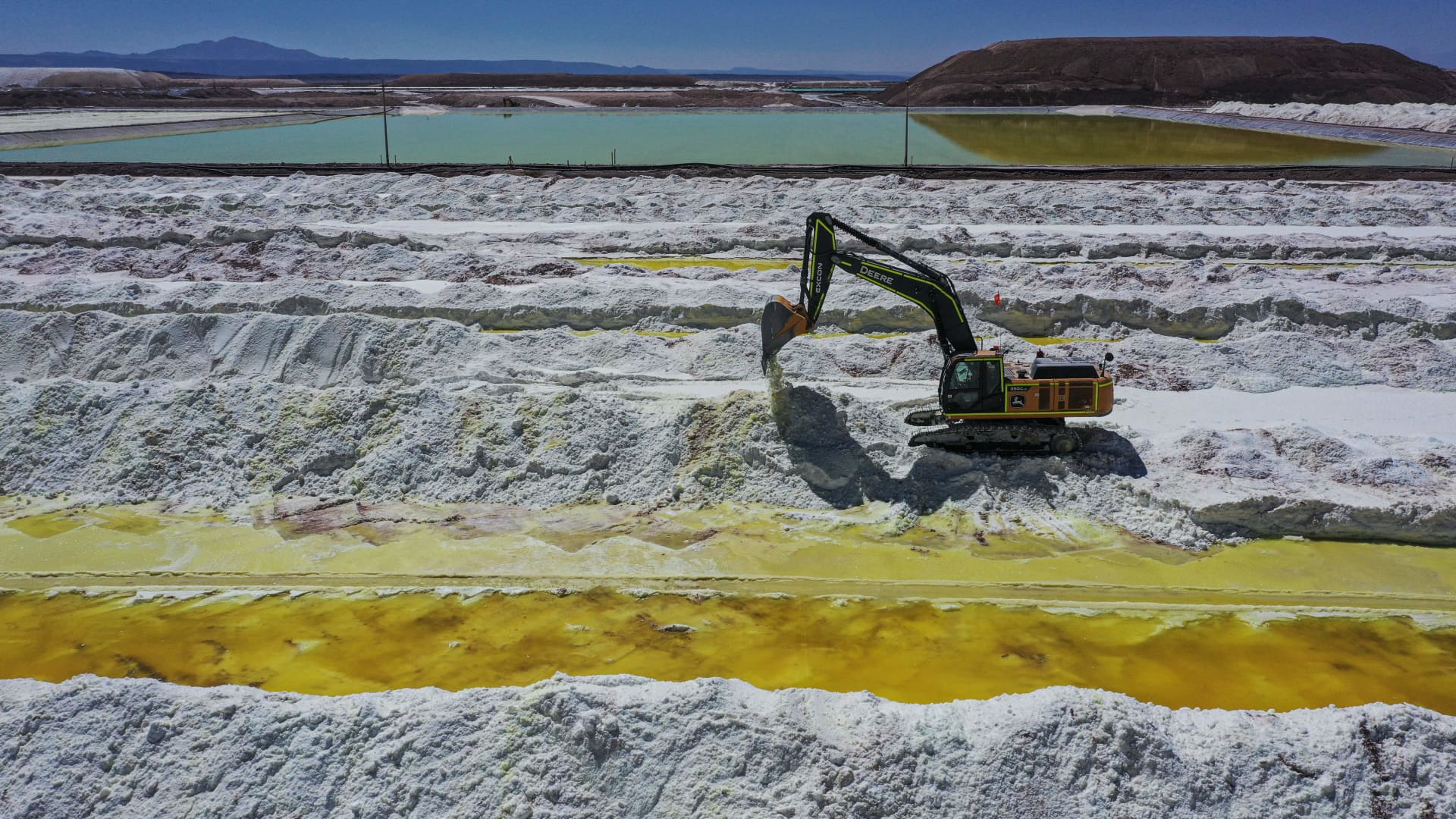
The recent downgrade of Lithium Americas (LAC) by Canaccord Genuity to a “Sell” rating, following the U.S. government’s decision to take an equity stake, sends a potent message to investors across the entire energy spectrum. While the immediate focus is on a critical minerals miner crucial for the electric vehicle supply chain, the underlying themes of government intervention, valuation pitfalls, and the nuanced impact of strategic partnerships resonate deeply with traditional oil and gas investors navigating a complex energy transition. This development underscores that even in areas deemed vital for national security and future energy independence, the financial implications for shareholders remain paramount, demanding rigorous scrutiny of deal terms and a clear understanding of potential dilution.
The Price of “Partnership”: Dilution and Disappointment for LAC Investors
Canaccord Genuity’s decision to cut Lithium Americas to a “Sell” rating, accompanied by a price target of $6.50 Canadian ($4.66 U.S.), suggests a significant downside of 32% from its last closing price of $9.59 Canadian ($6.87 U.S.). This sharp re-evaluation comes despite the stock having more than doubled since the White House first signaled its interest in a stake. The core of Canaccord’s bearish stance revolves around the perceived inadequacy of the revised deal terms with the Department of Energy (DOE).
The government’s arrangement involves taking a 5% equity stake in Lithium Americas and an additional 5% economic stake in its Thacker Pass mine in Nevada, a joint venture with General Motors. This was a renegotiation of a $2.2 billion DOE loan, with the government agreeing to defer $182 million in loan repayments over the first five years. However, analyst Katie Lachapelle noted that these modifications were “minor,” and the requirement for LAC to provide $120 million into a government reserve account over the next year largely offsets the near-term financial flexibility. Crucially, the equity stake itself, taken via warrants exercisable at a nominal one cent per share, introduces a significant threat of dilution for existing shareholders, overshadowing any perceived benefit of government backing. Investors must recognize that government involvement, while potentially de-risking a project, doesn’t automatically equate to shareholder value creation if the terms are not sufficiently favorable.
Strategic Materials and the Shifting Energy Landscape: Lessons for Oil & Gas Investors
The Lithium Americas deal, while specific to critical minerals, offers broader insights for oil and gas investors monitoring the evolving energy landscape. Governments globally are increasingly focused on securing supply chains for strategic materials vital for the energy transition, akin to how national interests have long shaped traditional hydrocarbon policies. However, the nature of these interventions can vary significantly, impacting investor outcomes.
The analyst’s comparison of the LAC deal to the MP Materials transaction from July highlights this divergence. In the MP Materials case, the Defense Department’s equity stake came with “major additional benefits,” including an above-market floor price and guaranteed offtake from a new facility. Such terms provide a clear, tangible benefit to the company and its shareholders. The absence of similar protections or guaranteed market mechanisms in the LAC deal raises questions about the true value proposition of such partnerships for investors. This distinction is critical for O&G investors, many of whom are asking about the future trajectory of traditional energy markets, including “What do you predict the price of oil per barrel will be by end of 2026?” and “What are OPEC+ current production quotas?” These questions reflect a focus on market fundamentals and policy impacts within their core sector. The LAC scenario demonstrates that government policy, whether in supporting critical minerals or influencing hydrocarbon markets, must be scrutinized not just for its existence, but for its specific terms and their direct financial implications for shareholders.
Macro Headwinds and Future Catalyst Watch: Navigating Volatility in Energy Investments
The timing of the LAC downgrade comes amidst a period of significant volatility in the broader energy markets, adding another layer of complexity for investors. As of today, Brent crude trades at $90.38, reflecting a substantial 9.07% decline on the day, with its range fluctuating between $86.08 and $98.97. Similarly, WTI crude has seen a sharp downturn to $82.59, down 9.41%, trading within a day range of $78.97 to $90.34. This recent dip follows a challenging 14-day trend where Brent crude has shed nearly 20% of its value, dropping from $112.78 on March 30th to its current level.
Such macro-level price fluctuations and uncertainty invariably influence capital allocation decisions across the entire energy complex, including critical minerals projects like Thacker Pass, which are capital-intensive and long-term. Investors are keenly watching upcoming events that could dictate market direction. The OPEC+ Ministerial Meeting scheduled for April 19th is a critical catalyst, with its outcome potentially setting the tone for global crude supply and prices. Following this, the API Weekly Crude Inventory reports (April 21st, April 28th) and the EIA Weekly Petroleum Status Reports (April 22nd, April 29th) will offer essential insights into U.S. supply-demand dynamics. Additionally, the Baker Hughes Rig Count on April 24th and May 1st will provide a real-time pulse on drilling activity and future production trends. These events are not just for O&G specialists; they shape the broader economic environment in which all energy-related ventures, from traditional hydrocarbons to nascent critical minerals, must secure financing and demonstrate value. In a bearish or volatile market, the perceived benefits of government backing in a deal like LAC’s can quickly diminish if the financial terms are not robust enough to withstand broader market pressures.
Investor Questions and the Search for Value in a Complex Energy Future
The current investor sentiment, as evidenced by questions such as “How well do you think Repsol will end in April 2026?” and detailed inquiries about data sources like “What data sources does EnerGPT use? What APIs or feeds power your market data?”, highlights a strong demand for predictive insights and transparent, reliable market intelligence. The LAC situation serves as a powerful reminder that while strategic importance and government backing can be attractive, they do not exempt an investment from fundamental financial scrutiny.
For oil and gas investors, the key takeaway from the Lithium Americas downgrade is the imperative for diligent analysis of deal structures, potential dilution, and the true value proposition for shareholders. Whether evaluating an upstream oil play, a natural gas midstream project, or an investment in critical minerals supporting the energy transition, the principles remain constant: understand the terms, assess the risks, and demand clear shareholder value. The market’s reaction to LAC, despite the crucial role of lithium in the energy future, underscores that robust financial terms and tangible benefits are paramount for investor confidence, regardless of the commodity. In a world where energy markets are increasingly intertwined and subject to geopolitical and policy influences, a critical, numbers-driven approach remains the most reliable compass for navigating investment opportunities.