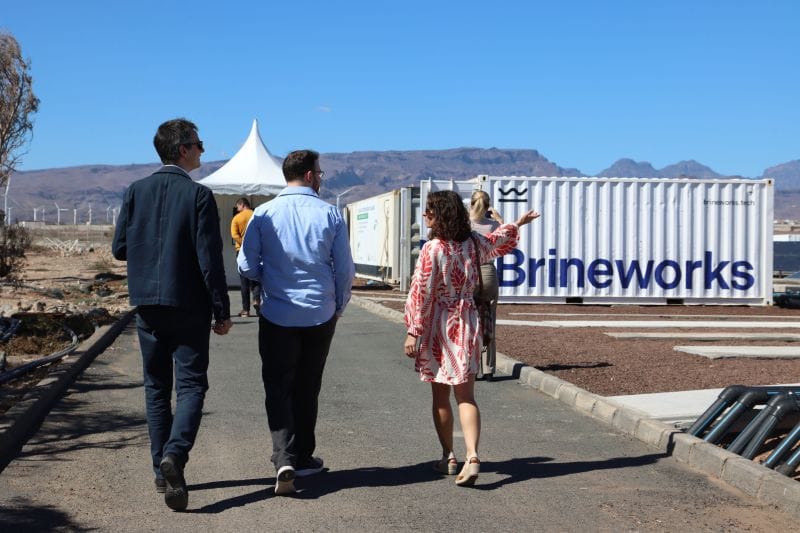
The energy investment landscape continues to evolve at a breakneck pace, with significant capital flowing into innovative solutions designed to decarbonize hard-to-abate sectors. A prime example is the recent €6.8 million (US$7.3 million) funding round, coupled with a €1.8 million EIC grant, secured by Dutch climate tech firm Brineworks. This substantial injection of capital positions the company to accelerate its patented Direct Air Capture (DAC) electrolyzer technology, aiming to achieve carbon removal at a groundbreaking sub-€100 per ton cost. For investors navigating volatile traditional energy markets and seeking exposure to the long-term energy transition, Brineworks’ approach to co-producing hydrogen and CO₂ for e-fuels like sustainable aviation fuel (SAF) and e-methanol presents a compelling new frontier.
De-Risking Decarbonization: The Sub-€100/ton Threshold for E-Fuels
Brineworks’ successful funding round underscores a growing investor confidence in science-led solutions that promise to fundamentally shift the economics of carbon removal. The stated goal of capturing CO₂ directly from the air at below €100 per ton is not merely an incremental improvement; it represents a critical psychological and economic threshold for widespread adoption. Joseph Perryman, Brineworks’ co-founder and CTO, highlighted this, noting it’s the cost point the world has been anticipating. This breakthrough is particularly pertinent for the aviation and shipping sectors, which collectively contribute over 5% of global CO₂ emissions and face limited viable options for decarbonization at scale. By generating both captured CO₂ and hydrogen – the essential building blocks for synthetic fuels – Brineworks aims to unlock a cost-effective pathway to e-methanol and SAF. The company targets commercial readiness by 2026, signaling a relatively rapid timeline for deploying a technology with potentially transformative implications for global carbon intensity and fuel supply chains.
Navigating Market Swings: DAC as a Long-Term Hedge Against Volatility
The investment in climate tech like Brineworks occurs against a backdrop of significant dynamism in the broader energy markets. As of today, Brent Crude trades at $90.38, reflecting a substantial 9.07% decline within the day, with its range fluctuating between $86.08 and $98.97. Similarly, WTI Crude stands at $82.59, down 9.41% today, experiencing a daily range from $78.97 to $90.34. This intraday volatility follows a notable trend over the past two weeks, where Brent Crude has shed nearly 18.5% of its value, falling from $112.78 on March 30th to $91.87 just yesterday. Such pronounced swings in traditional crude prices naturally lead investors to question the future trajectory of oil, with many asking about predictions for oil per barrel by the end of 2026. While short-term commodity price movements capture headlines, investments in DAC and e-fuels offer a distinct value proposition: a long-term hedge against future carbon pricing and the persistent, non-negotiable demand for emission reductions.
This dichotomy is crucial for portfolio strategy. While traditional oil and gas investments remain subject to geopolitical shifts, supply-demand imbalances, and economic cycles that drive price fluctuations, capital deployed into advanced carbon capture and synthetic fuel production taps into a different, more stable growth vector driven by regulatory mandates, corporate sustainability targets, and a global imperative to decarbonize. Even as gasoline prices have seen a dip to $2.93 today, down 5.18%, the underlying pressure to transition away from fossil fuels for specific applications, regardless of the immediate price of crude, continues to intensify. Investors are increasingly looking for assets that can perform in a carbon-constrained world, providing diversification away from pure commodity plays.
The Flexible Electrolyzer Edge and Upcoming Market Catalysts
A core innovation highlighted by Brineworks is its patented electrolyzer, engineered for flexible operation with renewable power sources. Unlike conventional systems that suffer degradation from intermittent operation, this unit is designed to start and pause in sync with the availability of solar and wind energy. This flexibility is a critical enabler for the economic viability of green hydrogen and e-fuel production, addressing a major bottleneck identified by CEO Gudfinnur Sveinsson: the need for technology that can efficiently utilize increasingly cheaper, but often intermittent, renewable power. This technological leap positions Brineworks to localize carbon-neutral fuel production, enhancing energy independence for nations looking to reduce import dependencies while meeting climate targets.
Looking ahead, the broader energy market will be shaped by several key events that could indirectly bolster the case for such innovative solutions. Investors keenly await the OPEC+ Joint Ministerial Monitoring Committee (JMMC) meeting this weekend, followed by the full Ministerial meeting. The outcomes of these discussions on production quotas, a frequent point of inquiry among our readers, will significantly influence global crude supply and price stability. Subsequent weekly data releases, including the API Weekly Crude Inventory on April 21st and 28th, and the EIA Weekly Petroleum Status Reports on April 22nd and 29th, will further refine the near-term supply-demand picture. While these events directly impact conventional oil markets, any tightening of traditional supply or persistent demand growth could amplify the urgency and economic viability of alternative, domestically produced e-fuels. Furthermore, the Baker Hughes Rig Count reports on April 24th and May 1st will offer insights into upstream activity, providing another data point for investors assessing the long-term trajectory of fossil fuel production versus the accelerating shift towards decarbonized energy sources.
Strategic Positioning and Investor Sentiment in the Decarbonization Race
The substantial investment in Brineworks reflects a strategic realignment among venture capitalists and institutional funds towards solutions that offer a genuine “step-change” in carbon removal economics. This sentiment aligns with broader investor questions, such as how established energy giants might fare in this evolving landscape. While specific companies like Repsol are on investors’ minds, the underlying question concerns the adaptability and future positioning of the entire oil and gas sector. Firms like Brineworks offer a glimpse into how the industry could diversify and remain relevant in a net-zero future, potentially becoming partners or acquisition targets for larger players seeking to meet their ESG commitments and expand into new revenue streams.
The ability to localize e-fuel production provides a compelling narrative around energy security, an increasingly vital consideration in global geopolitics. For countries reliant on imported fossil fuels, domestic synthesis of SAF and e-methanol using DAC and renewable electricity could offer a dual benefit: reducing emissions while bolstering national energy independence. This dual advantage is a powerful draw for policymakers and investors alike, creating a robust market for technologies that can deliver at scale. The current funding round for Brineworks is not just about a single company; it signifies a maturing segment of the energy transition, where foundational technologies like flexible DAC electrolyzers are moving from concept to commercialization, attracting serious capital and offering a distinct investment thesis for those looking beyond the ebb and flow of traditional commodity cycles.


