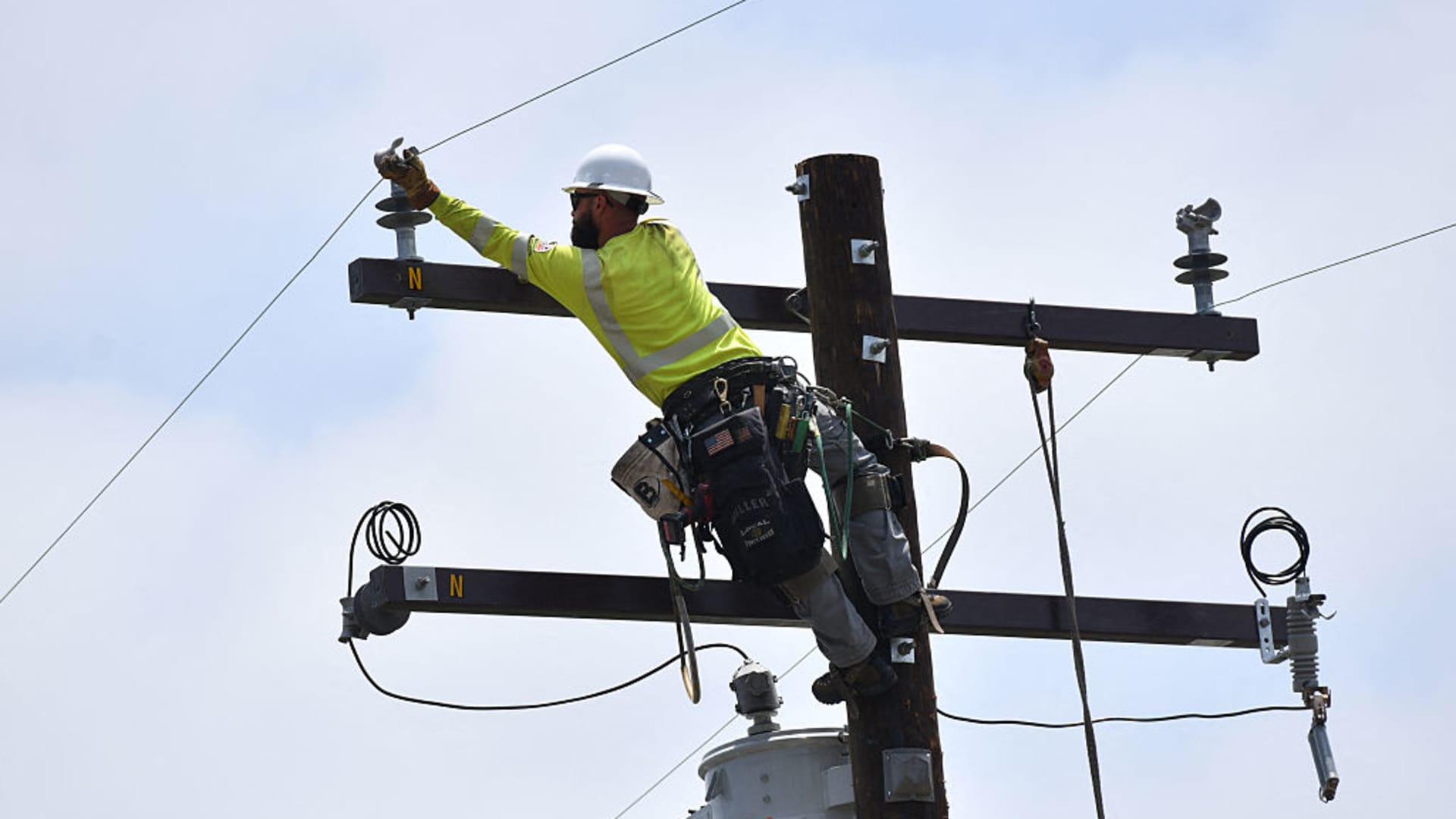
The burgeoning artificial intelligence industry promises a transformative shift across global economies, yet its immediate impact on energy demand, particularly electricity, remains shrouded in significant uncertainty. While the stock market has enthusiastically priced in a massive buildout of data center infrastructure, leading to a substantial rally in utility sector stocks, the underlying reality for electricity providers is a complex web of speculative demand forecasts and logistical challenges. This creates a critical juncture for investors, not just in utilities, but across the broader energy complex, including oil and gas, as the true scale and timing of AI’s energy footprint could significantly reshape future commodity markets.
The AI Power Demand Fog of War
The narrative around AI’s insatiable hunger for power is compelling, with projections suggesting server farms could consume electricity equivalent to entire cities. However, the path from ambitious plan to operational reality is proving opaque for utility companies. A key challenge is the phenomenon of AI companies “shopping” their substantial data center projects across multiple regions, seeking the fastest and most reliable power access. This practice means utilities often receive identical project requests, making it nearly impossible to ascertain genuine, committed demand versus exploratory inquiries. This creates a “fog of war” for electricity providers, hindering their ability to accurately forecast future load growth and plan the necessary generation and transmission infrastructure.
Regulators have voiced serious concerns over these forecasting discrepancies. The Federal Energy Regulatory Commission has highlighted that even minor percentage point differences in electricity load forecasts can translate into billions of dollars in misallocated investments and higher customer bills. Industry leaders echo this caution; one nuclear power operator CEO publicly stated, “I think the load is being overstated. We need to pump the brakes here.” This skepticism from within the utility sector itself underscores the inherent risks in the current speculative environment. Without clearer visibility into actual demand, the multi-billion-dollar investments needed for new power generation, often fueled by natural gas, face considerable uncertainty, potentially impacting future gas demand and infrastructure planning.
Market Exuberance vs. Underlying Realities
Despite the considerable uncertainty acknowledged by industry experts, the stock market has been anything but cautious. The utility sector has experienced a remarkable surge, gaining approximately 21% this year, building on a robust 19% rally in the preceding year. This two-year period has seen U.S. electricity providers add nearly $500 billion in market value, a growth trajectory last observed two decades ago in 2003 and 2004. This aggressive valuation reflects widespread market belief in an imminent, massive surge in electricity consumption driven by AI.
However, this exuberance is not without its critics. Prominent tech leaders have warned of an “AI bubble,” cautioning investors against becoming “overexcited.” The disconnect between the market’s bullish outlook and the operational uncertainty faced by utilities presents a classic investment dilemma. While a historic increase in electricity consumption is broadly anticipated after a long period of flat growth, the precise magnitude and timing remain critical unknowns. Should the actual buildout of data centers be slower or less extensive than currently priced in, the utility sector could face significant headwinds. Conversely, if demand materializes rapidly, the strain on existing energy infrastructure, including the demand for natural gas as a primary fuel for new power plants, could be immense, creating distinct opportunities for oil and gas investors.
Crude Dynamics Amidst Power Sector Uncertainty
While the AI boom directly impacts the electricity sector, its indirect effects on the broader energy market, including crude oil, warrant close attention. As of today, Brent crude trades at $96.28 per barrel, marking a 3.13% decline within the day’s range of $95.59 to $98.97. Similarly, WTI crude is priced at $87.82, down 3.67%, fluctuating between $87.02 and $90.34. This recent bearish sentiment follows a significant downward trend for Brent, which has shed $14, or 12.4%, from its $112.57 peak just two weeks ago on March 27 to $98.57 yesterday. This sharp correction highlights the market’s sensitivity to immediate supply-demand signals, even as long-term energy demand forecasts from AI remain robust but nebulous.
Looking ahead, several key events will shape the near-term crude market. The upcoming OPEC+ Joint Ministerial Monitoring Committee (JMMC) and full Ministerial meetings on April 17th and 18th, respectively, will be crucial. With crude prices showing weakness, the cartel’s decision on production quotas will heavily influence market direction. A deeper cut could provide support, while a decision to maintain current levels might signal either confidence in future demand recovery or a willingness to absorb current oversupply concerns. Further insights into global supply-demand balances will come from the API Weekly Crude Inventory and EIA Weekly Petroleum Status Reports on April 21st/22nd and April 28th/29th, followed by the Baker Hughes Rig Count on April 24th and May 1st. These reports will offer vital data points to assess the current market equilibrium and calibrate expectations for how any AI-driven economic activity might eventually translate into broader energy demand, including transportation fuels.
Investor Focus on Data and Transparency
In an environment characterized by both immense opportunity and significant uncertainty, investors are increasingly prioritizing access to reliable, real-time data and transparent market intelligence. Our proprietary reader intent data reveals a strong focus on fundamental market drivers and data integrity. Questions such as “What are OPEC+ current production quotas?” and “What is the current Brent crude price and what model powers this response?” underscore a demand for precise, verifiable information that underpins investment decisions.
The “shopping around” behavior of data center developers, which obscures true demand for utilities, creates a similar analytical challenge for oil and gas investors. Gauging the future trajectory of natural gas demand for power generation, or assessing the broader economic activity that might boost crude consumption, requires robust forecasting built on credible data. Investors are keenly aware that accurate, timely insights into supply, demand, and geopolitical factors are paramount. In this complex landscape, the ability to cut through the noise and access high-fidelity market data becomes a competitive advantage, enabling more informed positioning across the energy value chain.