Navigating Energy’s Shifting Sands: Investment Horizons in Agrivoltaics and Supply Chain Resilience
The global energy landscape continues its dramatic transformation, presenting both formidable challenges and compelling investment opportunities for those tracking the oil and gas sector. While traditional hydrocarbon markets grapple with intense geopolitical pressures and price volatility, a compelling narrative is unfolding around renewable energy solutions. Solar power, in particular, is proving its mettle as a rapidly deployable and cost-effective method to bolster electricity grids. This accelerated adoption comes precisely when surging demand and international conflicts, notably the war in Iran, are driving significant spikes in oil and natural gas prices.
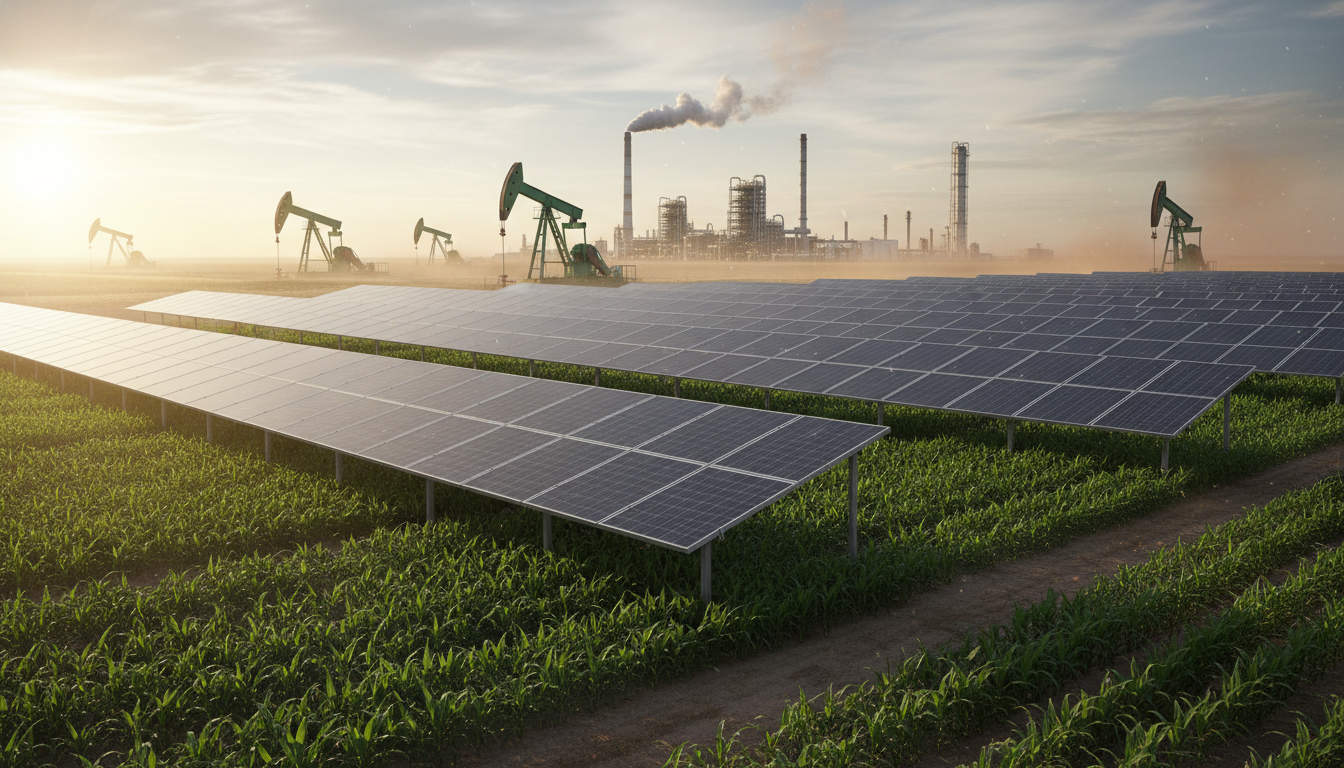
Beyond utility-scale installations, solar technology is innovatively integrating into agricultural operations, creating new revenue streams for farmers and presenting a fascinating frontier for infrastructure investment. While California explores transforming vast tracts of fallow farmland, rendered unproductive by diminishing water resources, into sprawling solar fields, other regions are pioneering integrated approaches. The burgeoning field of agrivoltaics involves co-locating solar panels with active crop cultivation or livestock grazing. Researchers across universities and government agencies are uncovering surprising synergies within these systems.
The benefits of agrivoltaics are multifaceted and directly contribute to agricultural resilience and efficiency. Solar panels, strategically elevated and spaced, provide essential shade for crops, shielding them from the most intense midday sun and mitigating heat stress. This shading also significantly reduces water evaporation from the soil, a critical advantage in increasingly arid environments. Livestock likewise benefit from the shade during peak heat, contributing to animal welfare and potentially improved productivity. In a symbiotic exchange, the transpiration from plants beneath the panels releases water vapor, which in turn helps cool the solar modules from below, according to the U.S. Department of Agriculture, boosting their electrical generation efficiency.
A notable pilot project near Nashville, Tennessee, illustrates the innovative potential for integrating solar into livestock operations. Solar Ranch’s 40-acre facility in Christiana is currently assessing the viability of pivoting solar panels designed to track the sun, specifically for cattle ranching. Over the coming year, this initiative aims to confirm whether cattle thrive as effectively under these installations as various crops do. Should these trials prove successful, the model offers a compelling proposition for ranchers and dairy farmers: leveraging swaths of their rural land for a consistent, diversified revenue stream by leasing it for solar deployment.
The policy environment plays a crucial role in accelerating or hindering such developments. Earlier this year, the Trump administration completely discontinued the Rural Energy for America Program (REAP). Established in 2008, REAP provided vital financial assistance to farmers and rural cooperatives for installing solar and wind energy systems, yielding substantial energy cost savings and reducing greenhouse gas emissions. The rise of privately financed agrivoltaic projects, where companies lease land from farmers for solar installations without disrupting agricultural operations, could partially offset the loss of REAP funding. However, the potential restoration of these funds through a new farm bill, which enjoys bipartisan support, could unlock significant investment in farm-based solar, positioning it as a major contributor to the national power grid.
Energy Security: The Unseen Catalyst for Sustainable Investment
For too long, the discourse surrounding the transition to renewable energy has been dominated by concerns over cost implications and perceived system volatility. While these factors remain relevant, recent global geopolitical events are fundamentally reshaping the narrative. The focus has irrevocably shifted toward a more primal concern for investors and national economies alike: the security of energy supply and the strategic control over its sources.
The disruption of Russian gas deliveries to Europe, particularly after the Nord Stream pipeline sabotage, starkly illustrated the vulnerabilities inherent in reliance on centralized, politically sensitive energy imports. In nations like Germany and the United Kingdom, escalating electricity prices were frequently linked to the rapid expansion of renewable capacity, reinforcing the notion that the energy transition carried a significant economic penalty. This argument gained further momentum following Mario Draghi’s comprehensive report on European competitiveness, which highlighted higher energy costs as a structural disadvantage when compared to economic powerhouses like the U.S. and China.
However, price volatility is merely one facet of a much larger, more complex story. Contemporary events compel a thorough re-evaluation of what truly defines a robust energy system. Today, availability, resilience, and sovereign control over energy resources are ascending to the forefront of strategic planning and investment considerations. Investors are increasingly recognizing that energy independence, bolstered by diversified and localized renewable generation, offers a potent hedge against geopolitical instability and the inherent price fluctuations of fossil fuel markets. This shift signifies a long-term re-rating of what constitutes a “secure” energy investment.
Global Supply Chains Under Pressure: An Executive Perspective
The intricate web of global supply chains, a cornerstone of modern manufacturing and commerce, is currently under immense strain, exacerbated by geopolitical flashpoints. John Burke, CEO of Trek Bicycles, offers a telling glimpse into these challenges, even in an industry seemingly far removed from direct energy production. Burke confirms that e-bikes now constitute a significant portion of Trek’s sales, representing between 40% and 50% of their business – a testament to the rapid evolution of the cycling industry.
The integration of advanced technologies like batteries and electric motors has necessitated a significant internal evolution for Trek. Burke emphasizes their application of the same rigorous, high-end product development processes used for racing bikes to their e-bike segment, resulting in superior products and a pipeline of future innovations. While Trek remains laser-focused on the consumer market, eschewing the commercial delivery e-bike sector pursued by some competitors, the company identifies substantial growth opportunities in e-bikes globally, particularly in Europe and Asia, as well as in mountain bikes.
Burke highlights the enduring growth potential of the e-bike market, noting that Europe’s market is five to ten years ahead of the U.S. and continues its upward trajectory. He advocates for increased cycling as a societal good, citing health benefits, environmental advantages, growing government investment in cycling infrastructure post-pandemic, and its role in mental well-being. This perspective underscores broader societal trends that drive demand for sustainable transportation solutions, implicitly reducing reliance on fossil fuels.
However, the interview pivots sharply to the immediate, tangible impacts of geopolitical instability on Trek’s operations. Burke unequivocally states that the ongoing conflict in Iran and the resultant disruption to shipping lanes, particularly through the Strait of Hormuz, are directly affecting the company’s cost structure. “Every supplier is asking us for price increases,” he notes, emphasizing that freight costs have gone “off the charts” in the past month, even for domestic shipments within the United States from Trek’s warehouses to retailers.
The rising costs extend beyond freight to raw materials. Aluminum, steel, and especially carbon fiber materials are experiencing significant price hikes, particularly those requiring extensive international shipping. Burke underscores a critical point: “I don’t think people totally understand the global economy in which we live.” He provides a concrete example, explaining that Trek’s large factory near Dresden, Europe, relies on freight that transits through the Strait of Hormuz. This illustrates how geopolitical events in key energy transit chokepoints can ripple through seemingly unrelated industrial sectors globally, impacting manufacturing costs and, ultimately, consumer prices. For investors, this serves as a stark reminder of the interconnectedness of global supply chains and the pervasive financial risk emanating from geopolitical instability.