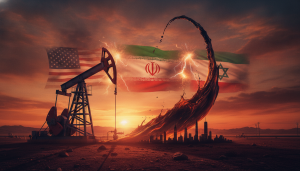
Global crude markets reacted sharply on Friday, witnessing significant price declines following a pivotal announcement from former President Donald Trump regarding potential developments with Iran. This pronouncement injected fresh uncertainty into an already volatile energy landscape, sending key benchmarks tumbling as investors weighed the implications of a possible diplomatic breakthrough that could unlock Iranian oil supply.
By late morning Eastern Time, the financial fallout was evident across trading screens. The U.S. benchmark, West Texas Intermediate (WTI) crude, experienced a fall exceeding 2%, settling at $86.73 per barrel. Concurrently, international bellwether Brent crude also saw its value diminish by more than 2%, trading at $91.61 per barrel. These price movements underscore the market’s hypersensitivity to geopolitical shifts, particularly those involving major oil-producing nations and critical transit routes.
The immediate catalyst for this market retreat was Trump’s social media post, declaring his imminent participation in a Situation Room meeting at the White House. His statement, “I will be meeting now, in the Situation Room, to make a final determination,” signaled an impending decision on a potential agreement with Tehran, igniting speculation that fresh Iranian crude could soon enter global markets. Such an outcome carries profound implications for supply-demand balances and could significantly depress oil prices further.
This latest downturn contributes to a broader trend observed throughout the current month, during which crude prices have collectively shed over 17% of their value. Much of this sustained decline has been fueled by persistent market anticipation and investor optimism surrounding a potential rapprochement between the U.S. and Iran. The hope is that a diplomatic resolution could lead to the lifting of sanctions, thereby unleashing millions of barrels of Iranian crude onto a market already grappling with demand concerns and fluctuating production quotas from OPEC+ members.
Stark Demands: Trump’s Conditions for a Deal
However, the path to any agreement appears fraught with significant hurdles, as Trump outlined a series of stringent demands on Friday that Iran has historically resisted. These conditions represent formidable obstacles, likely complicating swift progress towards a comprehensive deal and tempering investor exuberance regarding immediate supply increases.
Foremost among these demands is an unequivocal commitment from Tehran that it will “never have a nuclear weapon.” This central non-proliferation condition remains a cornerstone of international security concerns and a significant sticking point in previous negotiations. For investors, the credibility and verifiability of such a commitment are crucial, as a nuclear-armed Iran presents an elevated geopolitical risk profile that could trigger further instability in the Middle East.
Furthermore, Trump insisted on the immediate and unrestricted opening of the Strait of Hormuz. This vital maritime choke point, through which approximately one-fifth of the world’s total oil consumption transits daily, must allow free passage in both directions without the imposition of tolls, according to the former president. The consistent threat of disruption or closure in the Strait of Hormuz has historically underpinned a significant geopolitical risk premium in crude prices. An assurance of unrestricted passage would theoretically reduce this premium, impacting futures contracts and shipping costs.
Adding to the maritime security demands, Trump also called for Iran to remove “any remaining mines in Hormuz.” The presence of naval mines poses a direct threat to commercial shipping, raising insurance costs and creating a hazardous environment for tanker traffic. A commitment to clearing these obstacles would be a significant step towards de-escalation and securing the free flow of global energy supplies through this strategic waterway.
Finally, a highly contentious demand involves Iran agreeing to permit the U.S. to “unearth and destroy their enriched uranium,” which Trump stated is currently “buried under rubble from U.S. and Israeli attacks last year.” This specific and intrusive condition targets the heart of Iran’s nuclear program and its alleged clandestine activities. Such a demand would likely be viewed by Tehran as a severe infringement on its national sovereignty and a direct challenge to its nuclear ambitions, making it particularly difficult to secure agreement.
Whispers of a 60-Day MOU: A Glimmer of Progress?
Despite the tough rhetoric and seemingly intractable demands, there were earlier reports suggesting a degree of diplomatic momentum. On Thursday, sources within U.S. official circles indicated that negotiators had successfully formulated a 60-day Memorandum of Understanding (MOU). This preliminary agreement aims to extend the current ceasefire and initiate substantive discussions surrounding Iran’s contentious nuclear program.
The reported MOU offers a slender thread of hope for de-escalation, potentially paving the way for more comprehensive talks. However, the critical caveat remains: Trump’s personal approval is still required for the MOU to take effect. The initial report of this potential interim deal first emerged from Axios, providing a brief moment of optimism before Trump’s more recent, hardline public statements.
For energy investors, the confluence of these developments paints a complex picture. On one hand, the prospect of a deal, even a temporary one, creates downward pressure on oil prices by hinting at increased supply. On the other, the starkness of Trump’s demands suggests that any lasting agreement is far from guaranteed, retaining a significant geopolitical risk premium in the market. Traders will continue to monitor every statement and diplomatic maneuver, recognizing that the fate of Iranian crude supply, and by extension, global oil prices, hinges on these delicate and high-stakes negotiations.