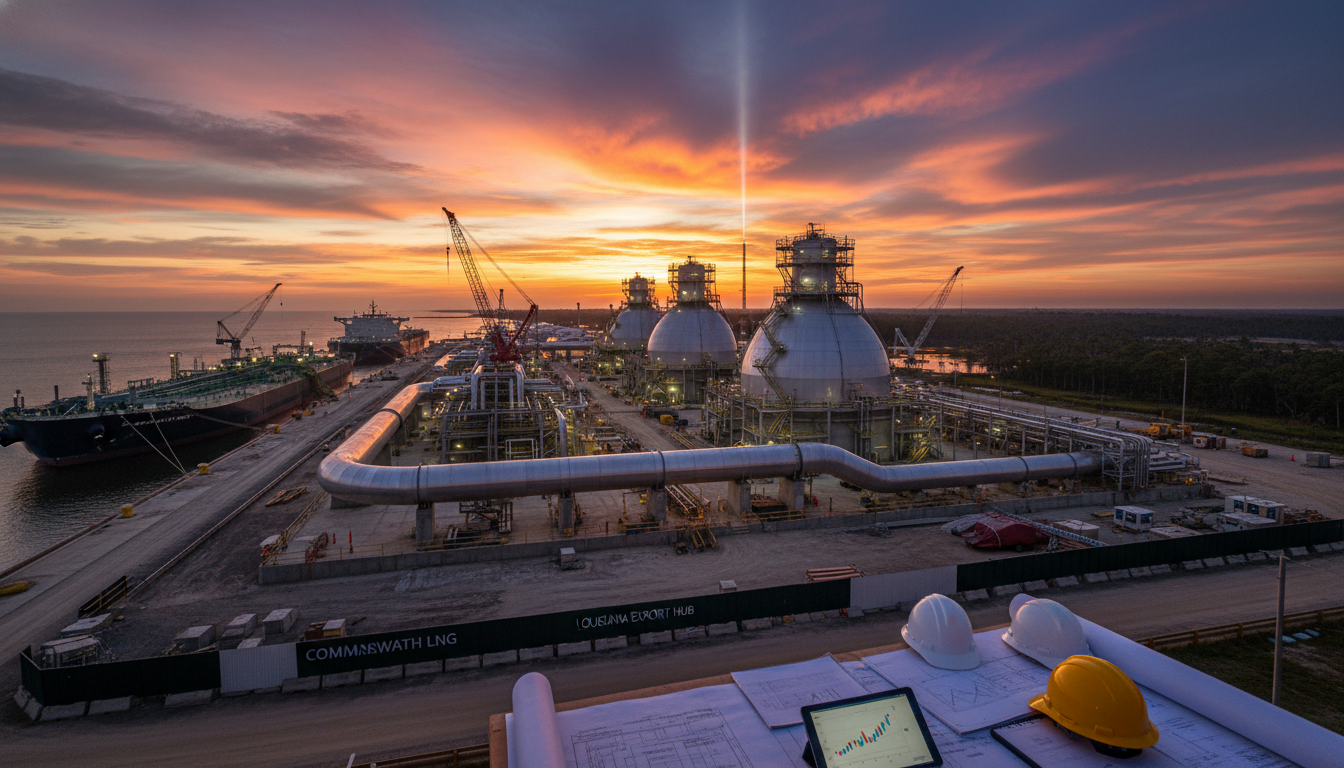
Major U.S. LNG Export Project Gets Green Light Amidst Surging Global Demand
The U.S. liquefied natural gas (LNG) export landscape just received a significant boost with the final investment decision (FID) to construct the Commonwealth LNG plant in Louisiana. This monumental $13-billion project underscores growing confidence in the long-term demand for natural gas, particularly as geopolitical shifts redefine global energy supply chains. Key financial backing for this ambitious undertaking comes from an consortium of prominent investors, including Kimmeridge, Abu Dhabi-based Mubadala Energy, and the Canada Pension Plan Investment Board (CPP Investments), signaling robust institutional conviction in America’s burgeoning role as a leading energy exporter.
Positioned on the west bank of the Calcasieu Ship Channel in Cameron Parish, Louisiana, the Commonwealth LNG facility is engineered to deliver an impressive annual capacity of 9.5 million tons of liquefied natural gas. Project developers anticipate the plant will commence operations in 2030, a timeline that places it strategically to meet forecasted global energy deficits. Upon reaching full operational status, the initial phase of this export hub is projected to generate over $3 billion in annual export revenue, creating substantial economic impact and reinforcing the U.S. Gulf Coast’s dominance in energy infrastructure.
Capital Mobilization and Investor Confidence Propel Construction Forward
The FID for Commonwealth LNG signifies a critical inflection point, not merely a regulatory approval, but a definitive green light for full-scale construction. This decision follows the successful closure of $9.75 billion in project financing, a testament to the project’s compelling economics and strategic importance. The transaction attracted overwhelming interest from both equity and debt providers, culminating in total commitments reaching an impressive $21.25 billion. This robust oversubscription underscores the significant market appetite for well-structured, large-scale energy infrastructure projects, particularly those positioned for global export.
The strategic involvement of institutional heavyweights like Kimmeridge, Mubadala Energy, and CPP Investments extends beyond initial funding. These entities are not only providing fresh capital for Commonwealth LNG’s development but are also maintaining their roles as integral equity investors in the broader Caturus platform. Mubadala Energy, notably, reinforces its commitment with a 24.1% equity stake in Caturus, which strategically encompasses both the Commonwealth LNG facility and its associated upstream natural gas operations. This integrated approach, linking gas production with liquefaction and export, is designed to optimize efficiency and capture value across the entire LNG supply chain, enhancing the project’s appeal to long-term investors.
Caturus’s Integrated Strategy and Accelerating Global Gas Demand
David Lawler, CEO of Caturus, articulated the platform’s strategic vision, stating, “Global gas demand is unquestionably accelerating, and Caturus is positioned to be a differentiated leader across the value chain from upstream production to LNG export.” This perspective highlights the company’s intent to leverage a vertically integrated model, ensuring a stable, cost-effective supply of natural gas directly to the liquefaction facility. Such integration offers substantial advantages, including enhanced operational control, reduced exposure to third-party pipeline bottlenecks, and potentially higher margin capture, factors highly attractive to sophisticated energy investors.
The development of Commonwealth LNG arrives at a particularly opportune moment in the global energy market. Recent geopolitical developments, notably escalating conflicts in the Middle East, have dramatically reshaped international LNG supply-demand dynamics. Contrary to earlier, more conservative forecasts, market analysts now project a significant tightening of global LNG supplies in the 2026 and 2027 timeframe. This revised outlook stems from several critical disruptions, including curtailed production from key exporters such as Qatar and the United Arab Emirates.
Geopolitical Headwinds Reshape LNG Market Outlook
A primary driver of this anticipated market tightness is the severe impact on Qatar’s critical Ras Laffan LNG complex. Reports indicate that the facility sustained damage from alleged Iranian missile attacks in March, with Qatar itself suggesting repairs could necessitate a recovery period of up to five years. This potential prolonged outage from one of the world’s largest LNG producers represents a substantial blow to global supply stability, creating an urgent imperative for new, reliable sources of liquefied natural gas. Against this backdrop, U.S. export projects like Commonwealth LNG gain amplified strategic significance, offering diversified and secure energy supplies to a volatile global market.
For investors monitoring the energy sector, the Commonwealth LNG project represents a compelling opportunity. Its substantial capacity, strong financial backing from institutional leaders, and an integrated value chain approach position it as a robust player in the rapidly evolving global gas market. The current geopolitical climate, marked by supply disruptions and heightened energy security concerns, further solidifies the economic rationale for U.S. LNG exports. As nations worldwide seek to diversify their energy portfolios and secure reliable natural gas supplies, projects like Commonwealth LNG stand ready to meet this escalating demand, promising long-term revenue generation and strategic value for its stakeholders.


