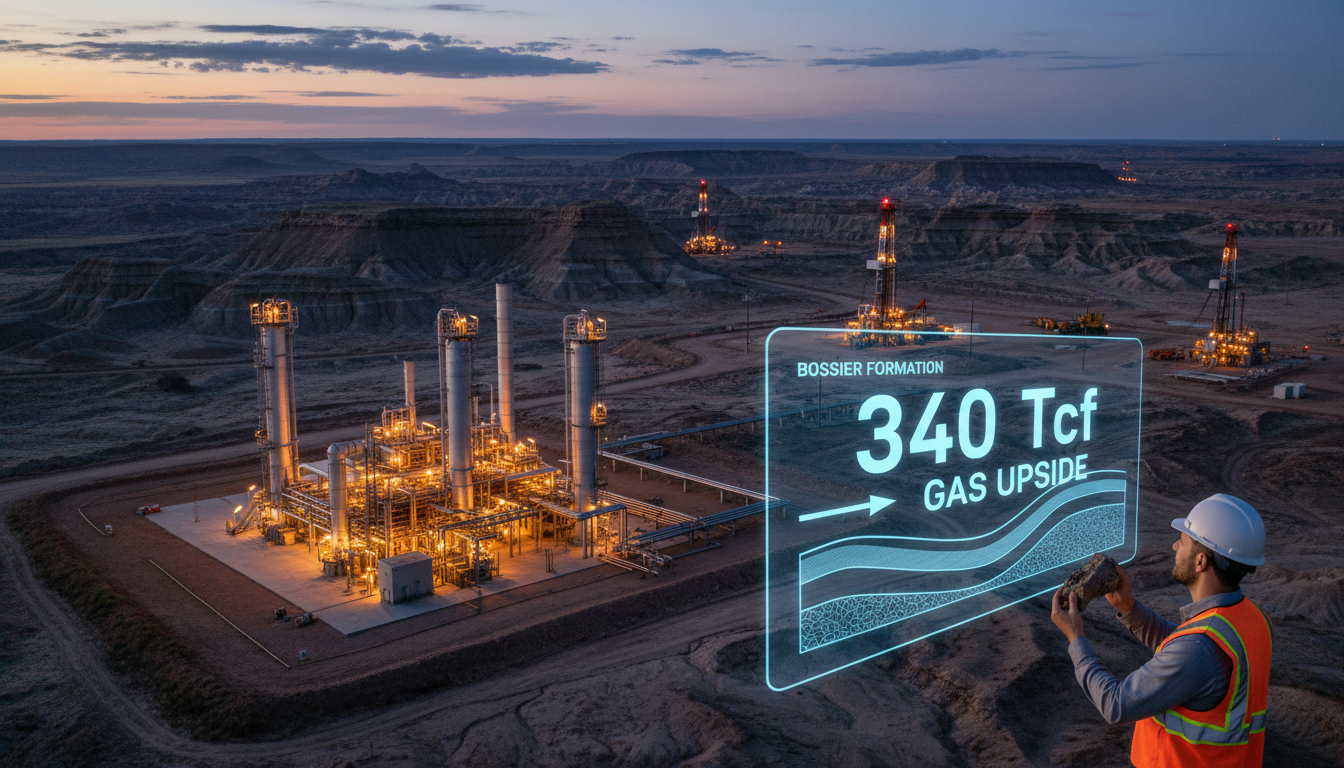
The U.S. Gulf Coast region is once again at the forefront of the nation’s energy outlook, with a new assessment from the U.S. Geological Survey (USGS) revealing immense, technically recoverable resources within the Bossier Formation. This latest report highlights an astounding 343.5 trillion cubic feet (Tcf) of natural gas and three million barrels of oil, a discovery poised to significantly bolster the country’s energy independence and present compelling opportunities for investors in the upstream sector.
To put these figures into perspective, the newly identified gas reserves alone could satisfy U.S. natural gas demand for over a decade at current consumption rates. This substantial potential builds on the Bossier Formation’s already impressive production history, which has yielded 3.8 Tcf of gas since operations began—a volume equivalent to nearly six weeks of projected U.S. consumption at the record-high levels anticipated for 2025. Such findings underscore the enduring productivity and future potential of the Gulf Coast as a cornerstone of American energy supply.
Understanding the Bossier Formation’s Deep Potential
The USGS defines the Bossier Formation as an integral component of the Upper Jurassic Cretaceous-Tertiary Composite Total Petroleum System, spanning a vast subsurface area across Texas, Arkansas, Louisiana, Mississippi, Alabama, and Florida. Gas within the organic-rich shales of the Bossier is primarily self-sourced, though it also receives contributions from the underlying Smackover and Haynesville Formations, indicating a complex and highly prospective geological structure.
This updated assessment follows a period of aggressive exploration drilling by industry players, which brought to light deep, highly over-pressured shale formations. These discoveries necessitated a fresh evaluation by the USGS, leading to the identification of new plays such as the Bossier Western Shale Gas Assessment Unit, frequently referenced by industry as “Western Haynesville” or “Waynesville.” These emerging plays demonstrate that tapping into deeper, higher-pressure reservoirs can unlock significantly more resources than previously estimated, offering a lucrative frontier for exploration and production companies.
USGS Director Ned Mamula emphasized the critical role of these assessments, stating, “The U.S. economy and our way of life depend on energy, and USGS oil and gas assessments point to resources that industry hasn’t discovered yet.” He added, “In this case, we have assessed there are significant undiscovered resources in the Bossier Formation.” For investors, this reaffirms the long-term viability and growth potential within domestic unconventional resource plays, particularly those in geologically proven basins.
The Gulf Coast: A Pillar of U.S. Energy Security
The Gulf Coast’s legacy as a prolific energy basin remains unchallenged, and the Bossier Formation extends this narrative to greater depths. Operators are extracting these organic-rich shales from up to 18,000 feet below the surface, positioning them as some of the deepest-producing resources in the region. The technical expertise and capital investment required for such deep unconventional development highlight the sophisticated capabilities within the U.S. energy sector and the potential for technological innovation to drive future resource expansion.
The latest Bossier assessment echoes previous significant findings from the USGS. Earlier in the year, the agency released an evaluation of the Permian Basin’s Woodford and Barnett shales, identifying technically recoverable resources totaling 28.3 Tcf of gas and 1.6 billion barrels of oil. Since their inception in the late 1990s, the Woodford and Barnett shales have produced 26 million barrels of oil, equivalent to one day’s U.S. consumption. Like the Bossier, these Permian shales are found at considerable depths, up to 20,000 feet below the surface.
The ability to access these challenging formations, such as the Woodford and Barnett, is a direct result of advancements in unconventional production techniques, specifically hydraulic fracturing and horizontal drilling. These innovations have revolutionized the energy landscape, transforming previously inaccessible and technically complex resources into economically viable assets, thereby expanding the investment horizon for energy companies.
A Mandate for Future Energy Insights
The foundation of USGS oil and gas assessments traces back 50 years to the wake of an oil embargo against the U.S. This historical event underscored the urgent need to thoroughly understand the occurrence, distribution, and potential volumes of the nation’s undiscovered resources. This mandate continues to drive the USGS’s mission today, focusing on identifying new domestic production resources and evaluating international reserves that influence global market conditions. For investors, these comprehensive assessments provide vital intelligence for strategic planning and risk evaluation in the dynamic energy sector.
Further reinforcing the Gulf Coast’s importance, a prior statement from USGS Director Mamula in late 2023 highlighted “significant” undiscovered resources within the region’s broader Haynesville Formation. A detailed fact sheet from December outlined estimated undiscovered, technically recoverable mean resources of 152 million barrels of oil and 47.9 Tcf of gas in Haynesville reservoirs within the onshore United States and State waters of the Gulf Coast Basin. These consistent findings across multiple formations in the Gulf Coast underscore the region’s unparalleled capacity to meet growing energy demand and generate substantial value for industry stakeholders and investors alike.


