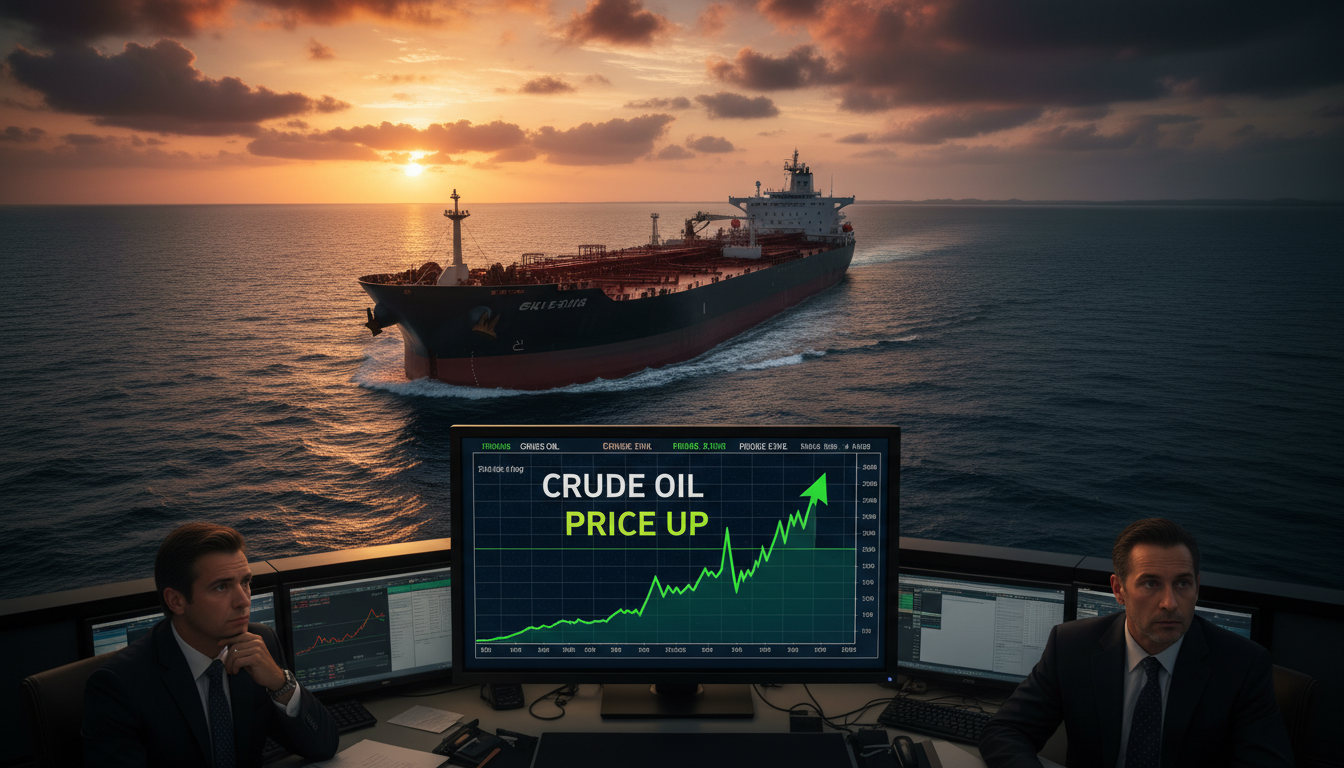
The global crude oil market finds itself at a critical inflection point, with July WTI and Brent futures reflecting the heightened geopolitical tensions and razor-thin supply buffers. Investors are now keenly observing key price thresholds, recognizing that the fundamental landscape has shifted dramatically, pushing the commodity into a high-risk, high-reward trading environment. For July WTI crude oil futures, a decisive move above the $100.00 mark will strongly signal sustained bullish momentum. Conversely, a retreat below $94.96 indicates a bearish sentiment taking hold. Meanwhile, July Brent crude oil futures traders should watch for buying conviction on a sustained push past $107.93, while a drop below $105.67 would signify increasing selling pressure.
Geopolitical Rhetoric Ignites Market Volatility
The delicate balance of geopolitical forces recently tipped, fundamentally altering market sentiment around energy security. Following high-level discussions between the U.S. and China, there was a consensus on two crucial points: Iran must not acquire nuclear weapons, and the Strait of Hormuz must be fully reopened for international shipping. However, the subsequent commentary from the U.S. leader introduced a jarring shift. His explicit declaration that patience with Tehran was “running out” immediately resonated as a stern warning, not a diplomatic overture. This unvarnished statement acted as an instantaneous catalyst, causing the crude oil market to reprice risk premiums with startling speed. The cautious optimism that had accumulated over two days, stemming from initial reports of resumed Strait traffic, evaporated in a single press appearance. While the energy sector has a history of reacting swiftly to headlines, Thursday’s abrupt transition from relative calm to a robust 3.7% surge in prices underscores just how fragile the underlying “peace trade” truly was.
The Strait of Hormuz: A Bottleneck of Leverage, Not Freedom
Analyzing the actual flow of maritime traffic through the Strait of Hormuz paints a stark picture, contradicting any notion of a full return to normalcy. While Iranian state media initially reported approximately thirty vessel crossings within a roughly 24-hour period, independent shipping analytics presented a much more conservative figure: only ten ships transited during the latest 24-hour window. The historical context here is critical; prior to the recent escalations, the Strait typically facilitated the passage of around 140 ships daily. The disparity is not just mathematical; it’s existential for global energy supply. Ten vessels simply does not equate to 140. What was briefly misinterpreted by some traders as a sign of normalization is now being correctly re-evaluated as Tehran’s strategic control over who gains passage and who does not. This is not a freely reopened international shipping lane; it is a clear demonstration of leverage, and the oil market is rapidly adjusting its valuations to reflect this critical difference between open access and controlled passage.
Global Inventories Offer No Comfort Zone
The latest Energy Information Administration (EIA) data has served as a sobering reminder of the global oil market’s diminishing resilience. This past week saw a larger-than-anticipated draw in U.S. crude oil stockpiles. Specifically, the critical Cushing hub experienced a sharp decline in its inventory levels, indicating reduced storage buffers. Gasoline inventories also registered a notable fall, as market participants increasingly shied away from Gulf supply routes due to ongoing uncertainties. Despite healthy domestic U.S. production levels, robust export demand prevented any meaningful recovery in domestic stockpiles. Furthermore, U.S. refiners have been operating at exceptionally elevated utilization rates, striving to meet the seasonal surge in summer fuel demand. Each weekly inventory report reinforces the same unsettling conclusion: the global oil market possesses virtually no spare capacity. Every day the Strait of Hormuz remains under restricted passage strips away another layer of what little buffer still exists, leaving the market increasingly vulnerable to supply shocks.
Two Agencies, One Looming Crisis
The world’s leading energy agencies, while approaching the current crisis from different angles, are converging on a singular, concerning outlook for the oil market. The International Energy Agency (IEA) has explicitly quantified the risk, warning of impending supply deficits should disruptions in the Persian Gulf persist. The IEA highlights that global inventories, which have been steadily depleting for months, simply lack the capacity to absorb further losses, especially as peak summer demand places additional strain on the system. Conversely, the Organization of the Petroleum Exporting Countries (OPEC) has adjusted its demand growth forecasts downwards. Their analysis suggests that the current environment of $100+ oil prices is beginning to inflict tangible pain on consumers and businesses globally, potentially throttling economic activity. Crucially, OPEC acknowledges that production increases from its member countries are not materializing at a pace sufficient to bridge the supply gap created by the Strait of Hormuz situation. Thus, one agency signals alarm over dwindling supply, while the other expresses concern over potential demand destruction. Both these critical problems are unfolding simultaneously, creating an exceptionally complex and volatile environment that July WTI crude oil futures are now pricing in.
Navigating the Key Price Levels Amidst Uncertainty
For astute investors, the $100.00 level for July WTI crude oil represents the immediate and most significant trade indicator. A confident breach and sustained hold above this psychological and technical threshold would unlock further upside potential, with $103.78 emerging as the next resistance target, followed by a more ambitious aim towards $110.93. Should WTI futures fail to gather momentum and instead stall or retreat from the $100.00 mark, attention will quickly pivot to the critical 50% retracement level at $94.96 as the next downside test. On the Brent side, July futures face an equivalent pivotal moment at $107.93. A decisive move beyond this resistance point would bring the May 4 high of $115.24 back into play, signifying a strong resurgence of bullish sentiment. Ultimately, the fundamental catalyst that initiated Friday’s significant market shift, a reflection of heightened geopolitical risk, remains the U.S. leader’s stark declaration regarding patience with Tehran. Investors must remain vigilant, as the interplay of geopolitical rhetoric, physical supply constraints, and inventory fragility will continue to dictate price action in this highly sensitive market.


