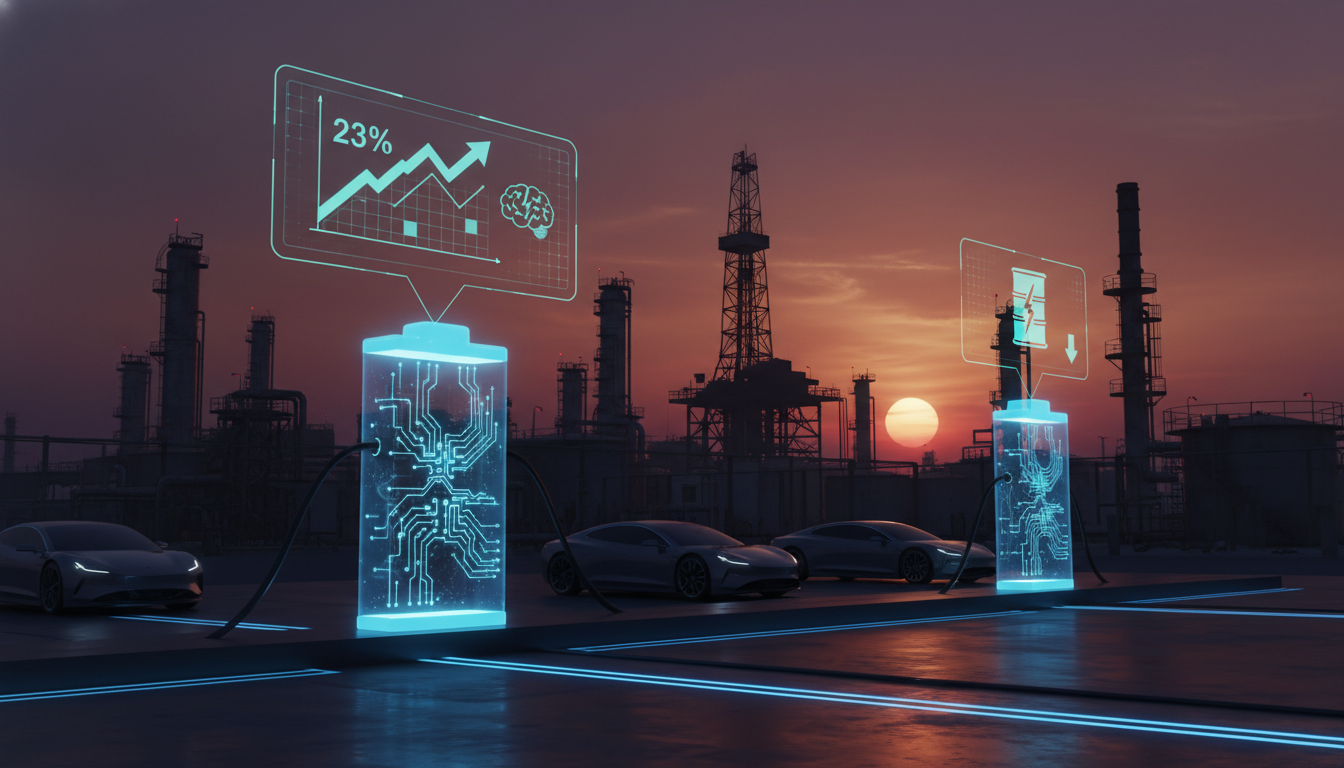
The global energy landscape continues its dramatic shift, and recent breakthroughs in electric vehicle (EV) battery technology warrant close attention from oil and gas investors. A pioneering development from Sweden’s Chalmers University of Technology in Gothenburg introduces an artificial intelligence (AI) methodology designed to optimize the fast charging of electric vehicle batteries. This innovation promises to extend battery longevity by an impressive 23 percent without compromising charging speed, a critical factor for wider EV adoption and, consequently, a significant variable in future oil demand projections.
For investors monitoring the energy transition, understanding the trajectory of EV market penetration is paramount. While numerous studies suggest EV battery wear over the initial 100,000 kilometers is often less severe than previously estimated, the inherent degradation of traction batteries remains an unavoidable reality. The ‘State of Health’ (SoH) inevitably declines with vehicle age and accumulated mileage, leading to a gradual reduction in usable capacity compared to original manufacturing specifications. This capacity loss represents a major hurdle for prospective buyers of both consumer and commercial electric vehicles, directly influencing resale values and overall consumer confidence.
Researchers at Chalmers University, keenly aware of these market dynamics, concentrated their efforts on DC fast charging. This method, while indispensable for long-distance travel and commercial fleet operations, is known to accelerate battery degradation more rapidly than conventional AC charging. As Professor Changfu Zou from Chalmers University’s Department of Electrical Engineering highlights, the availability of efficient fast charging is crucial for various sectors, from taxi fleets and heavy industrial vehicles to everyday passenger cars, enabling greater mobility and commuting flexibility.
AI Unleashes Extended Battery Lifespan for EVs
The groundbreaking study, co-authored by Professor Zou and Dr. Meng Yuan, formerly of Chalmers and now an Assistant Professor at Victoria University of Wellington in New Zealand, conclusively demonstrates how artificial intelligence can dramatically extend battery lifespan without imposing significant increases in charging duration. This AI-powered charging strategy delivers an approximate 23 percent improvement in battery longevity when compared to current standard procedures, all while maintaining virtually identical charging times. This represents a significant leap forward in addressing one of the primary concerns for EV ownership and a potential accelerant for the electrification trend.
For investors with stakes in the oil and gas sector, these technological advancements are not merely academic; they directly influence the long-term outlook for refined product demand. Fast charging, while convenient, inherently stresses battery cells by forcing high-current electricity through them, escalating the risk of detrimental chemical side reactions. A particularly insidious issue is ‘lithium plating,’ where metallic lithium deposits on the electrode rather than integrating properly into the battery’s structure. This phenomenon not only diminishes capacity but can also compromise safety, with uneven lithium distribution potentially leading to dangerous short circuits. Minimizing such degradation is key to extending battery life and making EVs a more compelling, durable investment for consumers and businesses.
Preventing Lithium Plating Through Intelligent Charging
A crucial insight from the research underscores the growing vulnerability of batteries over time. As Dr. Meng Yuan points out, “The risk of lithium plating increases with the age of the battery. However, the standard methods of charging today use the same current and voltage regardless of whether the battery is new or has been used for years.” This highlights a fundamental inefficiency in current charging protocols that the new AI method aims to rectify.
The innovative AI-based charging strategy leverages reinforcement learning, a machine learning paradigm where the system learns optimal actions through trial and error, reinforcing successful outcomes. The AI model underwent training to dynamically adapt the charging process based on the battery’s real-time state of charge (SoC) and, crucially, its overall State of Health (SoH). This holistic approach is vital for safeguarding both capacity and electrochemical performance throughout the battery’s lifecycle. The outcome is an intelligent charging regimen that not only curbs charging time but, more importantly for investors, significantly mitigates the harmful reactions that lead to premature battery degradation.
From an investment perspective, the practical implications are substantial. The researchers emphasize that this novel charging strategy offers a cost-effective and relatively straightforward implementation path. It could potentially be deployed through simple software updates to existing vehicle battery management systems (BMS). While widespread adoption would necessitate some adjustments across the industry, the low barrier to entry for implementation could accelerate its integration into the broader EV ecosystem. This ease of deployment suggests that the benefits of extended battery life could manifest relatively quickly across new and potentially even some existing EV fleets.
For oil and gas companies, this development represents another data point in the accelerating pace of the energy transition. Enhanced EV battery longevity directly impacts the total cost of ownership, making electric vehicles a more attractive and sustainable long-term investment for consumers and commercial enterprises. This, in turn, could drive a faster-than-anticipated shift away from internal combustion engine vehicles, influencing future forecasts for global oil demand and refined product consumption. Savvy investors in the traditional energy sector must integrate such technological advancements into their strategic planning, evaluating potential impacts on upstream investments, downstream margins, and opportunities for diversification within the evolving energy landscape. The race for energy dominance is increasingly being shaped not just by production, but by intelligence applied to its consumption.