Major Global Players Eyeing EV Battery Recycling: A New Frontier in Resource Security
The global energy landscape continues its rapid evolution, and astute investors in the oil and gas sector understand that staying ahead requires monitoring not just hydrocarbon markets, but also emerging adjacent and competitive energy technologies. A significant development demanding attention is the recent joint initiative between the European Union and India, pledging a substantial €15.2 million towards advanced electric vehicle (EV) battery recycling. This program signals a critical strategic shift, aiming to bolster mineral security and establish domestic supply chains for the burgeoning EV market – a movement with profound implications for future energy commodity dynamics and geopolitical resource allocation.
Strategic Investment in a “Virtual Mine”
This ambitious collaboration, spearheaded by the EU and India’s Joint Trade and Technology Council (TTC), focuses squarely on the crucial domain of green and clean energy technologies. The €15.2 million funding package is designed to attract a broad spectrum of innovators, from established corporations and agile small and medium-sized enterprises (SMEs) to dynamic startups, cutting-edge research institutions, and academic bodies across both regions. These entities are invited to submit proposals through a competitive tender process, with the deadline for applications set for September 15th. For investors, this represents a nascent but rapidly expanding sector ripe for innovation and potential capital allocation, indicating a clear governmental push for circular economy principles in high-tech manufacturing.
Financial backing for this initiative comes from two significant sources: the European Union’s Horizon Europe program and India’s Ministry of Heavy Industries (MHI). Their combined investment is poised to accelerate the development of sophisticated recycling technologies, including methods for high-efficiency material recovery, the creation of secure and digitally integrated collection systems, and the piloting of ground-breaking processing techniques. A central pillar of this funding is the establishment of a state-of-the-art pilot plant in India. This facility will serve as a crucial testbed, validating new technologies under real-world operational conditions and paving the way for their subsequent industrial-scale deployment. The TTC’s overarching objective is to forge a powerful alliance of leading minds and innovative enterprises from both the EU and India, focused on developing sustainable and scalable recycling solutions that promise global impact. This foresight into creating domestic supply capabilities reduces reliance on external sources, a critical lesson learned repeatedly in the oil and gas sector.
Technical Imperatives for Future Sustainability
The pilot plant’s design and operational priorities highlight several key technical areas crucial for investor evaluation. First, achieving a high yield is paramount, demanding advanced processes that can extract lithium and cathode-active materials (CAM) with exceptional purity. This directly impacts the economic viability and material quality of recycled products. Second, the ability to handle mixed chemical substances is critical, requiring flexible recycling methods adaptable to the diverse and evolving chemistries of current and future battery types. This forward-looking approach mitigates obsolescence risk for recycling infrastructure. Third, robust logistics & inclusion are central to the program, emphasizing digitalized collection and sorting systems that effectively integrate India’s informal sector. The goal here is to ensure safe, ethical, and risk-free material flow, an often-overlooked but vital component of any large-scale recycling operation. Finally, safety & second-life considerations are paramount, involving advanced diagnostics for identifying batteries suitable for second-life applications and implementing active safety monitoring throughout the recycling chain. These technical priorities underline a comprehensive approach to building a robust and secure supply chain, appealing to investors seeking long-term sustainable growth opportunities.
Securing Critical Minerals: A New Geopolitical Race
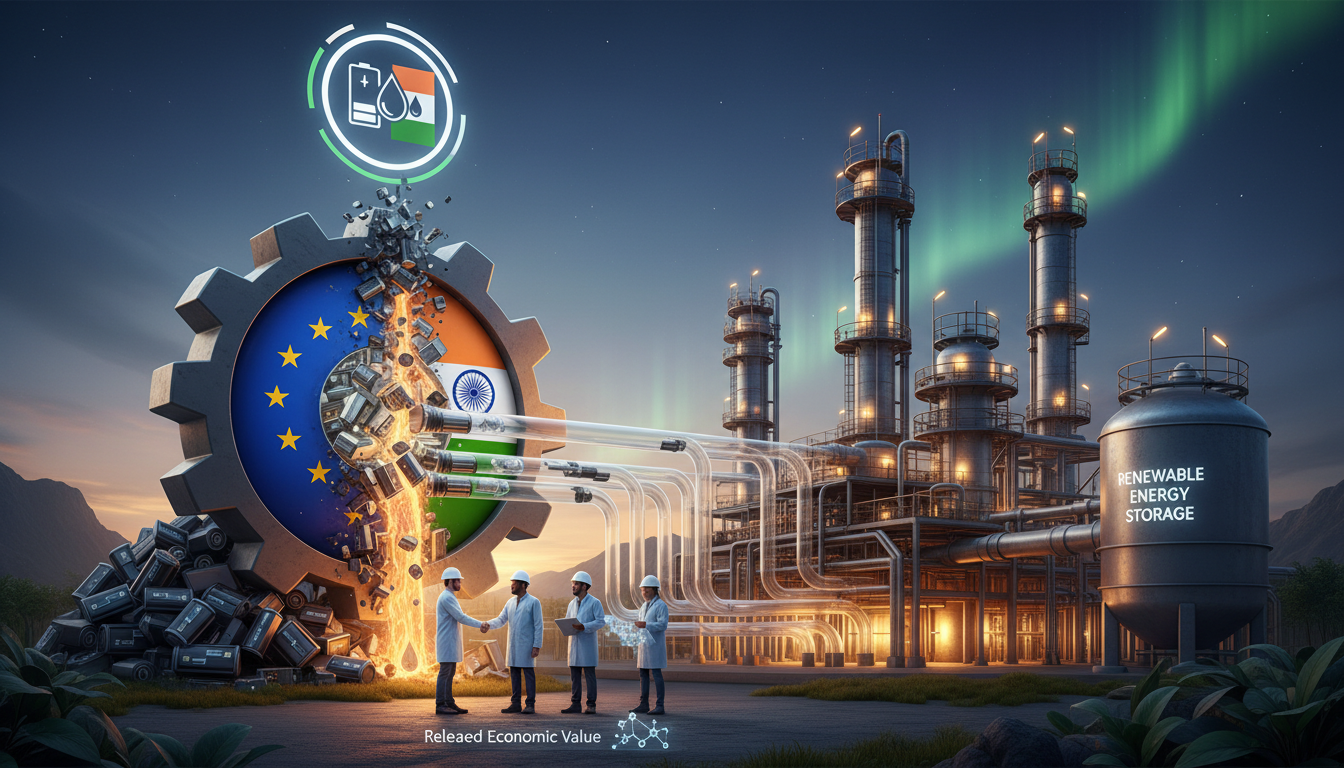
The impetus behind this joint venture is clear: rapidly escalating demand for electric vehicles has made the recovery of strategic raw materials an urgent global priority. Critical minerals like lithium, graphite, and cobalt are the bedrock of the EV revolution, and both the EU and India are proactively seeking to diminish their dependence on international imports, particularly from dominant players like China. This strategic collaboration is designed to transform battery waste, often viewed as a liability, into a potent “virtual mine.” The aim is to recover high-purity materials that can be directly re-integrated into the production cycle of new batteries, creating a closed-loop system. This mirrors the strategic importance of secure energy supplies for traditional oil and gas economies, illustrating a broader global push for energy and resource autonomy.
Hervé Delphin, the European Union Ambassador to India, underscored this sentiment, stating, “Batteries are at the heart of the green transition, and their components are simply too strategic to be discarded after a single use. By launching this joint call, we are uniting European and Indian expertise to tackle one of the most pressing challenges of our time. Our goal extends beyond mere development; we aim for real-world deployment—a direct investment in our mineral security and our collective climate objectives.” His comments resonate strongly with the oil and gas investment community, which has long understood the direct link between resource security and national economic stability.
Adding to this perspective, Dr. Parvinder Maini, Scientific Secretary in the Office of the Principal Scientific Adviser to the Government of India, emphasized the domestic impact: “This joint initiative represents a critical leap in India’s circular economy, establishing a cutting-edge pilot line designed to convert battery waste into a strategic resource. Through these endeavors, we are poised not only to secure a domestic supply of critical minerals but also to catalyze momentum for pioneering a digitalized, inclusive logistics model that responsibly integrates the informal sector while upholding the highest safety standards for second-life applications.” These statements highlight the dual benefit of economic opportunity and environmental responsibility, framing the recycling endeavor as a national strategic imperative.
Implications for the Broader Energy Investment Landscape
For investors focused on the oil and gas sector, these developments in EV battery recycling are not tangential. They represent a fundamental shift in how critical resources are valued, secured, and managed within the broader energy ecosystem. The establishment of “virtual mines” through advanced recycling directly impacts the long-term demand projections for virgin minerals, influencing commodity prices and geopolitical leverage. As nations strive for greater energy independence and reduce their reliance on foreign suppliers for critical components, the success of initiatives like the EU-India collaboration could reshape global supply chains, affecting everything from manufacturing strategies to international trade agreements.
Furthermore, the significant capital investment and policy support directed towards circular economy solutions for EVs signal a broader trend of resource optimization across the energy sector. While traditional energy investors continue to navigate the complexities of hydrocarbon markets, understanding the accelerating pace of innovation and investment in areas like battery recycling becomes crucial. These initiatives directly influence the speed and scale of the energy transition, impacting future energy demand scenarios for fossil fuels and presenting new avenues for investment diversification in the burgeoning green economy. Staying informed on these strategic mineral plays is no longer optional but essential for a holistic understanding of the evolving global energy and investment landscape.