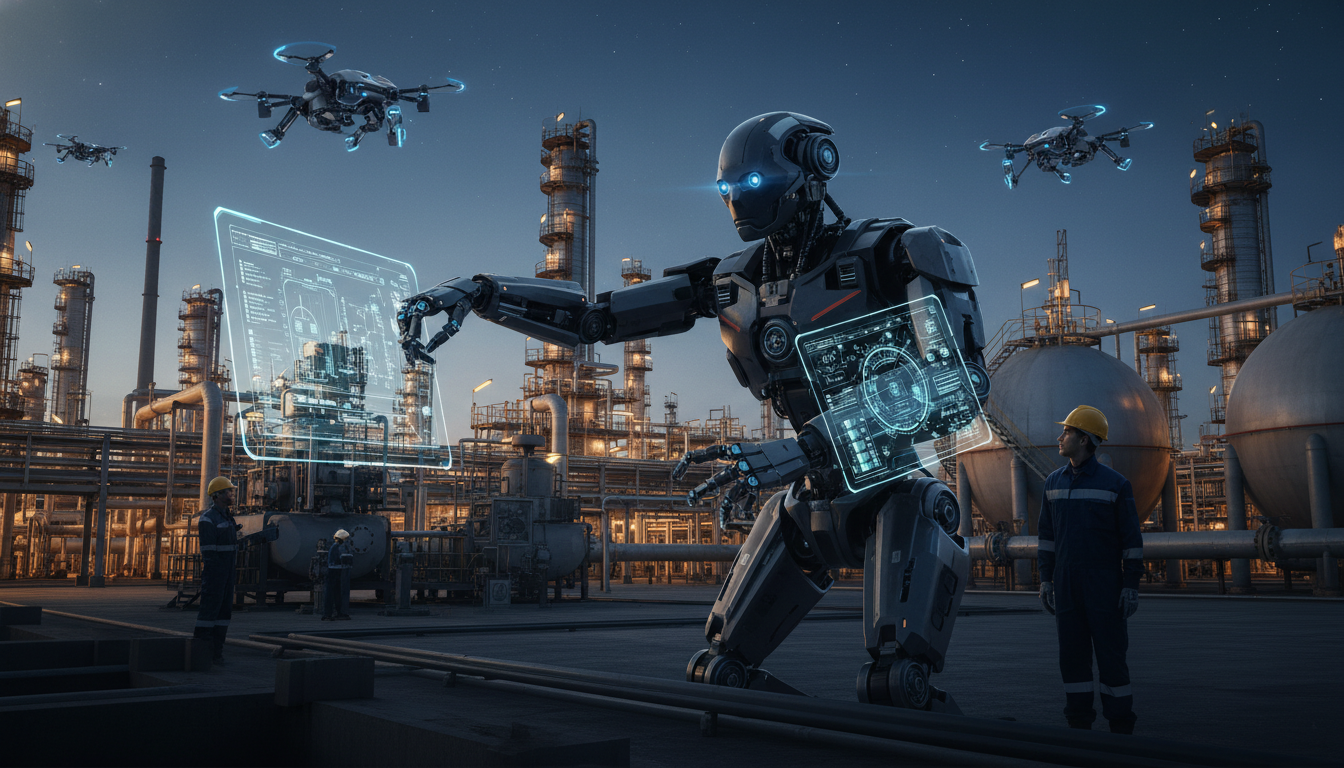
Robotics Redefines Operational Efficiency: A Deep Dive into Genesis AI’s Manipulation Breakthroughs for Oil & Gas Investors
The quest for truly dexterous and autonomous robotic manipulation stands as one of the most formidable challenges in advanced robotics. For investors keenly observing the oil and gas sector, the ability of machines to precisely grasp, move, disassemble, or assemble objects with human-like dexterity is not merely a technological marvel but a potential game-changer for operational efficiency, safety protocols, and labor cost optimization across the energy value chain. Against this backdrop, a startup attracting significant backing from venture capital firm Eclipse and former Google CEO Eric Schmidt, Genesis AI, has announced a substantial leap forward in addressing this critical hurdle.
Genesis AI Unveils Human-Level Dexterity in Robotics
Genesis AI, a French startup with a strategic research and development hub in Silicon Valley, recently revealed groundbreaking advancements in achieving what it describes as “human-level capability” in robotic manipulation. Through recorded demonstrations, the company showcased its robots performing remarkably intricate tasks, including fluidly playing a piano, delicately cracking an egg, and expertly harnessing electrical wires. These aren’t just proofs of concept; one video highlighted robotic hands effortlessly keeping pace with a piano composition moving at approximately 130 beats per minute, demonstrating impressive speed and coordination.
Crucially for industrial applications within the demanding oil and gas environment, these demonstrations were executed autonomously, meaning no human teleoperation was involved, and were shown at real-time, 1x speed. This level of independent operation signals a maturity that could unlock significant automation potential in hazardous or remote energy infrastructure settings, from complex valve operations to intricate equipment maintenance on offshore platforms or within refining facilities.
Training Methodologies and Performance Metrics for Industrial Deployment
While Genesis AI’s achievements are significant, CEO Zhou Xian candidly explained that the demonstrations were not examples of “zero-shot execution.” This means the robots still necessitate training for specific tasks, such as learning a particular musical piece. However, the efficiency of this training process is a key metric for investors considering future deployment. Xian reported that his team of approximately 60 individuals could teach a robot to perform a new song on the piano in a mere one hour.
For more complex scenarios, like the cooking demonstration involving cracking an egg or chopping a tomato, the training required what Xian termed “a few hundred trajectories” – essentially recorded examples of relevant movements. A 30-second “complex skill,” such as those seen in the cooking demo, reportedly demanded a few hours of human data, augmented by less than half an hour of data collected from the robot itself performing the task. From a performance standpoint, while most subtasks within the cooking demonstration achieved a success rate of roughly 90% to 95%, more challenging actions like one-handed egg cracking and transferring chopped tomato with a knife currently hover closer to 50% to 60% during filming. Despite these initial variations, Xian asserts that these robots are exhibiting about 60% to 70% of human speed, performing what he considers “probably the most complex tasks ever being performed by a robot in a very human-like way.” For oil and gas investors, these figures provide a tangible measure of current capabilities and the roadmap for scaling reliability in challenging industrial applications.
A Full-Stack Vision for General-Purpose Robotics in Energy
Genesis AI’s overarching ambition is to engineer a general-purpose robot capable of executing a wide array of tasks across vastly different environments. Unlike many firms that concentrate solely on AI models, Genesis AI is pursuing a holistic, full-stack development strategy. This encompasses the development of the core AI model, the proprietary robot hand, specialized training gloves, an in-house simulator, and ultimately, the complete robotic system itself. Zhou Xian envisions a future, potentially within the next decade, where the fundamental distinctions between a factory robot and a home robot effectively disappear.
“I think the beauty of being a full-stack company is when you design the hardware, you know exactly what’s needed,” Xian remarked. This integrated approach offers a distinct advantage for industries like oil and gas, where bespoke solutions and seamless hardware-software interaction are paramount. A truly versatile, general-purpose robot could revolutionize maintenance schedules, inspection regimes, and emergency response capabilities across the diverse asset portfolio of the energy sector, offering significant long-term operational flexibility and cost savings.
Innovation in Hardware and Data Collection for Industrial Adoption
A critical component of Genesis AI’s innovation lies in its highly advanced robot hand, meticulously designed to closely resemble human form and function. Xian detailed that the startup’s robot hand boasts an impressive 20 degrees of freedom and integrates 20 motors directly within the hand structure. This direct-drive mechanism represents a departure from more common tendon-driven hands, where motors are typically housed in the forearm and connected to fingers via cables. The direct integration promises enhanced precision, strength, and responsiveness, crucial for manipulating heavy or delicate components in the energy industry.
Beyond hardware, Genesis AI’s data acquisition strategy is equally cutting-edge. Instead of solely relying on video data or teleoperation, the company leverages a rich blend of internet data and proprietary raw human data. This human data is collected through specialized training gloves that capture not only intricate hand motions but also vital tactile and force-like signals. This multi-modal data approach creates a significantly more comprehensive and nuanced dataset for AI training. Looking ahead, Xian confirmed that Genesis AI is actively engaging with several industrial partners, exploring opportunities for their employees to wear these training gloves during their work, thereby collecting invaluable real-world operational data. This, combined with an in-house simulator used to rapidly test models trained on real-world data across numerous virtual environments, allows the company to evaluate and refine its systems far more efficiently than relying solely on physical robot tests. For oil and gas investors, this robust and scalable development pipeline de-risks future deployments and accelerates the path to tangible returns on automation investments.
The Investment Horizon: A Critical Step Towards Autonomous Energy Operations
While CEO Zhou Xian maintains a pragmatic perspective, refraining from the bold claim that robot manipulation has been entirely “solved,” he firmly positions Genesis AI’s pioneering approach as a “critical step” in elevating robot manipulation capabilities to an unprecedented level. “We’re indeed an ambitious company,” Xian stated, “and we’re just not happy with the status quo, and we want to push the field forward.”
For astute investors in the oil and gas sector, Genesis AI’s breakthroughs represent more than just technological novelties. They signify a tangible progression towards a future where intelligent robotics and automation can significantly enhance operational safety, mitigate labor challenges, and unlock new levels of efficiency in everything from complex maintenance and inspection tasks on remote rigs to precision operations in refineries. The capacity for robots to perform highly dexterous, human-like tasks autonomously, even with initial training requirements, presents a compelling investment thesis for those looking to capitalize on the profound transformation intelligent automation will bring to global energy production and infrastructure.


