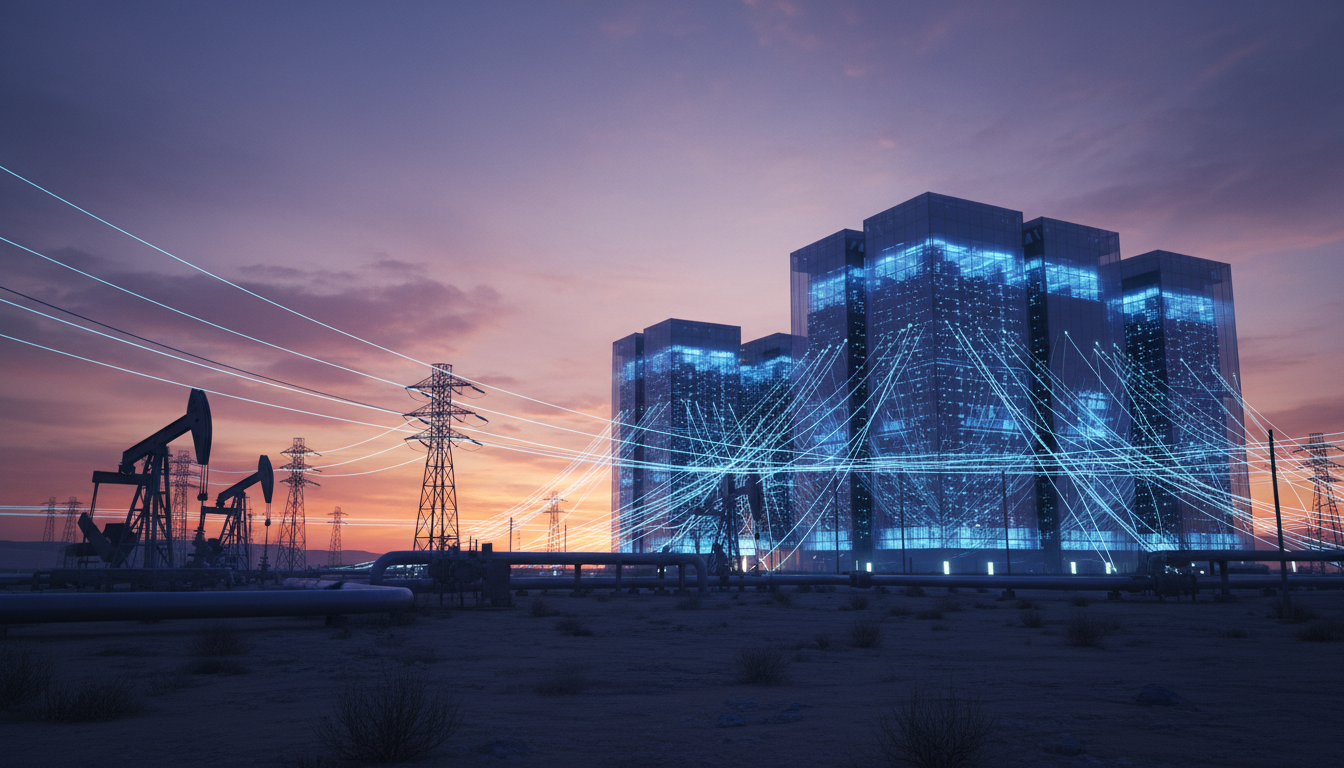
The Digital Powerhouse: Navigating Data Center Energy Dynamics for Oil & Gas Investors
The rise of data centers represents one of the most transformative energy demand trends in the United States today. Far from being a niche consumer, these digital infrastructure hubs are rapidly becoming primary drivers of electricity demand, compelling significant capital deployment across power generation, transmission networks, cooling solutions, carbon management technologies, and fuel supply chains. For investors in the oil and gas sector, understanding this evolution is not merely an academic exercise; it presents a substantial opportunity to re-evaluate energy portfolios and identify strategic growth areas.
Often, public discourse surrounding data centers oversimplifies their impact, pitting economic necessity against environmental concerns. This binary framing, however, overlooks the sophisticated reality. The true challenge and opportunity lie in the execution: how these massive facilities are strategically planned, powered, efficiently cooled, and seamlessly integrated into existing regional energy systems. This is not a question of technological capability, but rather a complex systems and coordination puzzle—one that the robust U.S. energy sector is exceptionally well-equipped to solve.
Why Data Centers Demand Investor Attention in Energy Markets
Data centers have cemented their status as essential infrastructure, underpinning critical facets of modern society and the global economy. Their foundational role extends to:
- Powering the advancements in artificial intelligence and machine learning.
- Enabling the vast networks of cloud computing and cybersecurity defenses.
- Facilitating secure financial clearing and payment systems.
- Storing and processing vital healthcare data and diagnostics.
- Driving efficiency in industrial automation and complex logistics.
- Bolstering national security and defense operations.
The demand growth from these applications is not merely cyclical; it is structural and appears relentless. Artificial intelligence workloads, in particular, are dramatically reshaping long-term electricity load forecasts nationwide, forcing utilities, developers, and regulators to accelerate planning timelines previously designed for a much slower pace of demand expansion. From an energy market perspective, data centers present an unusually attractive customer profile for capital providers and energy producers alike. They are characterized by large, creditworthy consumption patterns and long-duration operational lifecycles. Furthermore, their 24/7 baseload demand, willingness to contract for firm capacity, and openness to innovative on-site or behind-the-meter energy solutions make them ideal anchor tenants for new infrastructure investments. When planned effectively, these facilities can de-risk substantial energy projects.
Addressing Key Concerns: Energy, Water, and Rate Structures
Investor scrutiny rightly highlights some legitimate concerns surrounding data center development. Hyperscale facilities can demand hundreds of megawatts (MW) per campus, placing significant strain on existing generation and transmission infrastructure if growth proceeds without adequate coordination. In regions already facing capacity constraints, this has, at times, led to increased congestion costs and considerable political opposition. Moreover, traditional evaporative cooling systems, a common technology in these facilities, can consume millions of gallons of water annually. In water-stressed or drought-prone areas, such consumption naturally becomes a contentious issue.
Additionally, poorly structured utility tariffs and incentive packages in some jurisdictions have inadvertently shifted the costs of necessary grid upgrades onto residential and small commercial customers. These risks, while genuine, are not inherent flaws in data centers themselves. Instead, they stem from suboptimal sequencing of development and inadequately designed contractual agreements between data center operators and energy providers. Addressing these systemic issues through proactive planning and robust governance is key to unlocking the full potential of data center growth.
Strategic Planning: Lessons from Mississippi and Wyoming
The experiences of states like Mississippi and Wyoming offer compelling counter-examples, showcasing how proactive planning can transform potential challenges into mutual benefits. Ahead of significant data center commitments, utilities and regulators in these states collaborated to align on several critical fronts:
- Implementing comprehensive, long-term load forecasting models.
- Mandating dedicated interconnection funding provided directly by developers.
- Ensuring new, highly efficient power generation capacity came online *ahead* of demand.
- Designing innovative rate structures explicitly crafted to prevent cross-subsidization of costs.
Entergy Mississippi, for instance, has demonstrated through both regulatory filings and independent analysis that integrating large data center loads has not only avoided retail rate spikes but has, in some instances, helped stabilize rates by spreading fixed grid costs across a larger sales base. This favorable outcome was not accidental; it was the direct result of deliberate and effective governance.
Cooling Solutions Evolve: Minimizing Water Footprints
A persistent misconception holding back data center development is the belief that large facilities must consume vast quantities of water. This is simply no longer the case, thanks to advancements in cooling technology.
Lithium Bromide Absorption Cooling: A Proven Alternative
Commercial-scale lithium bromide (LiBr) absorption chillers are already widely deployed in industrial and mission-critical facilities, proving their reliability and efficiency. These advanced systems operate by using water as the refrigerant and lithium bromide as the absorbent. Critically, they are driven primarily by thermal energy, rather than high-demand electric compressors. This thermal-driven process allows for deployment in air-cooled or closed-loop configurations, which dramatically reduces or even eliminates the need for evaporative water use. Furthermore, absorption systems contribute to grid stability by lowering peak electrical demand compared to traditional mechanical chilling methods. When integrated with on-site generation or waste heat recovery, these systems offer both superior energy efficiency and significant water minimization. This technology is not experimental; it is mature, bankable, and represents a compelling, yet underutilized, solution for data center developers and energy investors.
Achieving Firm Power with Carbon Management
The environmental concern regarding carbon emissions from power generation for data centers is also rapidly being addressed with innovative solutions. The debate often lags behind the practical realities of carbon capture and storage (CCS) technology.
The Reality of Carbon Capture and Storage (CCS)
Carbon capture and storage is far from a theoretical concept. In the U.S. alone, 15 commercial-scale CCS facilities are currently operational, with over 120 additional projects under construction or in advanced stages of development. These sophisticated systems efficiently capture CO₂ at its source, compress it, transport it, and then permanently store it in deep, regulated geologic formations. The storage process adheres to stringent EPA Class VI standards, which include long-term monitoring requirements to ensure containment integrity. Historically, these systems have been successfully applied in natural gas processing, ethanol production, fertilizer manufacturing, and various other industrial operations. Crucially, their application is now being increasingly evaluated and deployed for power generation facilities, offering a pathway to decarbonized firm power.
Towards a Closed-Loop Energy Architecture for Digital Infrastructure
When strategically integrated, data center infrastructure can operate within an innovative closed-loop energy ecosystem, offering a highly sustainable and financially attractive model:
- Firm, reliable generation provides consistent electricity supply.
- Waste heat generated from operations is efficiently recovered and repurposed for absorption cooling.
- CO₂ emissions are captured directly at the source, preventing their release.
- The captured carbon is securely stored in regulated geologic repositories.
- Continuous monitoring verifies the long-term containment of stored CO₂.
This integrated approach is not merely about offsetting emissions; it represents direct, physical carbon management. Large, steady data center loads are uniquely positioned to bolster the economic viability of CCS projects. Their continuous operation improves capture efficiency, while long-term power purchase agreements provide the financial certainty necessary to support significant CCS investments. Furthermore, co-location of capture facilities with power generation reduces the complexity and cost associated with CO₂ transport. Federal policy, including expanded 45Q tax credits, dedicated infrastructure funding, and accelerated development of CO₂ transport and storage networks, clearly signals governmental support for this trajectory, aligning with investor interest in sustainable, resilient energy solutions.
Identifying Solvable Challenges and Investor Opportunities
While the vision for integrated, sustainable data center energy is compelling, it is not without its challenges. These include managing upfront capital costs, navigating complex permitting timelines, ensuring effective community engagement, and coordinating across diverse power, cooling, and carbon infrastructure. However, these are fundamentally engineering, regulatory, and commercial design problems—they are not indicative of a lack of capability within the U.S. energy sector.
The industry already possesses world-class engineers and EPC (Engineering, Procurement, and Construction) firms, proven cooling systems with minimal water impact, operational carbon sequestration facilities, sophisticated utility rate designs capable of preventing cost shifting, and deep capital markets eager to finance long-life infrastructure assets. The critical ingredient for success lies in early and comprehensive alignment among all stakeholders, rather than relying on late-stage mitigation efforts.
For capital allocators and developers eyeing the intersection of digital growth and energy innovation, the message is unambiguous. The entities poised to lead in data center-driven energy infrastructure will be those that:
- Approach power generation, cooling solutions, and carbon management as a singular, integrated system.
- Accurately and transparently price the full impact of their operations on the grid.
- Base technology selections on robust lifecycle economics, moving beyond superficial optics.
Investing in this integrated approach promises not only sustainable growth but also enhanced long-term value in a rapidly evolving energy landscape.