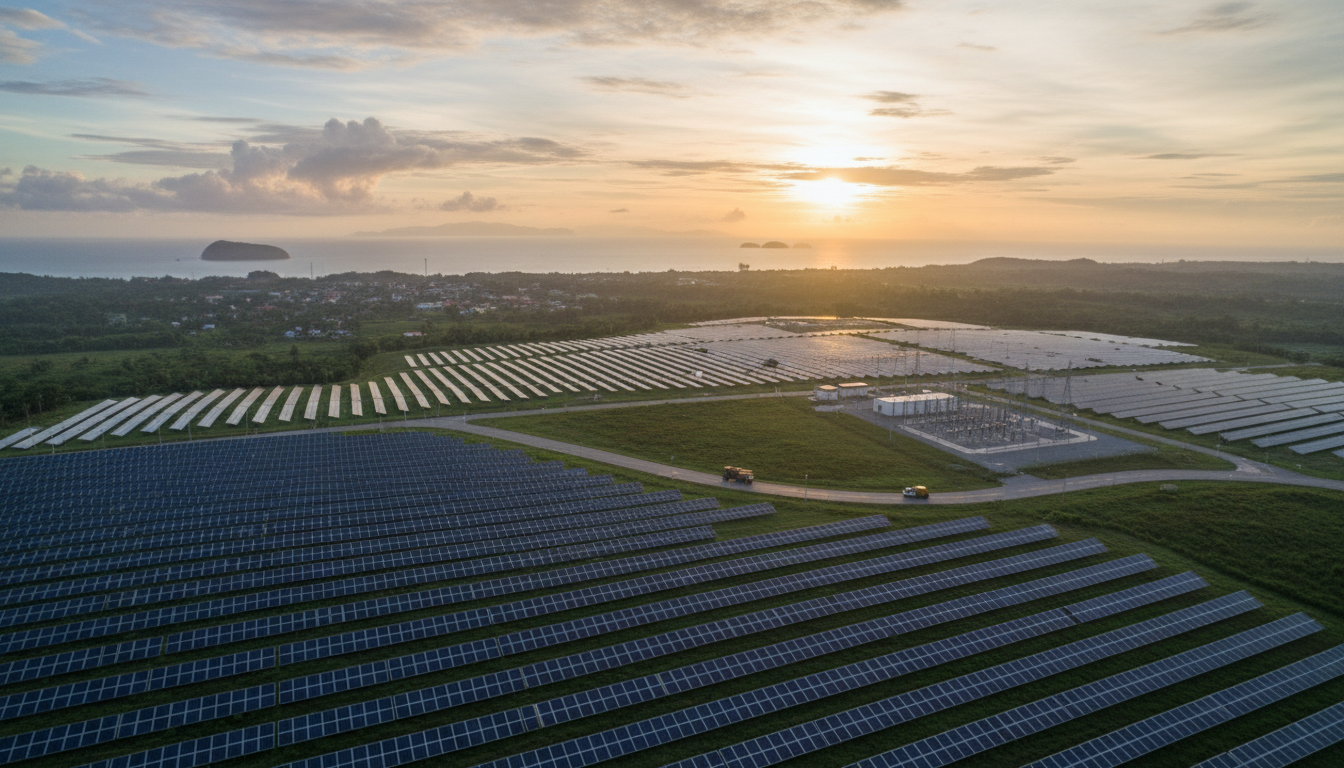
TotalEnergies and Nextnorth Drive $300 Million Solar Megaproject in Philippines, Setting New Financing Benchmark
A significant milestone in the Philippines’ energy landscape has been reached as European energy giant TotalEnergies and local developer Nextnorth officially commence construction on their 440 MWp solar power facility in Isabela. This $300 million endeavor, poised for completion by the close of 2027, has not only secured robust financing but also established a new benchmark for international capital deployment into the nation’s burgeoning renewable sector.
The joint venture sees TotalEnergies holding a 65% stake, with Nextnorth controlling the remaining 35%. This project represents a critical addition to the Philippine grid, projected to generate an impressive 13.5 TWh of electricity over its two-decade operational lifespan. For a nation grappling with escalating power demand and a persistent reliance on volatile imported fossil fuels, this large-scale solar development offers a strategic hedge against market fluctuations and contributes significantly to energy independence.
Financial Architecture Underpins Project Bankability
The financing structure for the Isabela project is particularly noteworthy for investors monitoring renewable energy opportunities in emerging markets. A consortium of leading international financial institutions—Sumitomo Mitsui Banking Corporation (SMBC), ING Bank NV, and Standard Chartered—has committed the $300 million required, marking it as the largest international financing package secured for a solar project in the Philippines to date. This landmark deal signals increasing confidence among global lenders in the country’s renewable energy sector and provides a vital precedent for future utility-scale developments.
For financial stakeholders, several elements within the project’s structure enhance its appeal and reduce perceived risk. The involvement of TotalEnergies, a major global energy player, as a primary sponsor lends significant credibility. Furthermore, a diversified revenue stream, combining long-term corporate power purchase agreements with government-backed grid supply, de-risks cash flow projections. This combination demonstrates how thoughtful policy design, coupled with transparent and bankable revenue models, can unlock substantial cross-border capital for renewable infrastructure.
Strategic Offtake Agreements Secure Revenue Streams
A crucial aspect ensuring the project’s financial stability and investor attractiveness lies in its meticulously structured off-take agreements. Over half of the electricity generated will be supplied directly to commercial and industrial consumers through long-term contracts with AdventEnergy and PrimeRES, both established Retail Electricity Suppliers. This direct supply model caters to a growing segment of corporate entities committed to decarbonizing their operations, offering predictable revenue streams that underpin the project’s long-term viability.
The remaining portion of the facility’s output will be fed into the national grid, following its successful award under Round 4 of the Philippine Government’s Green Energy Auction Program. This dual off-take strategy provides a robust revenue foundation, blending the stability of corporate demand with the policy support of a government auction mechanism designed to integrate more renewables into the national energy mix. Such a diversified approach is increasingly becoming a blueprint for large-scale renewable projects seeking to attract significant investment.
TotalEnergies’ Strategic Pivot in Asian Renewables
TotalEnergies’ substantial commitment to the Isabela solar project underscores its accelerating strategic pivot towards renewable energy, particularly within high-growth Asian markets. Olivier Jouny, SVP Renewables at TotalEnergies, emphasized the project’s role in advancing the Philippines’ clean energy objectives and its contribution to the company’s broader ambition of developing a 9 GW renewables portfolio across nine Asian countries, achieved through a 50/50 joint venture with Masdar. For investors tracking the evolution of traditional oil and gas majors, this move highlights a clear intent to diversify asset bases and capture growth opportunities in the global energy transition.
This initiative exemplifies how integrated energy companies are strategically deploying capital to build out significant renewable capacity in regions where energy demand is rapidly expanding. The Philippines, like many Asian nations, presents a compelling landscape for such investments, offering both robust economic growth and a government-led push to reduce reliance on imported fossil fuels, creating a fertile environment for clean energy development.
Energy Security at the Core of the Business Case
Nextnorth’s President and CEO, Miguel Mapa, articulated the critical strategic imperative driving the Isabela project: energy security. “Energy security has never been more relevant for the Philippines than it is today,” Mapa stated, highlighting the nation’s rising demand and continued exposure to imported fuel price volatility. He underscored the urgent need for “domestic, scalable, and bankable renewable capacity” to ensure a more energy-independent future for the Philippines, a message that resonates deeply across national economic and political spheres.
This framing positions renewable energy not merely as an environmental imperative but as a cornerstone of national resilience and economic stability. For institutional investors and corporate boards, this perspective reinforces the long-term investment thesis for clean power assets: they offer price stability, supply reliability, and reduced geopolitical risk. The Isabela project stands as a prime example of how clean energy infrastructure is increasingly viewed as critical national infrastructure, driving job creation and local economic development.
Investment Outlook for Asia’s Energy Transition
The Isabela solar project provides a compelling case study for investors keen on the evolving energy landscape. It demonstrates that large-scale renewable assets can attract significant international project finance when supported by a robust framework of government auctions, long-term corporate off-take agreements, and credible international sponsors. For the Philippines, this 440 MWp plant adds substantial domestic clean power, bolstering grid stability and reducing carbon intensity.
More broadly, this development reflects a powerful convergence of factors shaping Asia’s energy transition: growing power demand, a strategic imperative for energy security, proactive government policies supporting renewables, and increasing corporate demand for decarbonization solutions. As traditional oil and gas investors seek new avenues for growth and diversification, projects like Isabela showcase the bankable opportunities emerging in global clean energy markets, signaling a transformative shift in capital allocation across the energy sector.


