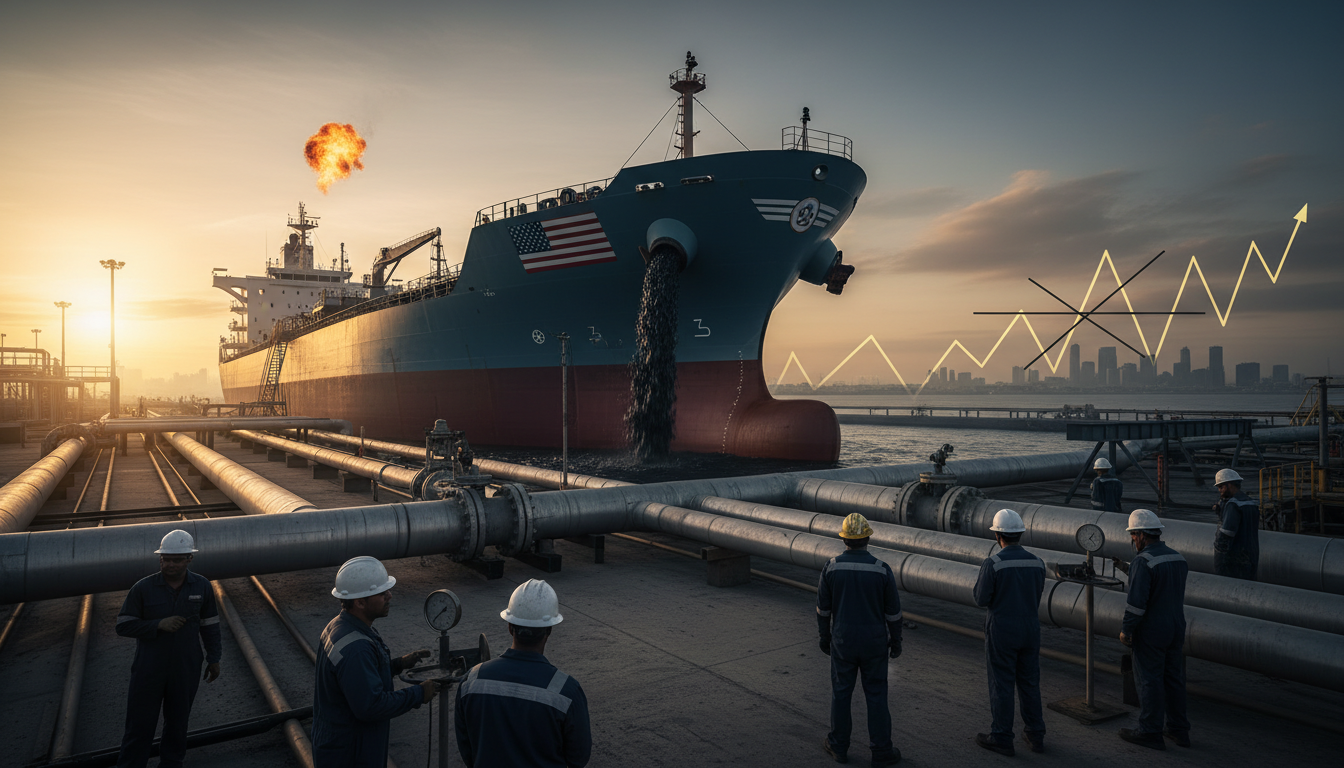
U.S. Crude Exports Soar Amid Global Crisis, Pressuring Domestic Energy Prices
The United States finds itself at a critical juncture in the global energy landscape. Recent data indicates U.S. crude oil exports have reached unprecedented levels, a trend that, if sustained, will inevitably impact the cost of gasoline, diesel, and other petroleum products for American consumers. This surge occurs against a backdrop of escalating international energy tensions, primarily triggered by geopolitical events in the Persian Gulf.
Nations worldwide are aggressively pursuing secure oil supplies following Iran’s declaration of the Strait of Hormuz as off-limits to tankers from “hostile” countries, including major oil producers such as Kuwait, Saudi Arabia, and the United Arab Emirates. While the U.S. Navy has reportedly implemented a blockade on vessels departing Iranian ports via the Strait, its overall effectiveness remains a subject of debate. This severe disruption to a vital global shipping artery has significantly tightened crude markets, creating a voracious demand for alternative sources.
America’s Energy Paradox: Producer, Consumer, and Exporter
In an address on April 1, then-President Trump acknowledged the global predicament, stating, “To those countries that can’t get fuel — many of which refused to get involved in the decapitation of Iran, we had to do it ourselves — I have a suggestion. Number one, buy oil from the United States of America; we have plenty. We have so much.” His remarks highlight America’s standing as a formidable energy power, yet they also underscore a complex domestic energy dynamic.
Indeed, the United States is the world’s leading crude oil producer, with output reaching 13.6 million barrels per day (mbpd) as of February. For context, Russia, the second-largest producer, recorded 9.9 mbpd as of December 2025. However, America also holds the distinction of being the world’s largest oil consumer, with refineries processing approximately 21.1 mbpd of finished petroleum products in late April. It is important to note that this figure includes about 2 mbpd of natural gas plant liquids, which are not direct crude oil inputs to refineries.
Adjusting for these liquids, the U.S. still processes around 19.1 mbpd of petroleum-related products. Comparing this to the 13.6 mbpd of domestic crude production reveals why the United States has historically been a net crude oil importer. The deficit between domestic production and refining capacity is typically bridged by crude oil imports and a phenomenon known as refinery gain. This gain refers to the volumetric expansion of crude oil as it is processed into lighter, higher-value products.
While precise real-time figures for refinery gain can fluctuate, the U.S. Energy Information Administration has estimated it at approximately 6.3 percent of total throughput. Applied to the 19.1 mbpd petroleum stream, this translates to roughly 1.2 mbpd of additional volume. The remaining supply gap is predominantly filled by imported crude, supplemented by other additives like ethanol and various chemicals, such as butane. Although American refineries export a portion of their output – including gasoline, diesel, and aviation fuel – the vast majority serves domestic consumption.
The Export Arbitrage and Domestic Price Implications
The recent release of oil from the U.S. Strategic Petroleum Reserve (SPR), initiated in response to the Strait of Hormuz closure and the subsequent reduction in global oil supplies, has temporarily shifted the U.S. into a net crude oil exporter position. However, a significant portion of these SPR releases is directly contributing to crude oil exports, rather than exclusively shoring up domestic supply.
This situation is unsustainable; SPR releases are finite, and the underground caverns where oil is stored have operational and legal minimums. Crucially, U.S. oil producers and refineries operate under legal frameworks that permit them to sell their products to the highest bidder globally. This legislative freedom explains why oil tankers are currently loading up at U.S. ports with domestically produced crude, priced around $100 per barrel, for onward sale in markets like Asia, where immediate delivery oil fetched as much as $150 per barrel in early April.
As long as U.S. domestic prices remain substantially below international benchmarks, oil trading firms will continue to capitalize on this arbitrage opportunity, shipping American crude overseas. Such export activity inherently exerts upward pressure on U.S. domestic prices. A critical question for policymakers and investors emerges: at what point will the American public demand that domestic oil be retained at home to stabilize prices? This potential public outcry could force political leaders to confront tough choices if the Strait of Hormuz remains closed, and global supply constraints persist.
LNG Exports: A Parallel Scenario Unfolding
The dynamic witnessed in crude oil exports is mirrored in the natural gas sector. The United States has emerged as the world’s largest exporter of liquefied natural gas (LNG). This exported natural gas becomes unavailable to the American domestic market, and its sale abroad inherently drives up U.S. domestic prices. In fact, the pursuit of higher, internationally linked prices was the primary motivation for U.S. natural gas producers to advocate for unlimited export rights, arguing that it was inequitable to restrict natural gas exports when most other American goods could be sold globally to the highest bidder.
The ongoing crisis in the Persian Gulf has disrupted approximately 20 percent of the world’s LNG supply. This significant reduction has further intensified global demand for American LNG and spurred investment in new export infrastructure. Consequently, a similar question arises for natural gas: will domestic prices in the U.S. escalate to a point where American consumers demand restrictions on LNG exports to safeguard affordability at home?
International Precedents and Future Policy Considerations
The intricate web of energy markets remains significantly entangled by the geopolitical conflict in Iran and the effective closure of the Strait of Hormuz. This situation has ignited a fierce global competition for adequate energy supplies. Some nations, notably China and Thailand, have already taken proactive steps to hoard domestic supplies as a precautionary measure against deepening uncertainty. Both countries implemented limitations on exports to secure their own energy futures.
For investors, monitoring these global and domestic pressures is paramount. The current environment forces a reevaluation of traditional supply-demand models and introduces significant policy risk. Will other nations, including the United States, eventually consider or implement measures to limit the export of petroleum products and natural gas as the crisis extends? Such decisions, particularly in the U.S., may not be driven solely by market economics but could be precipitated by mounting public discontent and even social unrest stemming from escalating energy costs. The balance between maximizing export revenues and ensuring domestic energy security will define the coming chapters for the global oil and gas markets.