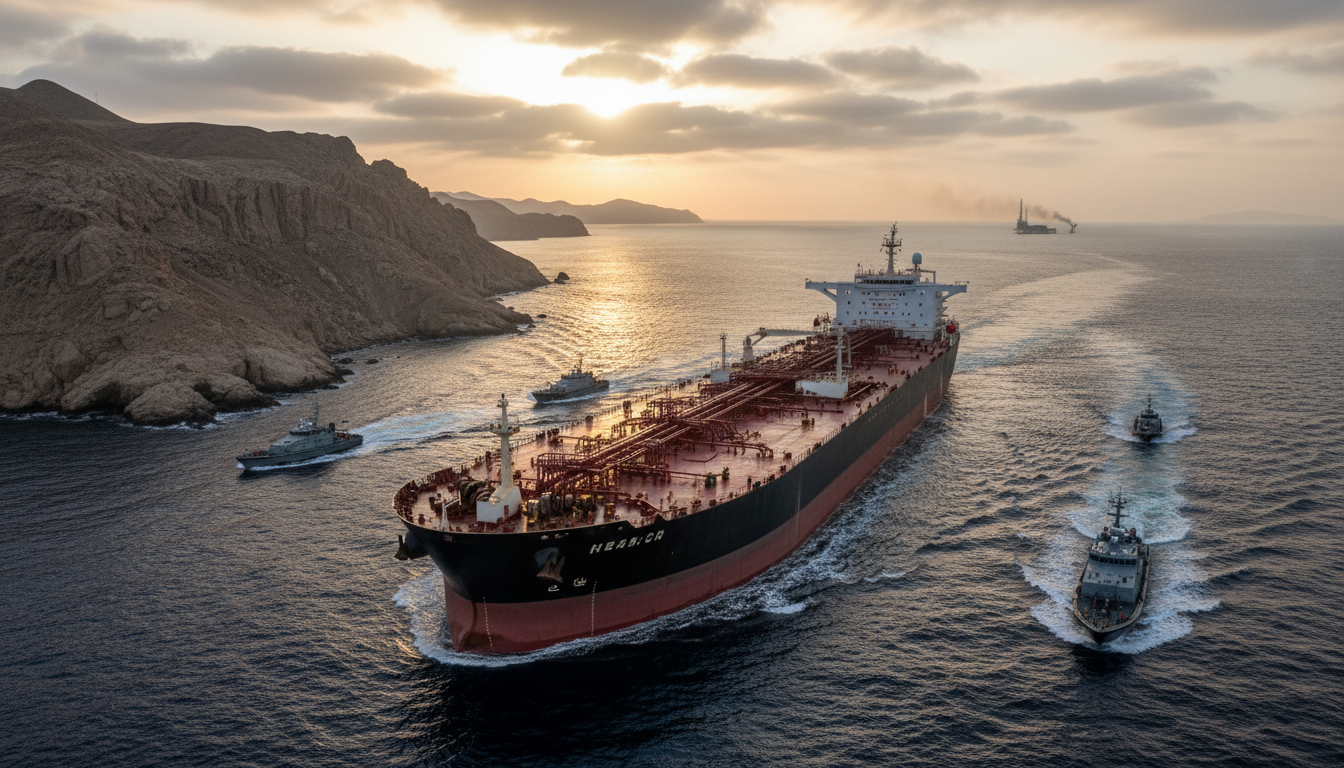
Global Oil Markets Brace for Hormuz Tensions Amidst AI-Driven Market Rally
Global crude oil benchmarks experienced an upward surge on Monday as renewed geopolitical jitters emanating from the Middle East placed a premium on energy security. Iran issued a stern warning to all commercial shipping and oil tankers, instructing them to avoid unauthorized transit through the critical Strait of Hormuz. This directive, which demands coordination with the Iranian military for passage, immediately amplified concerns over potential disruptions to the world’s most vital oil transit chokepoint.
The situation escalated further with a contested claim from Iran’s Fars news agency, which reported that an American frigate had been struck by two Iranian missiles within the Strait and subsequently retreated around 10:00 GMT. Washington swiftly refuted this account, dismissing the claim as false. These developments follow a declaration on Sunday by US President Donald Trump, who announced plans for American forces to begin escorting commercial vessels through the waterway. However, Iran countered this on Monday, cautioning the United States against further demands and asserting that any such escort operation would constitute a violation of the fragile ceasefire agreement that has temporarily halted the two-month-long conflict in the region.
President Trump framed the proposed US intervention, dubbed “Project Freedom,” as a “humanitarian gesture” aimed at assisting stranded ships in navigating the Strait of Hormuz. This ambitious operation was reportedly slated to commence on Monday, featuring substantial military assets including guided missile destroyers, over 100 land and sea-based aircraft, a range of multi-domain unmanned platforms (drones), and a deployment of 15,000 service members. Yet, as of the time of reporting, the operational success or full implementation of this US initiative remained unconfirmed, leaving market participants in a state of uncertainty.
The immediate market reaction was clear: Brent crude, the international benchmark, climbed significantly. By 12:10 GMT on Monday, Brent futures traded at $111 a barrel, marking a robust 3% increase. Similarly, West Texas Intermediate (WTI), the US benchmark, saw its price rise by 2% to $104 a barrel. Investors have maintained a cautious stance since the US-Iran ceasefire took effect in early April, with a single, unproductive round of negotiations doing little to alleviate fundamental tensions. The United States continues to enforce a blockade on Iranian ports, while Tehran, in turn, keeps the Strait of Hormuz closed—a crucial maritime artery through which an estimated one-fifth of global oil and natural gas supplies typically flow. A glimmer of optimism did emerge on Friday following an Iranian report indicating that Tehran had submitted a new peace proposal to mediator Pakistan the previous night, providing a slight counterpoint to the escalating rhetoric.
AI Sector Continues to Mask Geopolitical Headwinds
While the Middle East crisis continues to simmer, threatening to spill over into broader energy market instability, many investors have shifted their attention towards the buoyant corporate earnings landscape, particularly within the burgeoning artificial intelligence (AI) sector. This pivot reflects a broader market narrative where robust tech growth is effectively “masking” the potential adverse impacts of geopolitical events on other segments of the economy. A series of stronger-than-expected financial results from tech giants like Apple, Google, Microsoft, and Samsung has reignited significant investor interest and capital inflows into AI-related equities, overcoming the market turbulence initially sparked by US-Israeli strikes on Iran at the close of February.
Market analysts have highlighted this unique dynamic. Ipek Ozkardeskaya, an analyst at Swissquote, succinctly captured the sentiment, noting, “Optimism that AI continues to mask the pain elsewhere.” This suggests that the enthusiasm surrounding AI’s transformative potential is currently overshadowing, or at least mitigating, investor apprehension regarding global instability and its economic consequences. The latest data underscores this resilience: companies within the S&P 500 index are projected to report an impressive earnings growth rate of 27.1%, according to Factset. This figure represents the highest growth rate observed in more than four years, providing a powerful tailwind for equity markets despite underlying geopolitical fragility.
Indeed, the month commenced on a broadly positive note for equities, building on the momentum that saw both the S&P 500 and Nasdaq indices achieve all-time highs in New York on Friday. Asian markets, in particular, demonstrated exceptional performance. Seoul’s benchmark surged by over 5%, while Taipei recorded an impressive jump of more than 4%, with both hitting fresh record highs. South Korean chip manufacturing titan SK Hynix led the charge, soaring an remarkable 12.5%, closely followed by its rival Samsung, which gained over 5%. Taiwanese semiconductor behemoth TSMC also saw its shares climb by 6.6%, reflecting the intense demand and positive outlook for the chip industry powering the AI revolution. Hong Kong’s market also benefited from a strong showing by prominent Chinese tech firms, including Alibaba, while Mumbai, Singapore, Manila, Wellington, and Jakarta all registered gains. Conversely, European markets experienced some downward pressure in afternoon trading, with Paris and Frankfurt seeing declines. Major financial hubs including Tokyo, Shanghai, and London remained closed for public holidays, impacting overall trading volumes.
In currency markets, the Japanese yen exhibited a sharp upward movement against the US dollar early on Monday, fueling speculation of another potential currency intervention by Japanese authorities. This followed a significant appreciation of the yen against the greenback on Friday, with media reports suggesting that Tokyo had expended an estimated $31 billion in efforts to prop up its struggling currency. Japan’s Finance Minister, Satsuki Katayama, declined to comment on the matter on Monday, maintaining the market’s uncertainty regarding official actions.
China Defies US Sanctions on Iranian Oil
Adding another layer of complexity to the global geopolitical and economic landscape, China has reportedly issued directives to its private refiners, including significant players like Hengli Petrochemical (Dalian) Refinery, to disregard US sanctions targeting Iranian oil. This move signals a direct challenge to Washington’s efforts to curb Iran’s oil export capabilities. China’s Commerce Ministry articulated its position on Saturday, condemning the US sanctions as an unlawful infringement on normal international trade practices. While Chinese state media outlets have historically criticized US sanctions as an exercise in “long-arm jurisdiction,” Beijing has generally adhered to these restrictions in the past. However, the explicit order issued on Saturday marks a notable departure, with some observers interpreting it as a clear act of defiance, particularly significant given that it precedes a scheduled visit by President Trump to Beijing by merely ten days. The potential ripple effects of this directive on China’s state-owned financial institutions and their willingness to facilitate transactions involving Iranian oil, however, remain an open question for investors to monitor closely.
Key Market Figures Around 1200 GMT:
Crude Oil:
Brent North Sea Crude (July): UP 2.7% at $111.12 a barrel.
West Texas Intermediate (June): UP 2.0% at $103.95 a barrel.
Asian Equities (Close):
Tokyo – Nikkei 225: Closed for a holiday.
Hong Kong – Hang Seng Index: UP 1.2% at 26,095.88.
Shanghai – Composite: Closed for a holiday.
European Equities (Afternoon Trading):
London – FTSE 100: Closed for a holiday.
Frankfurt – DAX 40: DOWN 0.1% at 24,269.10 points.
Paris – CAC 40: DOWN 0.9% at 8,045.58.
US Equities (Previous Close):
New York – Dow: DOWN 0.3% at 49,499.27.
Currencies:
Dollar/yen: UP at 157.14 yen from 157.06 yen on Friday.