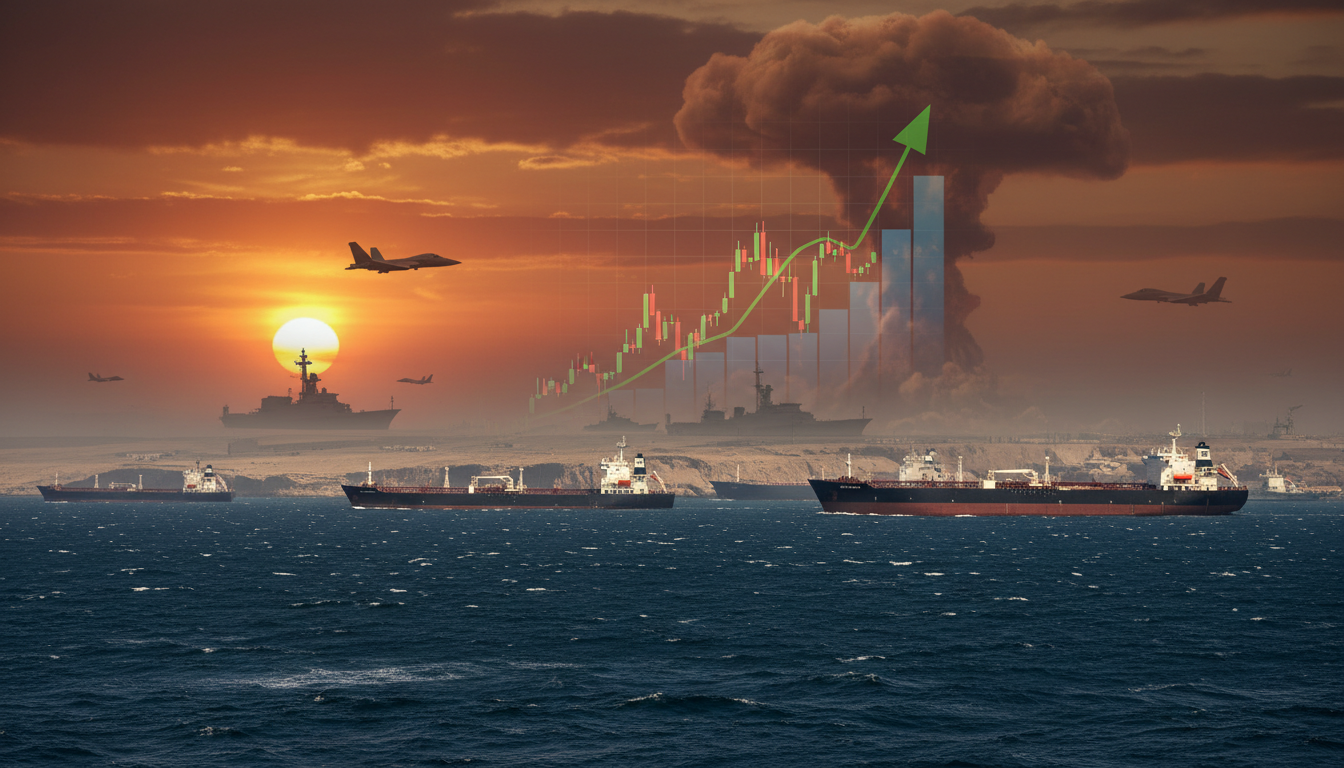
The global energy landscape finds itself navigating treacherous waters as a bitter stalemate continues to grip the Middle East, with peace initiatives to resolve the critical Strait of Hormuz blockade showing little forward momentum. This geopolitical tension immediately sent crude benchmarks surging, pushing Brent North Sea crude, the international standard, back above the significant $100 per barrel threshold and signaling inflationary threats across world economies.
Market reactions were swift and decisive. Equity indices across major Asian bourses registered declines, a trend that extended to European and American markets upon their opening. This broad-based investor pullback reflects mounting concerns that the unfolding developments in the Gulf region point towards a prolonged and unpredictable conflict, demanding heightened vigilance from energy investors and portfolio managers alike.
Hormuz Flashpoint: A New Red Line for Global Shipping
Despite a fragile ceasefire extension granted on Wednesday, diplomatic channels between the United States and Iran remain conspicuously quiet. The situation escalated dramatically as President Donald Trump issued a stern warning regarding the Strait of Hormuz, vowing a decisive military response against any vessel attempting to lay mines within the crucial maritime passage.
“I have ordered the United States Navy to shoot and kill any boat, small boats though they may be… that is putting mines in the waters of the Strait of Hormuz,” President Trump declared, emphasizing a zero-tolerance policy. He further asserted the active engagement of US mine-sweeping operations, indicating a proactive stance to maintain navigability. This directive underscores the strategic imperative placed on the Strait, a waterway vital for global energy flows.
The US Defense Department corroborated this aggressive posture by announcing a maritime interdiction in the Indian Ocean. Forces boarded the sanctioned stateless vessel M/T Majestic X, found to be transporting oil from Iran. This operation, highlighted by footage of US military personnel rappelling onto the tanker’s deck, signals an intensified global maritime enforcement effort aimed at disrupting illicit networks supporting Iran.
The US government’s commitment to this strategy remains firm, stating it will “continue global maritime enforcement to disrupt illicit networks and interdict vessels providing material support to Iran, wherever they operate.” This action directly follows the US imposition of its own blockade on Iranian ports earlier this month, intensifying economic pressure on the Islamic republic.
Iran’s Defiance and Strategic Calculus
Conversely, Iran has signaled its unwavering resolve. Mohammad Bagher Ghalibaf, Iran’s parliamentary speaker, asserted that a comprehensive ceasefire is contingent upon the lifting of the naval blockade. “Reopening the Strait of Hormuz is not possible amid a blatant violation of the ceasefire,” he stated, connecting the strait’s closure directly to US actions.
Further demonstrating its defiance, Iran confirmed it has begun collecting tolls from ships transiting Hormuz. Hamidreza Hajibabaei, deputy parliamentary speaker, announced the reception of the first revenues from these levies. This revenue stream, however modest, symbolically reinforces Iran’s control over a waterway that, in peacetime, facilitates approximately one-fifth of the world’s oil and gas movements, along with other essential commodities.
Analysts suggest that Iran’s hardline leadership, particularly those aligned with the Islamic Revolutionary Guards Corps (IRGC), believes this blockade provides significant economic leverage. They contend that sustained disruption to global energy supplies will compel Washington to retract its primary demands in any future peace negotiations. Danny Citrinowicz of the Tel-Aviv Institute for National Security Studies remarked on social media that Israel and the US might have misjudged Tehran’s position. “Tehran has consistently demonstrated a willingness to absorb economic pain while holding firm on what it views as core national interests. There is little reason to believe this time will be different,” he cautioned, adding, “Rather than moving toward concession, Iran is positioning itself to escalate.”
A brief from the Soufan Center think tank echoed this sentiment, noting that Iranian hardliners argue that “a prolonged elevation of global energy prices and mounting global shortages of some goods will increasingly pressure Trump to accede to Iran’s positions, end the war, and eventually withdraw US forces from the region.” The contrasting view from the US President and his team suggests the opposite: that the US blockade on Iran’s seaborne trade will swiftly cripple Iran’s economy and force its capitulation to American demands. President Trump, in a social media post, indicated internal power struggles within Iran, stating, “Iran is having a very hard time figuring out who their leader is! … We have total control over the Strait of Hormuz. No ship can enter or leave without the approval of the United States Navy. It is ‘Sealed up Tight,’ until such time as Iran is able to make a DEAL!!!”
Global Markets Brace for Protracted Volatility
While European nations prepare to dispatch naval vessels and minesweepers to help secure the Strait, the immediate outlook for global markets involves elevated energy prices and persistent stock market volatility. Recent weeks saw equities largely recover from earlier losses attributed to US and Israeli strikes, bolstered by robust first-quarter corporate earnings and sustained enthusiasm for artificial intelligence technologies. However, market analysts warn that a drawn-out conflict in the Middle East could quickly erode this confidence.
Joshua Mahony, chief market analyst at Scope Markets, observed a growing “risk aversion” as the crisis entered “yet another damaging phase.” He highlighted a shift from rapid escalation/de-escalation cycles to “a slow grind higher for energy prices as the prospect of a drawn-out stalemate comes into play.”
Despite the geopolitical headwinds, first-quarter corporate results have largely outperformed expectations. Data from Bloomberg indicates that nearly 80% of S&P 500 companies reporting Q1 earnings have surpassed analyst estimates. Tesla, for instance, reported impressive first-quarter profits, exceeding forecasts and confirming substantial investments in autonomous transport, humanoid robotics, and AI. This underlying strength, coupled with a tech sector rally, saw Seoul’s Kospi index hit a record high.
However, the broader economic impact is beginning to materialize. The eurozone experienced its first contraction in business activity in 16 months during April. The Flash Eurozone purchasing managers’ index (PMI), published by S&P Global, registered a figure of 48.6 for April, a decline from 50.7 in March. A reading below 50 signals economic contraction, directly linking rising energy prices and disrupted global supply chains due to the Middle East conflict to broader economic deceleration.
Investors must remain acutely aware of the dual forces shaping current markets: the immediate and severe geopolitical risks impacting energy supply and pricing, contrasted with the underlying resilience demonstrated by corporate earnings and technological advancements. The trajectory of crude oil futures, global equity performance, and economic indicators like the PMI will provide crucial insights as this volatile situation evolves.
Market Snapshot: Key Figures at 1345 GMT
- Brent North Sea Crude: UP 0.8% at $102.69 a barrel
- West Texas Intermediate: UP 1.0% at $93.97 a barrel
- New York – Dow Jones: DOWN 0.4% at 49,315.43 points
- New York – S&P 500: DOWN 0.1% at 7,129.20
- New York – Nasdaq: DOWN 0.2% at 24,598.06
- London – FTSE 100: DOWN 0.4% at 10,437.00
- Paris – CAC 40: UP 0.6% at 8,201.12
- Frankfurt – DAX: DOWN 0.2% at 24,150.25
- Tokyo – Nikkei 225: DOWN 0.8% at 59,140.23 (close)
- Hong Kong – Hang Seng Index: DOWN 1.0% at 25,915.20
- Shanghai – Composite: DOWN 0.3% at 4,093.25 (close)
- Dollar/yen: UP at 159.52 yen from 159.49 yen