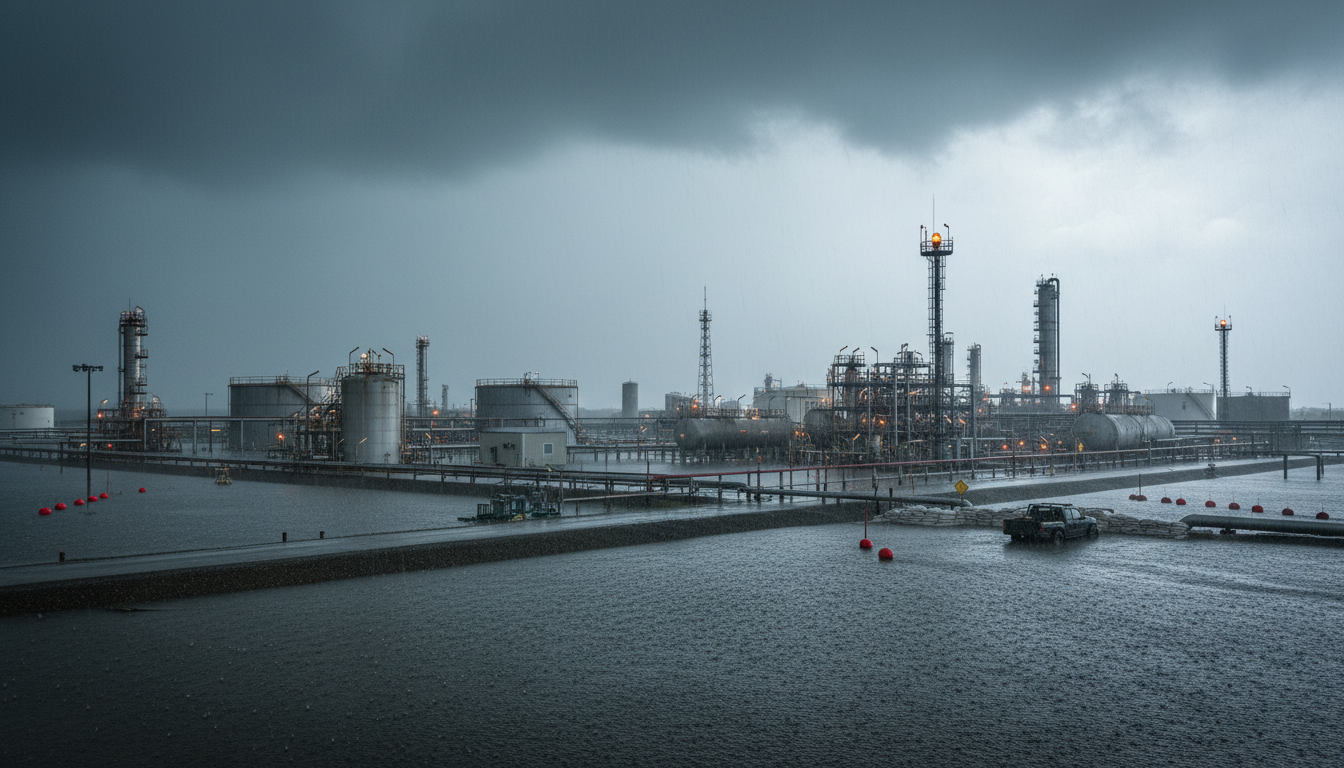
The energy markets are once again confronted with a localized, yet potentially impactful, supply-side risk as severe weather conditions in Northern Michigan escalate. Record snowfall in March, compounded by relentless recent rainfall, has pushed water levels to critical highs at the Cheboygan Lock and Dam Complex. This developing situation, marked by a declared state of emergency and ongoing efforts to prevent dam overflow, introduces a fresh layer of uncertainty for energy infrastructure and, by extension, for investors closely monitoring regional supply stability. Our proprietary market intelligence, combining real-time price feeds with forward-looking event calendars and investor sentiment, provides a unique lens through which to assess the potential ramifications.
Northern Michigan’s Flood Crisis and Infrastructure Vulnerability
Authorities in Michigan’s northern Lower Peninsula and Upper Peninsula are grappling with significant flooding concerns, primarily centered around the Cheboygan Lock and Dam Complex. Governor Gretchen Whitmer formally declared a state of emergency last Friday, highlighting the gravity of the situation. Efforts are underway to mitigate the risk of dam overflow, with crews actively increasing water flow through the complex. This includes adding more pumps to the Cheboygan Dam to redirect water towards Lake Huron. Furthermore, specialized industrial equipment has been brought in from Illinois to aid DTE Energy and Department of Natural Resources (DNR) crews in their attempt to restart a hydroelectric station that has been non-operational since 2023. The goal is to bring this station back online not for power generation, but purely to enhance water movement and alleviate pressure on the dam. Public information officer Kathleen Lavey confirmed efforts to remove dam gates using a giant crane to maximize water passage. While no evacuations have been reported, residents between the dam and Lake Huron have been advised to prepare “go-bags” and monitor official updates, underscoring the serious nature of the threat. This localized crisis serves as a potent reminder of the fragility of infrastructure against extreme weather, a key consideration for energy investors with assets in climatically vulnerable regions.
Market Response Amid Broader Price Swings
Today’s market activity reflects a general upward trend, with Brent Crude trading at $95.32, marking a robust 5.47% increase, and WTI Crude at $87.23, up 5.62%. Gasoline prices have also climbed to $3.04, a 3.75% rise. This upward movement comes after a period of significant volatility; our 14-day Brent trend data shows a sharp decline from $112.78 on March 30th to $90.38 on April 17th, representing a nearly 20% contraction. While the immediate cause for today’s bounce is multifaceted, the unfolding situation in Northern Michigan, with its implicit threat to regional energy infrastructure, likely contributes to a heightened sense of supply-side risk. Even without direct impacts on major oil and gas pipelines yet, the severe weather and potential for critical infrastructure failure add a layer of geopolitical and environmental premium to prices. Investors are keenly aware that localized disruptions, if they escalate or persist, can create chokepoints in supply chains, impacting refined product distribution or even crude movement, especially in a tightly balanced market. This underscores the need for constant vigilance over seemingly regional events that can quickly garner broader market attention.
Investor Focus: Navigating Uncertainty and Upcoming Catalysts
Our proprietary reader intent data reveals a prevalent theme among investors this week: questions revolving around market direction, such as “is WTI going up or down?” and “what do you predict the price of oil per barrel will be by end of 2026?” These questions highlight the current uncertainty, and the Northern Michigan floods add a tangible, if regional, input to the complex array of factors influencing price forecasts. While the immediate impact on global crude flows may be limited, the incident underscores the vulnerability of domestic energy supply chains. Looking ahead, the confluence of this developing weather crisis with a packed energy calendar demands close attention. Today, April 20th, marks the OPEC+ JMMC Meeting, followed by the API Weekly Crude Inventory report on April 21st and the critical EIA Weekly Petroleum Status Report on April 22nd. The OPEC+ Ministerial Meeting is also scheduled for April 25th. These events will provide crucial insights into global supply/demand dynamics. The potential for a significant infrastructure breach in Michigan, though still a developing risk, will undoubtedly be weighed against these broader market signals. The planned public meeting on Tuesday to update residents and business owners on the flood situation will also be an important local event to monitor for further developments that could impact regional economic activity and energy demand.
Strategic Implications for Energy Portfolios
For discerning energy investors, the Northern Michigan flood crisis serves as a stark reminder of the increasing influence of climate-related events on operational risk and asset valuations. While direct pipeline disruptions have not been confirmed, the scenario highlights the critical need for resilience in energy infrastructure. This incident prompts a deeper dive into the geographic exposure of energy companies, particularly those operating in regions prone to extreme weather events. Investors should be evaluating portfolio companies not just on their production capacity or reserves, but also on the robustness of their midstream assets, their emergency response protocols, and their long-term strategies for climate adaptation. Diversification across geographies and asset types can help mitigate localized risks. Furthermore, understanding the interplay between regional disruptions and global market sentiment is paramount. As the world increasingly grapples with the effects of a changing climate, localized events like the Michigan floods will likely become more frequent and more impactful, demanding a proactive and informed investment approach. Monitoring the situation’s evolution and its potential ripple effects on transportation networks and energy distribution will be crucial for positioning portfolios effectively in the coming weeks and months.


