ExxonMobil’s Q1 Production Hit: A Bellwether for Geopolitical Risk in Energy
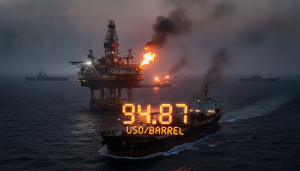
The global energy landscape continues to grapple with the profound and immediate consequences of ongoing geopolitical tensions, with ExxonMobil’s recent disclosure serving as a stark reminder. The Texas-based supermajor reported a significant 6% decline in its global oil and natural gas production during the first quarter, directly attributing a substantial portion of this downturn to disruptions stemming from the Mideast conflict. This reduction, half of which originated from a critical liquefied natural gas (LNG) facility in Qatar where Exxon holds a partnership, underscores the vulnerability of international energy supply chains to regional instability. As two LNG production trains at the facility sustained damage from missile strikes, the company indicated that repairs would be prolonged, with an on-site evaluation pending to determine the full extent and timeline for a return to normal operations. For investors, this revelation is not merely an operational update; it’s a critical signal about the tangible impact of geopolitical risk on the profitability and operational stability of major energy players.
Operational Setbacks and Financial Implications for Energy Giants
The 6% production decrease at ExxonMobil is a substantial figure, particularly considering that the Persian Gulf region typically contributes approximately one-fifth of the company’s total global output. The damage to the Qatar LNG complex, a critical asset, illustrates how quickly regional conflict can translate into global supply shocks. While Exxon awaits a comprehensive assessment, Qatari officials have previously estimated the facility could face an annual revenue loss of around $20 billion, with repairs potentially spanning half a decade. This long-term outlook introduces a significant element of uncertainty for future production volumes and revenues tied to these assets.
Beyond the direct production cuts, Exxon also provided an update on its first-quarter earnings for the energy-products division, which encompasses refining and trading activities. The company anticipates these earnings will be $3.7 billion lower than the final three months of 2025. This projected decline is primarily attributed to price volatility and the timing of cargo movements rather than a fundamental flaw in operations. Chief Financial Officer Neil Hansen reassured investors that these impacts are temporary and will eventually “unwind over time,” ultimately resulting in “net positive profit” from what he described as “sound trades.” Indeed, excluding these timing effects, the company noted that per-share earnings were actually higher than the preceding quarter, suggesting underlying operational strength despite the external headwinds. This mixed financial picture highlights the complexities of assessing energy company performance in a volatile market, where short-term accounting nuances can obscure underlying profitability trends. European peer Shell Plc also recently published a trading update, reporting lower quarterly gas production, further cementing the widespread impact of the Mideast conflict across the industry.
Geopolitical Dynamics and Current Market Temperament
The market’s reaction to these developments has been dynamic, reflecting the delicate balance between supply concerns and geopolitical shifts. Exxon shares experienced a 6.1% decline in pre-market trading following news of a two-week ceasefire announced by U.S. President Donald Trump, indicating that any perceived de-escalation can trigger immediate responses in equity markets. This sensitivity is further reflected in broader crude oil prices. As of today, Brent Crude is trading at $93.92 per barrel, up 0.73% within a day range of $91.39 to $94.86, while WTI Crude stands at $89.96 per barrel, showing a 0.32% increase within its daily range of $87.64 to $91.41. These current prices represent a rebound from recent lows, but the underlying trend has been downward. Over the past 14 days, Brent crude has seen a notable correction, declining by approximately 7% from $101.16 on April 1st to $94.09 on April 21st. This recent trajectory underscores the market’s ongoing struggle to price in the true risk premium associated with Mideast instability versus potential diplomatic resolutions. Energy executives have consistently cautioned that financial markets may be underestimating the profound and enduring severity of the conflict’s impact on global energy supplies, a sentiment that recent price fluctuations seem to support.
Navigating Uncertainty: What Investors Are Asking
In such a volatile environment, investors are naturally seeking clarity and direction. Our proprietary intent data reveals a common thread among reader queries this week: a deep desire to understand market trajectory and future price action. Questions like “Will WTI go up or down?” and “What do you predict the price of oil per barrel will be by end of 2026?” highlight the difficulty in forecasting in a landscape shaped by rapidly evolving geopolitical events. The ExxonMobil situation exemplifies this challenge. While a ceasefire might temporarily ease fears and pressure prices downward, the physical damage to critical infrastructure, with repair timelines stretching potentially to half a decade and significant revenue losses, represents a persistent, long-term supply constraint that markets must eventually absorb. The inherent unpredictability of conflict, coupled with the long lead times for energy project development and repair, makes precise price predictions incredibly difficult. What is clear is that the risk premium for Mideast production remains elevated, and any significant escalation or prolonged disruption could quickly send prices soaring, irrespective of short-term diplomatic maneuvers. Investors are right to be concerned about the longer-term implications, as the “underestimated severity” that executives warn about could manifest in sustained higher prices if supply struggles to keep pace with demand.
Key Dates and Forward-Looking Analysis for the Energy Investor
For investors focused on the energy sector, the coming weeks will offer crucial data points to help assess the evolving market dynamics and the broader implications of the Mideast conflict. A primary event on the calendar is ExxonMobil’s release of its complete first-quarter results on May 1st. This will provide a more detailed financial picture, including specific commentary on how the Mideast disruptions are impacting their outlook for the remainder of the year. Beyond individual company performance, broader market indicators will also be critical. The EIA Weekly Petroleum Status Reports, scheduled for April 22nd, April 29th, and May 6th, will offer essential insights into U.S. crude oil and product inventories, refinery activity, and demand trends, providing a pulse on domestic supply-demand balances. Similarly, the Baker Hughes Rig Count on April 24th and May 1st will indicate North American drilling activity, a key measure of future production capacity. The API Weekly Crude Inventory reports on April 28th and May 5th will also offer early glimpses into U.S. inventory changes. Finally, the EIA Short-Term Energy Outlook, due on May 2nd, will provide updated forecasts for global and domestic supply, demand, and prices, incorporating the latest geopolitical and economic factors. Monitoring these upcoming calendar events will be vital for investors seeking to contextualize the impact of current events and make informed decisions in a market defined by both persistent geopolitical risk and shifting fundamentals.