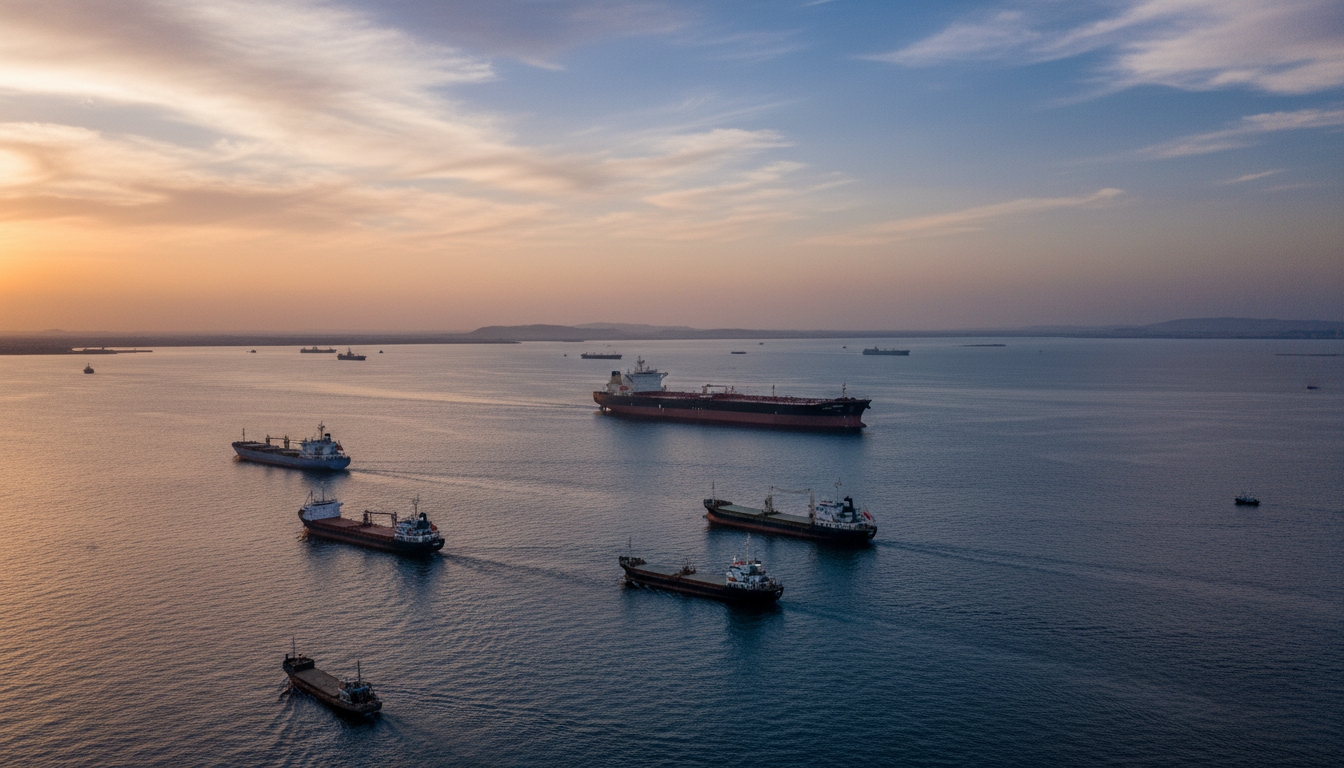
Strait of Hormuz Blockade Commences: Initial Traffic Steady Amid Escalating Geopolitical Risk
SINGAPORE/LONDON – The global oil and gas investment landscape witnessed a critical development as the United States initiated a full blockade on vessels bound for Iranian ports. On its inaugural full day, Tuesday, the highly anticipated move presented a complex picture for energy market participants: while Strait of Hormuz traffic appeared outwardly resilient, the underlying currents of geopolitical tension and operational risk intensified dramatically.
Despite the implementation of the U.S. directive, at least eight vessels, including three with known ties to Iran, successfully navigated the critical waterway. This initial observation, however, belies the profound uncertainty now gripping shippers, major oil companies, and war risk insurers, signalling sustained volatility for investors in the energy sector.
The Geopolitical Chessboard: Blockade Follows Failed Diplomacy
The blockade, announced by U.S. President Donald Trump on Sunday, escalated tensions following the collapse of peace negotiations between the U.S. and Iran in Islamabad over the weekend. This diplomatic failure paved the way for a more aggressive stance, introducing unprecedented operational hurdles for maritime trade through the Strait of Hormuz, a choke point for roughly one-fifth of the world’s oil supply.
Market observers and analysts are acutely aware that the current level of maritime activity remains a mere fraction of its former glory. Prior to the U.S. and Israeli military actions against Iran, which commenced on February 28, the Strait typically saw over 130 daily crossings. This stark reduction underscores the prolonged instability in the region and its pervasive impact on global supply chains.
Early Enforcement and Compliance: U.S. Central Command’s Report
The U.S. Central Command reported swift, albeit focused, enforcement during the blockade’s initial 24 hours. Their data indicated that no vessels attempting to reach Iranian ports successfully passed the U.S. cordon. Six ships reportedly complied with instructions from U.S. forces, altering course and returning to Iranian ports. This targeted enforcement suggests a strategic approach by U.S. naval assets, designed to disrupt direct trade with Iran without necessarily halting all traffic through the Strait.
Investors must recognize that this selective enforcement strategy aims to maximize economic pressure on Iran while potentially mitigating broader market panic that a full-scale interdiction of all traffic might cause. However, the inherent risks to global crude oil and refined product flows remain paramount.
Navigating the Sanctions Maze: Iran-Linked Vessels Transiting
Of particular interest were the three Iran-linked vessels that transited the Strait on Tuesday. Crucially, these tankers were not bound for Iranian ports, thereby sidestepping the direct impact of the new blockade. This highlights the complex network of global shipping and the persistent efforts to circumvent sanctions or operate within narrow compliance windows.
One such vessel was the Panama-flagged Peace Gulf, a medium-range (MR) tanker, reportedly en route to Hamriyah port in the United Arab Emirates. Shipping data from LSEG and Kpler indicates this vessel has historically been involved in transporting Iranian naphtha, a vital petrochemical feedstock, to other non-Iranian Middle Eastern ports for onward export to Asian markets. Its continued operation, albeit with a non-Iranian destination, demonstrates the intricate routes still active in regional energy trade.
Adding another layer of complexity, two U.S.-sanctioned tankers also successfully navigated the narrow waterway. The handy tanker Murlikishan, previously known as MKA, is now reportedly heading to Iraq with a projected arrival on April 16 to load fuel oil. This vessel has a documented history of transporting both Russian and Iranian oil, underscoring the challenges of enforcing comprehensive sanctions in a globally interconnected energy market.
Perhaps most indicative of the intricate landscape was the Rich Starry, another medium-range tanker, which marked the first sanctioned vessel to transit the Strait and exit the Persian Gulf since the blockade began. Data from LSEG and Kpler confirmed its passage. The tanker and its owner, Shanghai Xuanrun Shipping Co., are already under U.S. sanctions for dealings with Iran. The Rich Starry was observed carrying approximately 250,000 barrels of methanol, loaded at Hamriyah, UAE, and crewed by Chinese nationals. This incident directly tests the resolve and scope of the U.S. blockade, drawing sharp international attention.
International Reactions and Operational Realities
China’s foreign ministry wasted no time in condemning the U.S. blockade as “dangerous and irresponsible,” warning of an exacerbation of regional tensions. While the ministry did not specifically confirm whether Chinese-flagged or Chinese-operated vessels were impacted, the presence of Chinese crew on the Rich Starry underscores the direct implications for China’s vast maritime interests and energy security.
Beyond the Iran-linked vessels, five other ships transited the Strait since the blockade commenced at 1400 GMT on Monday. These included two additional chemical and gas tankers, two dry bulk vessels, and the cargo ship Ocean Energy, which successfully docked at Iran’s Bandar Abbas port. The U.S. military had clarified in a note to mariners, seen by Reuters, that humanitarian shipments would be exempt from the blockade, offering a narrow, yet significant, carve-out.
Expert analysis, such as that from Fabrizio Coticchia, a professor of political science at Italy’s University of Genoa, suggests the U.S. strategy may involve an “intermittent blockade” rather than a blanket interdiction of every vessel. He posits that ships would likely be diverted rather than directly attacked, with U.S. warships positioned outside the Strait in the Gulf of Oman. This approach aims to maintain strategic pressure while potentially avoiding direct kinetic confrontation within the crowded waterway.
Financial Implications: Enduring High Costs and Uncertainty
For investors, the most immediate financial repercussion lies in the sustained elevation of war-risk insurance premiums. While costs have not seen a fresh spike since the blockade’s initiation, they remain prohibitively high, amounting to hundreds of thousands of dollars in additional weekly expenses for voyages through the region. Underwriters are now reviewing coverage for transiting vessels every 48 hours, reflecting the dynamic and unpredictable risk environment. This adds a significant fixed cost to energy transportation, directly impacting profit margins for shippers and potentially translating into higher prices for consumers of crude oil and refined products.
Leading shipbroker BRS captured the market sentiment in a recent report, stating that “a return to ‘normality’ in the Middle East arguably now appears more distant than it did one week ago, especially given that the U.S. navy has started a blockade.” The firm anticipates “little or no commercial traffic in the strait for the foreseeable future,” a somber outlook that should resonate strongly with investors in the global energy market.
The blockade, even with its initial nuanced impact on traffic, signifies a further hardening of geopolitical stances. Investors in oil and gas equities, particularly those with exposure to Middle Eastern crude supply or refining capacity, must brace for continued volatility and a heightened risk premium in energy prices. The long-term implications for global oil supply chain stability and the cost of energy remain profound, demanding vigilant monitoring and strategic adaptation.