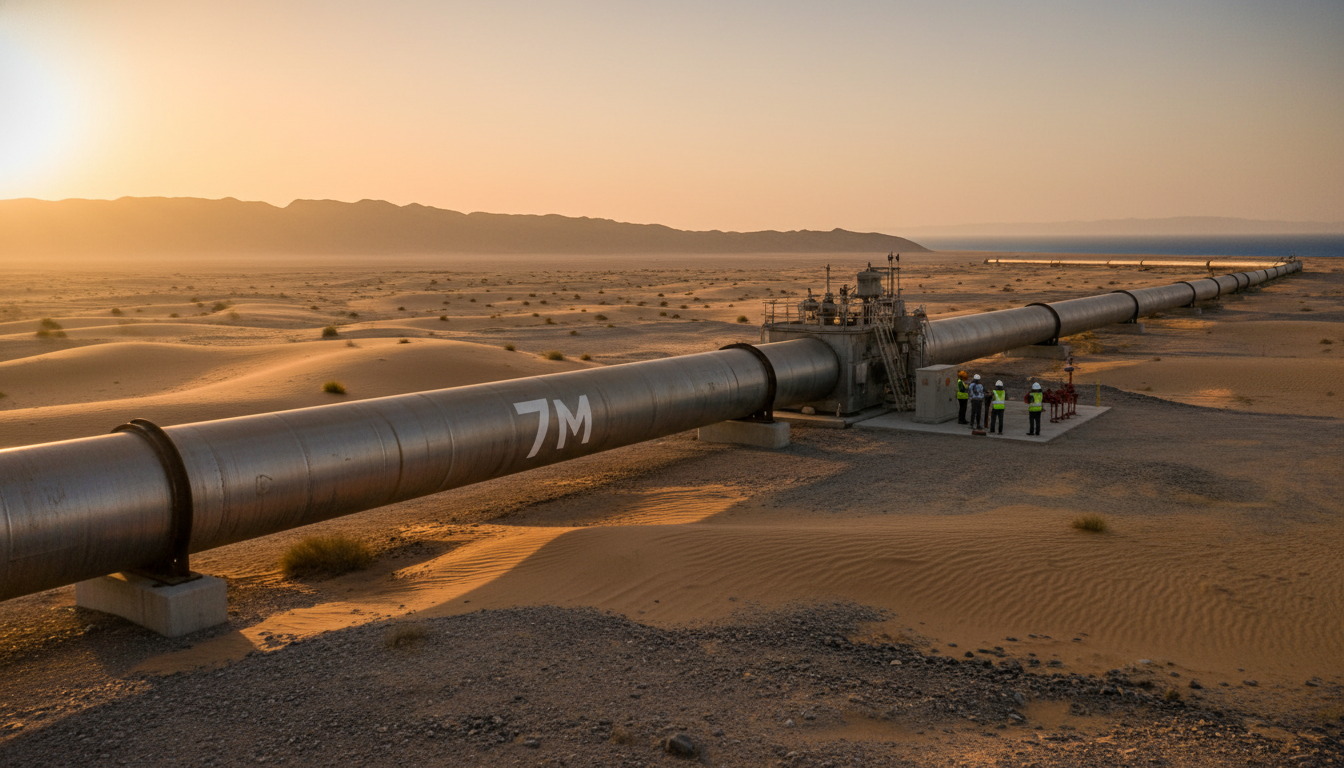
Saudi Arabia’s Strategic Pipeline Boosts Energy Security Amidst Red Sea Volatility
In a significant development for global energy markets, Saudi Arabia’s critical East-West pipeline, designed to bypass the volatile Strait of Hormuz, is now operating at its full capacity of 7 million barrels per day (bpd). This strategic maneuver underscores the Kingdom’s commitment to ensuring stable crude oil flows and offers a vital alternative export route at a time of heightened geopolitical tension in the Gulf region. The operational milestone was reported on Saturday, March 29, 2026, citing sources familiar with the Kingdom’s energy operations.
The East-West pipeline, also known as the Petroline, is a cornerstone of Saudi Arabia’s energy infrastructure, providing a crucial conduit for crude oil from the eastern oil fields directly to the Red Sea port of Yanbu. Its full activation comes at a pivotal moment, as regional conflicts involving US and Israeli actions against Iran have profoundly unsettled global energy and maritime transport markets. The ability to move vast quantities of oil without traversing the Strait of Hormuz significantly de-risks a substantial portion of Saudi oil exports, providing a buffer against potential disruptions to one of the world’s most critical maritime chokepoints.
Yanbu Exports Surge: A New Hub for Global Crude and Products
Accompanying the pipeline’s full utilization, crude oil exports from the strategically important Yanbu port on the Red Sea have escalated dramatically, now reaching 5 million bpd. This formidable volume highlights Yanbu’s emerging role as a major hub for global oil distribution. Beyond crude, Saudi Arabia is also exporting a substantial 700,000 to 900,000 bpd of refined oil products from its Red Sea terminals. These figures emphasize the comprehensive nature of the Kingdom’s strategy to diversify its export routes and enhance its resilience in the face of regional instability.
Investors should note that the pipeline’s accelerated full operation directly aligns with earlier statements from Saudi Aramco CEO Amin Nasser. In early March during an earnings call, Nasser had indicated that the East-West pipeline was anticipated to achieve its maximum 7 million bpd capacity “in the coming days,” driven by customers re-routing their crude supplies away from the Persian Gulf. While Aramco has declined to comment directly on the latest reports and independent verification has yet to be finalized, the consistent messaging and observed operational data point to a deliberate and successful strategic shift.
Geopolitical Headwinds and Soaring Oil Prices
The urgency behind maximizing the East-West pipeline’s capacity cannot be overstated. The escalating conflict in the Gulf, marked by alleged US and Israeli attacks on Iran, has created an environment of extreme volatility. A direct consequence of this tension has been Iran’s effective closure of the Strait of Hormuz, an act that has sent shockwaves through the global energy landscape. This audacious move has effectively trapped approximately one-fifth of the world’s total crude oil and liquefied natural gas (LNG) supplies within the Persian Gulf, triggering an immediate and sharp reaction in commodity markets.
The immediate market impact was unequivocal: crude oil prices surged dramatically, breaching the significant $100 per barrel threshold. This price spike reflects deep investor concern over supply security and the immense economic implications of any prolonged disruption to the Strait of Hormuz. For energy investors, the current environment presents a complex interplay of risk and opportunity, where geopolitical events directly translate into substantial market movements. Saudi Arabia’s preemptive measures to safeguard its export capabilities are thus a critical factor in mitigating what could otherwise be an even more severe global energy crisis.
Investor Implications: Strategic Resilience and Market Outlook
The full activation of the East-West pipeline offers a degree of reassurance to global oil markets by providing a robust alternative to the Strait of Hormuz. For investors analyzing the oil and gas sector, this development underscores the strategic importance of diversified infrastructure and the ability of key producing nations like Saudi Arabia to adapt to evolving geopolitical landscapes. While the pipeline’s capacity cannot fully offset all potential disruptions to global energy flows, particularly those impacting other Gulf producers or LNG shipments, it significantly enhances the resilience of the world’s largest oil exporter.
Looking ahead, the ongoing tensions in the Gulf will likely keep oil prices elevated and introduce a substantial geopolitical risk premium into the market. Energy companies with diversified asset bases and robust logistics are better positioned to navigate this uncertainty. Investors should closely monitor developments in the Red Sea and Gulf region, as any further escalation could severely impact global trade routes and commodity prices. Saudi Arabia’s strategic pipeline investments demonstrate a long-term vision for energy security that will remain paramount in an increasingly complex and interconnected world.
This dynamic situation highlights the critical need for robust supply chains and strategic foresight in the energy sector. The operationalization of the East-West pipeline at full capacity is not merely an engineering feat; it is a powerful statement about national energy resilience and a crucial stabilizing factor in an otherwise turbulent global oil market.


