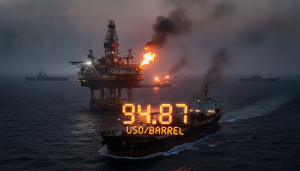
Navigating Geopolitical Crosscurrents: Why Military Intervention Won’t Solve Middle East Energy Disruptions
Global energy markets remain on edge as ongoing conflicts in the Middle East continue to cast a long shadow over critical oil and liquefied natural gas (LNG) shipping lanes. The strategic importance of arteries like the Strait of Hormuz has never been more apparent, with investors and analysts frequently debating the potential for decisive military action to restore unfettered flow. However, a recent gathering of leading energy strategists and former military officials highlighted the profound complexities and inherent risks that make such interventions far from straightforward solutions, suggesting a prolonged period of market volatility for global energy supplies.
The Critical Chokepoint: Strait of Hormuz Under Pressure
The Strait of Hormuz stands as the world’s most vital maritime oil transit chokepoint, a narrow passage through which a significant portion of global energy supplies must pass. Historically, over 20 million barrels per day (bpd) of crude oil and petroleum products, along with substantial LNG volumes, have transited this waterway. Today, while actual transit figures might fluctuate, the market disruption due to regional instability is staggering, impacting an estimated 10 to 12 million bpd of global supply. This current environment has seen approximately 800 vessels, ranging from supertankers to LNG carriers, experiencing significant delays on either side of the strait, with LNG production particularly vulnerable due to an inability to move vital cargoes. These physical constraints are not just theoretical; they translate directly into elevated shipping costs, extended delivery times, and heightened risk premiums in futures markets.
The Illusions of a Simple Military Solution
Amid such widespread disruption, a natural question arises for market participants: why doesn’t a major power simply intervene with military force to secure the strait? Experts at a recent energy industry conference, including a seasoned former U.S. Navy Admiral, unequivocally stated that such a proposition, while seemingly direct, is fraught with immense operational and strategic challenges. The threat environment within the Strait of Hormuz is far more sophisticated than widely perceived. It encompasses a multi-layered defense featuring advanced cruise and ballistic missiles, agile fast-attack boats, and an increasingly modern arsenal of naval mines. “The mine threat is there… it’s much more sophisticated than what people think,” noted the Admiral, dispelling notions of a simple passage.
Securing open passage through this contested waterway would demand a continuous, resource-intensive military commitment. This isn’t merely a matter of sending a few warships; it would require round-the-clock surveillance, constant air patrols, and a specialized array of supporting vessels. Crucially, the same vulnerabilities faced by commercial shipping—proximity to hostile shores, limited maneuverability, and potential for ambush—also apply to military assets. In such an environment, the odds are not in favor of continuous, unblemished success: “the enemy only has to get lucky once” for a significant incident to occur, carrying severe ramifications for global markets.
Beyond Force: The Absence of a Diplomatic Endgame
Beyond the immediate tactical complexities, the strategic and diplomatic landscape further complicates any military gambit. As emphasized by Middle East policy specialists at the recent forum, the underlying U.S. objectives regarding Iran’s nuclear and missile programs remain largely unmet. While informal points of contact may exist between Washington and Tehran, these do not constitute meaningful negotiations. Iran’s perspective, having hardened rather than softened amidst recent conflicts, adds another layer of intransigence. Tehran reportedly believes it is gaining leverage, suggesting that mere military pressure is unlikely to compel a swift resolution or significant policy shift. This hardened stance, coupled with Iran’s broader ambition to expand its regional influence, makes a diplomatic breakthrough following military action incredibly unlikely. Without a clear strategic end-state, military intervention risks becoming an open-ended engagement with unpredictable and potentially disastrous outcomes for regional stability and global energy security.
The Perils of Seizing Kharg Island
A more aggressive proposition sometimes discussed involves the seizure of Iran’s Kharg Island, a primary export terminal for Iranian crude. However, this option presents an even higher degree of escalation and risk. Experts cautioned that holding Kharg Island, which is positioned high up in the Persian Gulf and relatively close to the Iranian coastline, presents significant vulnerabilities. Unlike mobile naval vessels, an island facility cannot relocate, making it a static target for ongoing attacks. A former U.S. Navy Strategic Commander warned, “I don’t think that the loss of Kharg Island is going to do anything other than have Iran in turn attack the oil and gas infrastructure of our allies and partners in the Gulf.” The strategic calculation is stark: while gaining a geographical point, the broader war for energy stability could be irrevocably lost, leading to devastating blows against the production and export capabilities of other Gulf producers. Such an outcome would dwarf the current disruptions, plunging markets into unprecedented chaos.
Investor Outlook: Navigating Persistent Volatility and Geopolitical Risk
For energy investors, the takeaways from these expert discussions are unequivocally clear: simplistic military solutions to Middle East energy disruptions are fraught with peril. The operational complexities, the sophisticated threat landscape, and the profound risks of uncontrolled escalation mean that such interventions are unlikely to provide quick fixes or stable outcomes. Instead, they carry a high probability of exacerbating regional instability and triggering wider, more devastating attacks on crucial energy infrastructure across the Gulf. This analysis underscores the imperative for market participants to factor in prolonged geopolitical risk premiums and potential supply chain vulnerabilities into their investment strategies. The path forward for global energy security will likely involve navigating persistent volatility, rather than relying on rapid military interventions, keeping the global supply chain exposed to continued, unpredictable disruption.