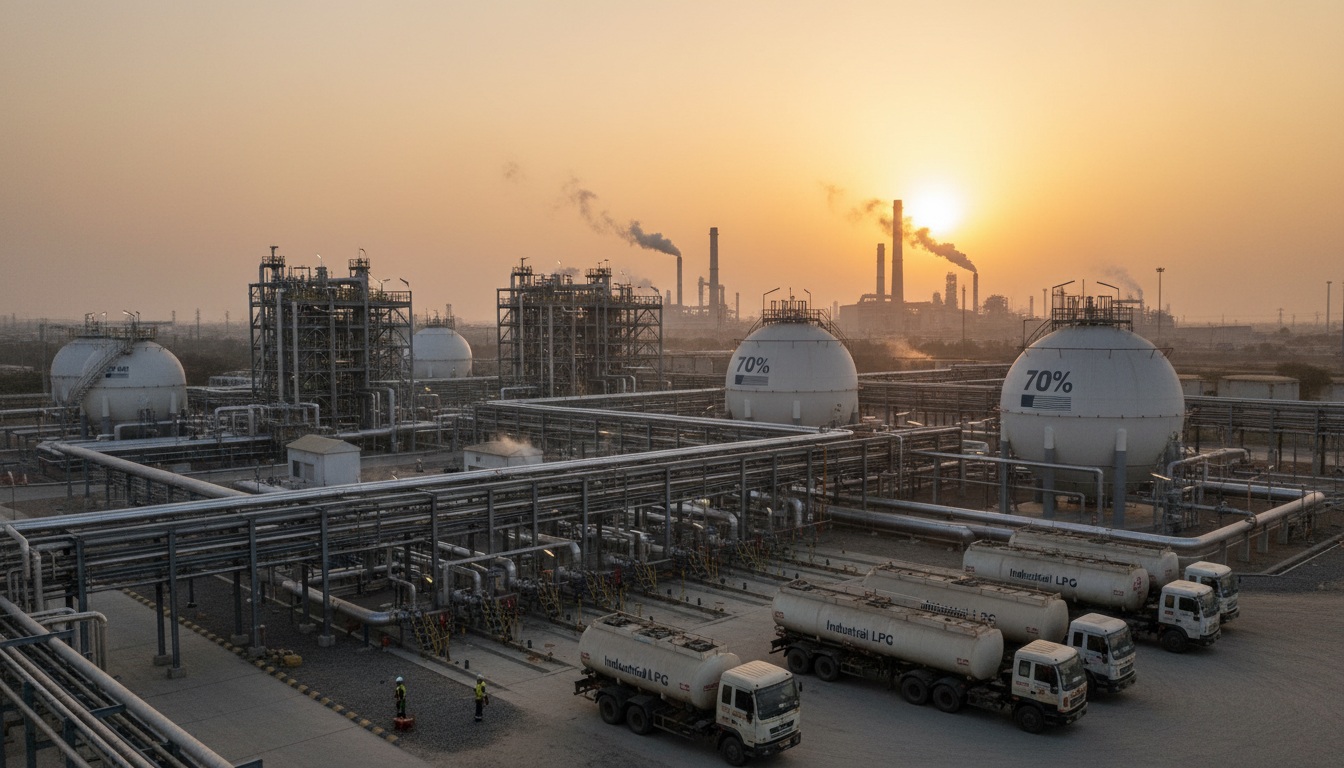
India Boosts Industrial LPG Allocation to 70% Amid Supply Squeeze, Signals Stability
New Delhi’s energy policymakers have delivered a significant uplift to India’s industrial and commercial sectors, proposing an additional 20 percent allocation of non-domestic liquefied petroleum gas (LPG) for states. This strategic move, announced on March 27 by Petroleum Secretary Neeraj Mittal, elevates the total commercial LPG availability to an impressive 70 percent of pre-crisis levels. For investors tracking India’s industrial output and energy security, this represents a crucial intervention designed to alleviate persistent supply bottlenecks and foster economic resilience.
The latest increase builds upon a foundational 50 percent base quota and an earlier 10 percent reform-linked additional allocation introduced this month, bringing the combined total to 70 percent. This phased enhancement underscores a proactive governmental approach to managing vital fuel supplies, particularly in the wake of global energy market volatility and geopolitical tensions, including the ongoing West Asia conflict, which have constrained gas availability. The Ministry of Petroleum & Natural Gas has been managing commercial LPG cylinders through a priority-based quota system, a testament to the essential nature of this commodity for industrial operations.
Targeted Relief for Core Industries and Specialized Applications
This bolstered allocation is explicitly engineered to buttress industries heavily reliant on LPG where alternative fuel sources, such as piped natural gas (PNG), are either unavailable or technically unfeasible. The government’s directive prioritizes key labour-intensive and core manufacturing sectors, including steel, automobiles, textiles, chemicals, dyes, and plastics. This focused approach aims to safeguard output and employment within these critical economic pillars, offering investors a clearer outlook on operational stability for companies in these segments.
Furthermore, the communication from the Petroleum Secretary delineates a preference for process industries and units that utilize LPG for specialized heating applications. These are typically areas where the chemical properties or precise temperature control offered by LPG cannot be easily replicated by natural gas, making substitution a significant challenge. This granular prioritization ensures that the enhanced supply reaches the most critical points of industrial demand, preventing potential production slowdowns that could impact corporate earnings and broader economic indicators.
Navigating Compliance and Future Fuel Transitions
Accessing this vital additional quota is not without stipulations. The government has linked the increased allocation to specific compliance conditions, urging industries to register with oil marketing companies (OMCs) and, where feasible, apply for PNG connections. This twin requirement signals a long-term strategic intent: while providing immediate relief through LPG, New Delhi simultaneously encourages a transition towards more sustainable and pipeline-based natural gas infrastructure where appropriate. This dual strategy offers insights into the evolving energy landscape and regulatory framework for industrial fuel consumption.
However, the policy includes judicious exemptions. Industries where LPG use is deemed integral to core processes and cannot be replaced by PNG will not be subjected to the PNG application mandate. This pragmatic flexibility acknowledges the diverse operational requirements across India’s industrial spectrum and aims to prevent undue disruption to specialized manufacturing. For investors, understanding these conditions and exemptions is crucial when evaluating the operational risks and fuel security of industrial assets within their portfolios.
Government Directives and Broader Market Implications
States have been tasked with the crucial responsibility of notifying and implementing the Natural Gas and Petroleum Products Distribution (Pipelines and Other Facilities) Order, 2026. This directive underscores the government’s commitment to developing and streamlining fuel distribution infrastructure across the nation. Additionally, states are urged to expedite the uptake of the earlier 10 percent reform-based allocation, reinforcing the immediate goal of maximizing fuel availability for industrial use.
The implications of this policy shift extend beyond mere supply numbers. “With this allocation, commercial and industrial LPG supply will rise to 70 per cent… and enable relief to industrial operations,” the communication noted, indicating a clear governmental objective to stabilize the fuel market. For investors, this translates into potentially reduced operational costs and enhanced reliability for businesses heavily reliant on LPG, fostering a more predictable environment for manufacturing and economic growth. The consistent efforts to increase allocation, from the previous week’s raise to 50 percent of pre-crisis levels to the current 70 percent, demonstrate a sustained commitment to supporting India’s industrial engine against global headwinds.
An Investor’s Outlook: Stabilizing Industrial Output
The decision to elevate commercial and industrial LPG allocation to 70 percent of pre-crisis levels represents a significant policy win for India’s manufacturing sector and a reassuring signal for investors. In an environment grappling with global energy supply volatility and inflationary pressures, securing essential industrial fuel at increased volumes mitigates a critical operational risk. This measure is expected to directly bolster production capabilities across vital sectors like steel, automotive, and textiles, contributing positively to India’s overall industrial output figures in the coming quarters.
Companies within the prioritized sectors, particularly those engaged in specialized heating processes, are likely to experience immediate relief from previous supply constraints. This enhanced fuel security not only supports current production but also provides a stable foundation for future expansion and investment. From a financial perspective, consistent fuel availability can help stabilize input costs, improve supply chain predictability, and ultimately contribute to healthier profit margins. As India continues its trajectory towards becoming a global manufacturing hub, strategic energy policy interventions such as this become pivotal for maintaining competitive advantages and attracting sustained capital flows into its robust industrial economy.


