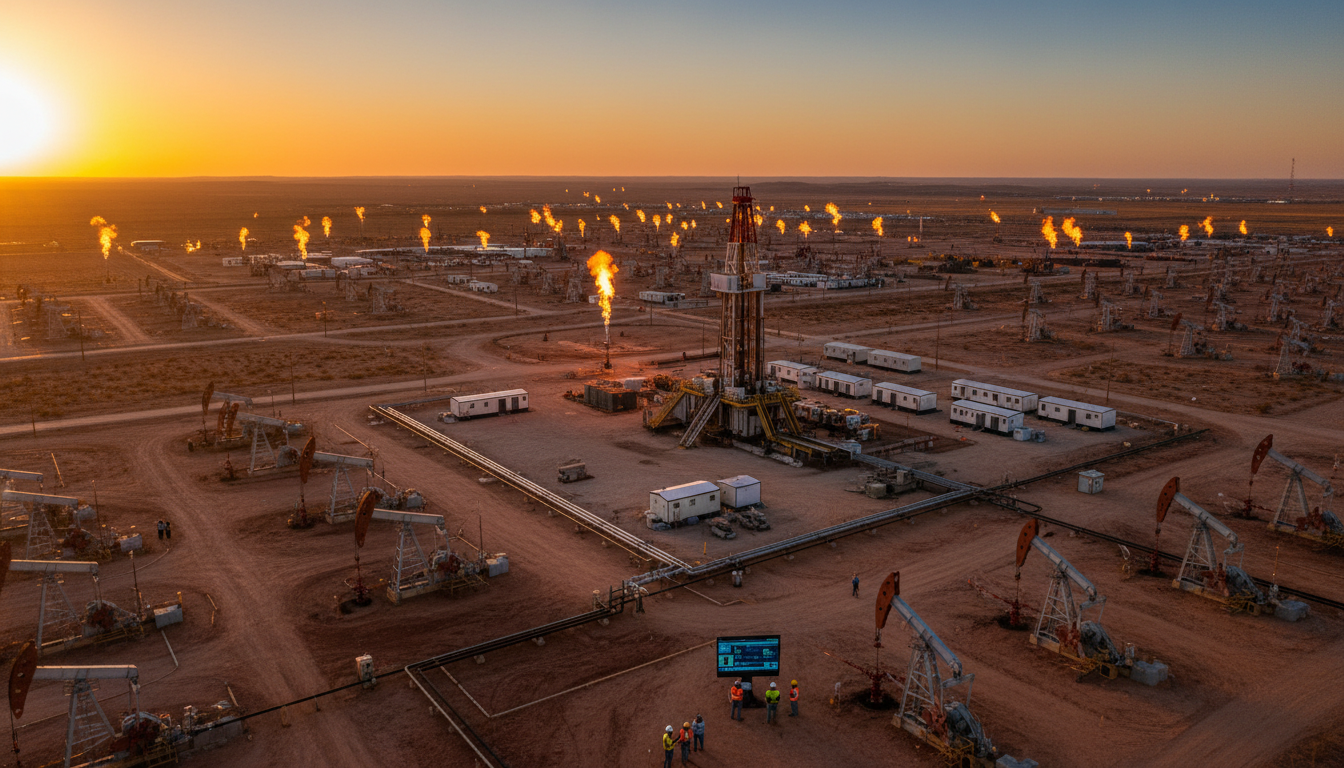
The Permian Basin stands as a formidable testament to the intricate interplay of geology, legal frameworks, capital allocation, technological advancement, and global geopolitics. Spanning vast stretches of West Texas and southeastern New Mexico, this prolific region has ascended to become the world’s leading crude oil-producing basin. Its output now surpasses the total production of numerous OPEC member states and rivals that of entire nations, underscoring its unparalleled significance in the global energy landscape.
Recent data indicates that Permian crude production surged past six million barrels per day (bpd) in 2024. To put this into perspective, this volume exceeds Iraq’s total crude output and closely approaches the production levels seen in Russia’s largest oil-producing regions. Commentators have even characterized the Permian as the closest equivalent the United States possesses to a “swing producer,” a role traditionally associated with Saudi Arabia. However, what truly distinguishes the Permian is not merely its staggering production volume, but the distinctively American ecosystem that facilitates such large-scale, rapid, and resilient hydrocarbon development.
A Century-Old Basin Reimagined for the Modern Era
The Permian Basin’s oil history traces back to discoveries in the early 1920s. For much of the 20th century, it operated as a conventional oil province, relying on vertical wells, primary recovery methods, and later, waterflooding. Production reached its zenith in the early 1970s before entering a prolonged period of decline. By the turn of the millennium, many considered the basin mature, envisioning a future marked by gradual depletion rather than robust growth.
This long-held assumption shattered after 2008 with the revolutionary adoption of horizontal drilling combined with multi-stage hydraulic fracturing. The Permian’s inherent geological advantage lies in its stacked stratigraphy. Formations like the Wolfcamp, Spraberry, and Bone Spring comprise multiple hydrocarbon-bearing layers, often thousands of feet thick. This contrasts sharply with single-zone shale plays, empowering operators in the Permian to repeatedly develop the same acreage across various benches, maximizing resource extraction and efficiency.
The period between 2014 and 2019 saw Permian oil production more than double. Following a temporary dip during the COVID-19 pandemic, output rebounded sharply. Crucially, this resurgence was propelled less by sheer capital intensity and more by significant efficiency gains. From 2014 to 2024, oil production per active rig in the Permian more than tripled, a powerful indicator of how technological innovation transformed the basin from a simple drilling narrative into a sophisticated manufacturing system for hydrocarbons.
The Undersung Advantage: America’s Unique Mineral Ownership Laws
A fundamental, yet often underappreciated, driver of the Permian’s spectacular success is rooted not in geology, but in American jurisprudence. The United States’ unique system of mineral ownership, though influenced by certain European legal traditions, allows for the private ownership of subsurface mineral rights. This stands in stark contrast to most parts of the world, where mineral rights typically vest with the state.
In the U.S., mineral rights are frequently privately held and legally separable from surface property rights. This framework empowers landowners to directly lease their mineral assets to exploration and production companies, receiving royalties directly tied to production volumes. The outcome is a powerful convergence of interests and incentives across landowners, operators, service providers, and financial backers. This dynamic fosters a highly collaborative and entrepreneurial environment crucial for rapid development.
As noted by energy historians, private mineral ownership forged a distinctively American pathway for oil development. This pathway inherently rewards experimentation, swift execution, and calculated risk-taking. In the Permian, this legal structure enabled a multitude of independent entities to innovate drilling techniques, quickly learn from failures, refine successful methods, and rapidly scale operations. The shale revolution, therefore, was not merely a technological marvel; it represented a profound legal and institutional transformation. Without this foundational framework, the Permian, despite its geological wealth, would likely face the same administrative and developmental constraints observed in many resource-rich basins globally, unable to unlock its full potential. Instead, it blossomed into the world’s most dynamic hydrocarbon system.
Unprecedented Scale Reshaping U.S. Energy Dominance
Today, the Permian Basin accounts for nearly half of the total U.S. crude oil production and approximately 20 percent of the nation’s natural gas output, much of which is produced as associated gas. In 2024, natural gas production in the basin surpassed 23 billion cubic feet per day, a volume comparable to the entire gas output of major exporting countries such as Algeria.
This exponential growth has fundamentally repositioned the United States as the world’s largest oil producer and a pivotal global energy exporter. U.S. crude exports exceeded four million barrels per day in 2023, with the Permian supplying the majority of these incremental barrels. These exports primarily flow to key markets in Europe and Asia via the U.S. Gulf Coast, seamlessly integrating West Texas production into the broader global energy supply chain.
International energy agencies have consistently highlighted that U.S. shale production, spearheaded by the Permian, has been the single most critical source of non-OPEC supply growth over the last decade. This reality has profoundly influenced OPEC+ strategy, helped temper sustained oil price spikes, and significantly altered the global balance of energy power, providing a substantial buffer against geopolitical disruptions.
Consolidation: Who Dominates the Basin Today?
The ownership landscape of the Permian Basin has undergone rapid consolidation. While early shale growth was largely driven by independent producers and private equity-backed operators, that phase has largely concluded. The basin is now increasingly dominated by large, well-capitalized firms. Industry giants like ExxonMobil, Chevron, and Occidental Petroleum collectively control millions of net acres across the Permian’s most prospective areas. Exxon’s landmark acquisition of Pioneer Natural Resources in 2024 created the basin’s single largest operator, boasting production exceeding 1.3 million barrels of oil equivalent per day. Similarly, Chevron’s acquisition of Hess further concentrates high-quality inventory among supermajors.
This consolidation reflects both geological imperatives and the increasing discipline of capital markets. As industry leaders have publicly stated, scale is paramount in the Permian, not only for achieving operational efficiencies but also for ensuring the longevity of inventory and optimizing long-term development strategies. Larger operators are better equipped to manage complex well spacing, mitigate parent-child well interference effects, and sustain robust returns amidst growing shareholder demands for capital efficiency and disciplined investment.
Advancing Technology Beyond the Wellbore
Productivity gains in the Permian are no longer solely contingent on drilling longer laterals or increasing proppant volumes in hydraulic fracturing. The cutting edge of innovation now lies in real-time data integration, sophisticated subsurface modeling, and precise decision-making at the wellbore itself. Cloud-based geosteering platforms exemplify this technological shift. These advanced tools enable operators to seamlessly integrate real-time drilling data with comprehensive geological models in a cloud environment. This capability allows for dynamic adjustments to well trajectories as drilling progresses, ensuring laterals remain within the most productive zones, thereby significantly reducing geological risk, enhancing recovery factors, and improving capital efficiency.
These sophisticated tools are particularly invaluable in a basin reaching maturity, where tighter well spacing, stacked development, and intricate well interactions increase the potential cost of operational errors. As one prominent Permian-focused operator articulated, “The next wave of gains won’t come from drilling faster, but from drilling smarter.” In this evolving operational landscape, software solutions, robust data architecture, and cloud computing infrastructure are becoming as critical to success as the physical rigs and hydraulic fracturing fleets.
The Gas Conundrum: Infrastructure as a Bottleneck
Despite its many strengths, the Permian faces a critical structural challenge: inadequate natural gas takeaway capacity. The rapid growth of associated gas production has repeatedly outpaced the expansion of pipeline infrastructure, leading to severe and persistent pricing dislocations at the Waha hub in West Texas. At various points throughout 2023 and 2024, Waha natural gas prices traded more than $10 per thousand cubic feet (Mcf) below benchmark Henry Hub prices, and on several occasions, plunged deep into negative territory. These extreme price differentials are a direct consequence of oil-driven drilling economics colliding with insufficient gas transportation infrastructure. In practical terms, this often forces producers to incur costs to dispose of their natural gas simply to continue producing lucrative crude oil.
Midstream sector investment has responded, but always with an unavoidable lag. New pipelines offer periodic relief, only to be subsequently overwhelmed by surging production volumes. Until liquefied natural gas (LNG) export capacity, power generation demand, and downstream industrial consumption expand sufficiently to absorb the basin’s abundant gas, takeaway capacity will remain a binding constraint on Permian development. For investors, Waha pricing is far from a peripheral issue; it represents a material variable that directly impacts drilling economics, project returns, and the long-term sustainability of basin operations.
A Mature Basin with Pivotal Strategic Importance
The Permian is no longer characterized as an unconstrained growth engine. It has evolved into a mature basin defined by capital discipline, operational optimization, and the practical limits of its infrastructure. Yet, this very maturity enhances, rather than diminishes, its strategic importance. As long as the Permian maintains production levels above six million barrels per day, it fundamentally underpins U.S. energy security, facilitates robust LNG exports, and exerts significant gravitational influence on global oil prices. For policymakers, the basin provides an invaluable strategic buffer that few other nations possess. For savvy investors, it represents a long-duration asset, demonstrating declining volatility and consistently improving capital efficiency.
In essence, the Permian Basin is more than just a geological phenomenon. It is the culmination of American mineral law, dynamic capital markets, pioneering technology, and evolving infrastructure converging in a singular, powerful location. No other oilfield on Earth combines these diverse elements at a comparable scale. This unique convergence unequivocally explains why the Permian remains not only America’s most vital energy basin but arguably the most strategically consequential oilfield in the world today.