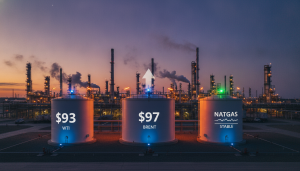
Geopolitical Tensions Drive Crude Volatility: Investors Eye Hormuz as Supply Fears Intensify
The global oil market remains highly susceptible to geopolitical shifts, with recent developments underscoring persistent supply chain vulnerabilities. Discussions at the highest levels of the U.S. government, specifically involving President Donald Trump and leading oil corporations, have centered on strategies to mitigate the potential fallout from a prolonged blockade of Iranian ports. These high-stakes conversations reflect a growing concern among policymakers and market participants that the current embargo, particularly impacting the vital Strait of Hormuz, could extend far beyond initial projections. The Strait, a critical chokepoint for global energy transit, is at the heart of the dilemma. With Iran imposing blockades on most Gulf shipping and the U.S. retaliating against Iranian vessels, the prospect of a swift resumption of normalized crude flows appears increasingly remote, signaling sustained pressure on global supply chains and elevated risk premiums for investors in the energy sector.
OPEC+ Supply Boost Falls Short as Physical Market Remains Tight
As the market grapples with these severe supply constraints, attention turns to the Organization of the Petroleum Exporting Countries and its allies (OPEC+), who are reportedly considering a modest quota increase of 188,000 barrels per day. While such a move might, under normal circumstances, offer some relief to surging prices, current market dynamics suggest this incremental adjustment is largely insufficient to bridge the substantial deficit. The chasm between available physical supply and burgeoning demand is far wider than what this proposed quota hike can address. For investors, the concern isn’t just about headline production figures, but about the actual barrels flowing into the global market. Without a significant uptick in physical exports from Gulf producers, the increase in “paper barrels”—or theoretical supply increments—may not translate into tangible relief or meaningfully ease the pressure on benchmark prices.
Adding another layer of uncertainty to the OPEC+ landscape is the United Arab Emirates’ potential withdrawal from the cartel. Should the UAE, a significant producer, decide to exit, it could fundamentally alter OPEC’s long-term influence over global oil prices and its collective ability to manage market stability. While such a move might not immediately impact current market fundamentals, especially given the ongoing geopolitical conflict severely disrupting production and exports, its long-term implications for investor confidence and the future structure of global oil governance are substantial. It’s crucial for investors to recognize that even if tensions were to ease, it could take several months for key Gulf oil producers to fully restore production levels to their pre-conflict benchmarks. This protracted recovery period, coupled with the continued restrictions at the Strait of Hormuz and other vital ports, implies that crude oil prices are likely to remain well-supported in the foreseeable future.
Technical Indicators Point to Further Upside for Brent and WTI
From a technical analysis perspective, the trajectory for both Brent and West Texas Intermediate (WTI) crude oil benchmarks signals continued bullish momentum, presenting intriguing opportunities and risks for energy investors. Brent crude, a global benchmark, has demonstrated remarkable resilience, successfully establishing a robust long-term support level at the $90 per barrel mark. Following this consolidation, Brent has once again ascended to retest the $120 threshold. The current short-term price action exhibits strong bullish characteristics, suggesting that this upward trajectory is far from exhausted. Based on prevailing technical signals, market analysts anticipate a likely push towards the $130 per barrel psychological barrier over the coming trading sessions, providing a clear upside target for investors.
Further reinforcing this bullish outlook is the emergence of a distinctive technical pattern in the crude oil charts: a descending broadening wedge. This pattern, typically observed after a significant price decline, often precedes a powerful upward reversal. The subsequent breakout above the crucial $90 area, followed by a confirming retracement back towards the $90 level before resuming its climb, serves as a strong indicator of sustained buying interest and robust bullish momentum in the broader oil market. For discerning investors, this technical confirmation suggests that the underlying market sentiment remains overwhelmingly positive, with significant upward potential still in play as fundamental supply constraints continue to underpin price strength. Monitoring these key price levels and patterns will be critical for navigating the volatile crude market in the coming weeks and months.