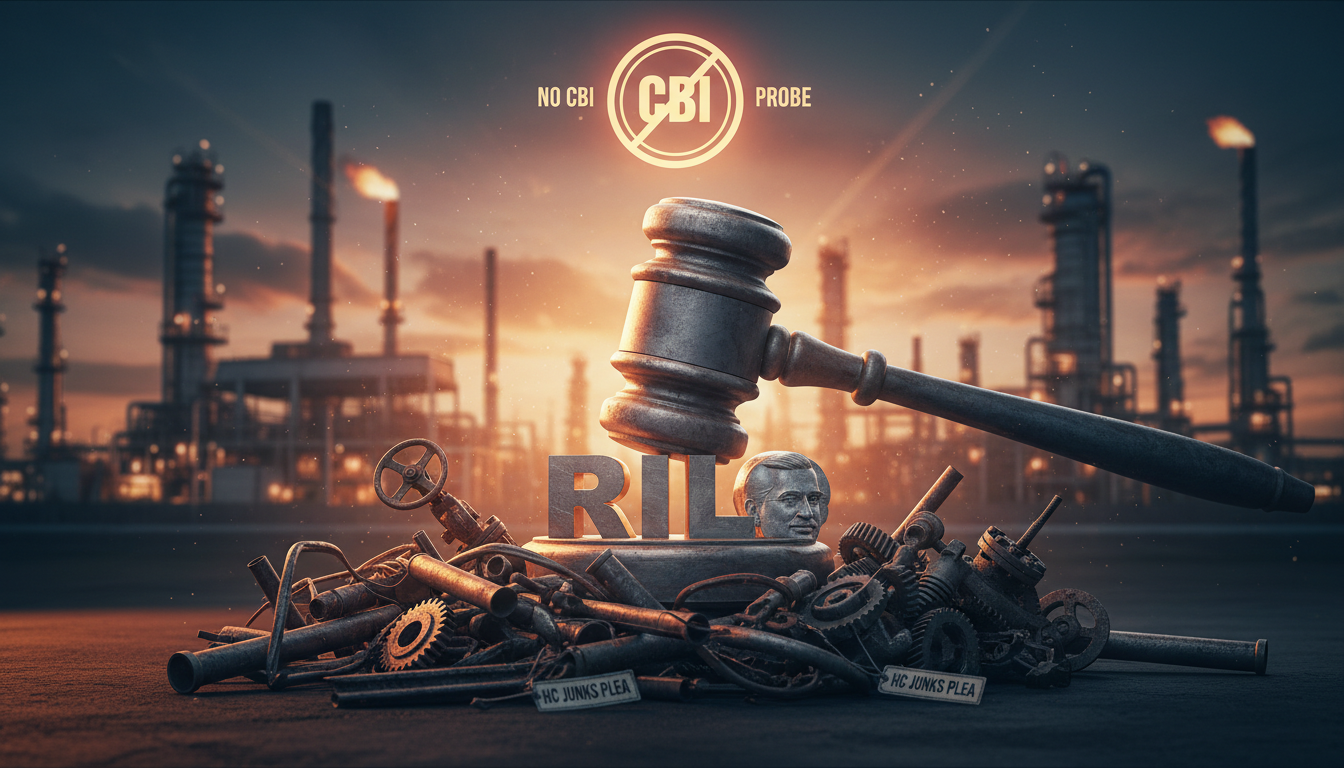
Bombay High Court Dismisses Petition for CBI Probe Against Reliance Industries and Mukesh Ambani Over Gas Extraction Claims
Mumbai – In a significant development impacting India’s oil and gas sector, the Bombay High Court has rejected a petition seeking a Central Bureau of Investigation (CBI) inquiry into Reliance Industries Limited (RIL) and its Chairman and Managing Director, Mukesh Ambani. The dismissed petition had alleged the unlawful extraction of natural gas from fields belonging to state-owned Oil and Natural Gas Corporation (ONGC) within the prolific Krishna-Godavari (KG) basin.
A judicial bench, comprising Chief Justice Shree Chandrashekhar and Justice Suman Shyam, declined to grant relief to petitioner Jitendra Maru, who had pressed for the registration of a First Information Report (FIR) against RIL and Mr. Ambani. The specific charges sought in the petition included theft, dishonesty, misappropriation of assets, and criminal breach of trust, underscoring the serious nature of the allegations that have long been a focal point of debate within the energy industry.
Investors closely monitor legal and regulatory challenges involving major energy players, as such issues can significantly influence corporate valuations and operational continuity. The high court’s decision to dismiss this particular petition offers a degree of legal clarity, at least regarding the immediate demand for a CBI investigation into the matter of alleged gas pilferage from shared reservoir structures.
Deciphering the Allegations: A Decade of Disputed Gas Reserves
The core of Maru’s petition outlined claims of a “massive organized fraud” allegedly perpetrated by RIL over a nearly a decade, specifically from 2004 to 2013. The petitioner asserted that RIL had engaged in drilling operations that extended sideways from its deep-sea wells, strategically positioned to tap into adjacent gas reservoirs definitively allocated to ONGC. This alleged clandestine extraction of natural gas from contiguous fields, if proven, would represent a substantial violation of concession agreements and resource ownership principles, with direct implications for shareholder value in both entities.
The Krishna-Godavari basin stands as one of India’s most strategically important hydrocarbon provinces, holding vast reserves of natural gas critical for the nation’s energy security and economic growth. Deepwater exploration and production in such complex geological settings inherently involve significant capital expenditure and advanced technological prowess. Discrepancies and disputes over reservoir boundaries and shared resource pools are not uncommon in global upstream operations, but allegations of deliberate unauthorized extraction carry far-reaching consequences for corporate governance and investor confidence.
Independent Reports and the Committee Findings
The petitioner’s arguments drew heavily upon a foundation of prior investigations and expert opinions. Crucially, the plea referenced an independent assessment conducted by the renowned consultants DeGolyer and MacNaughton. This firm, recognized globally for its expertise in reservoir engineering and resource evaluation, reportedly concluded that RIL had indeed tapped into ONGC’s designated natural gas reserves. Such independent validation, even in the context of a legal petition, typically carries considerable weight in stakeholder discussions regarding technical and operational integrity.
Further bolstering the petitioner’s claims was the mention of a report submitted by the retired Justice A.P. Shah Committee. This committee, tasked with examining the long-standing dispute, also arrived at a conclusion indicating that RIL’s operations had intersected with and extracted gas from ONGC’s fields. These reports, cited within the legal framework of the dismissed petition, highlight the technical complexities and the significant financial stakes involved in these inter-company resource disagreements within India’s upstream sector. ONGC itself reportedly discovered these alleged unauthorized extractions in 2013, promptly bringing the matter to the attention of the Government of India.
Investor Outlook and Market Implications
For investors tracking India’s energy giants, the dismissal of this petition by the Bombay High Court marks a key moment. While the court’s decision specifically addresses the request for a CBI probe and not necessarily the factual merits of the underlying allegations of gas siphoning, it does remove one immediate layer of legal and investigative uncertainty for Reliance Industries Limited. RIL, a conglomerate with significant investments across various sectors, has consistently maintained that its operations adhere strictly to regulatory guidelines and contractual obligations.
The long-running nature of these allegations, however, underscores the persistent regulatory and corporate governance risks that can impact companies operating in resource-intensive sectors. Shareholder value is intrinsically linked to perceived transparency, ethical conduct, and legal compliance. While the current dismissal may ease immediate concerns about a criminal investigation, the broader historical context of inter-company disputes over shared reservoirs remains a pertinent consideration for those evaluating long-term investments in India’s oil and gas landscape.
Conversely, ONGC, as the nation’s largest crude oil and natural gas producer, consistently aims to maximize production from its allocated blocks to ensure national energy security. Any perceived loss of resources due to unauthorized extraction from its fields can have implications for its production targets and, by extension, its financial performance. The ongoing dialogues and potential future legal avenues concerning these reservoir disputes will continue to shape investor sentiment towards both public and private sector players in the Indian energy market.
The Bombay High Court’s ruling, delivered by the Chief Justice and Justice Suman Shyam, thus signifies a particular procedural outcome in a complex and high-profile case. While the immediate call for a criminal investigation through a CBI probe has been declined, the underlying issues pertaining to resource sharing and alleged unauthorized extraction continue to resonate within the industry and amongst discerning oil and gas investors.


