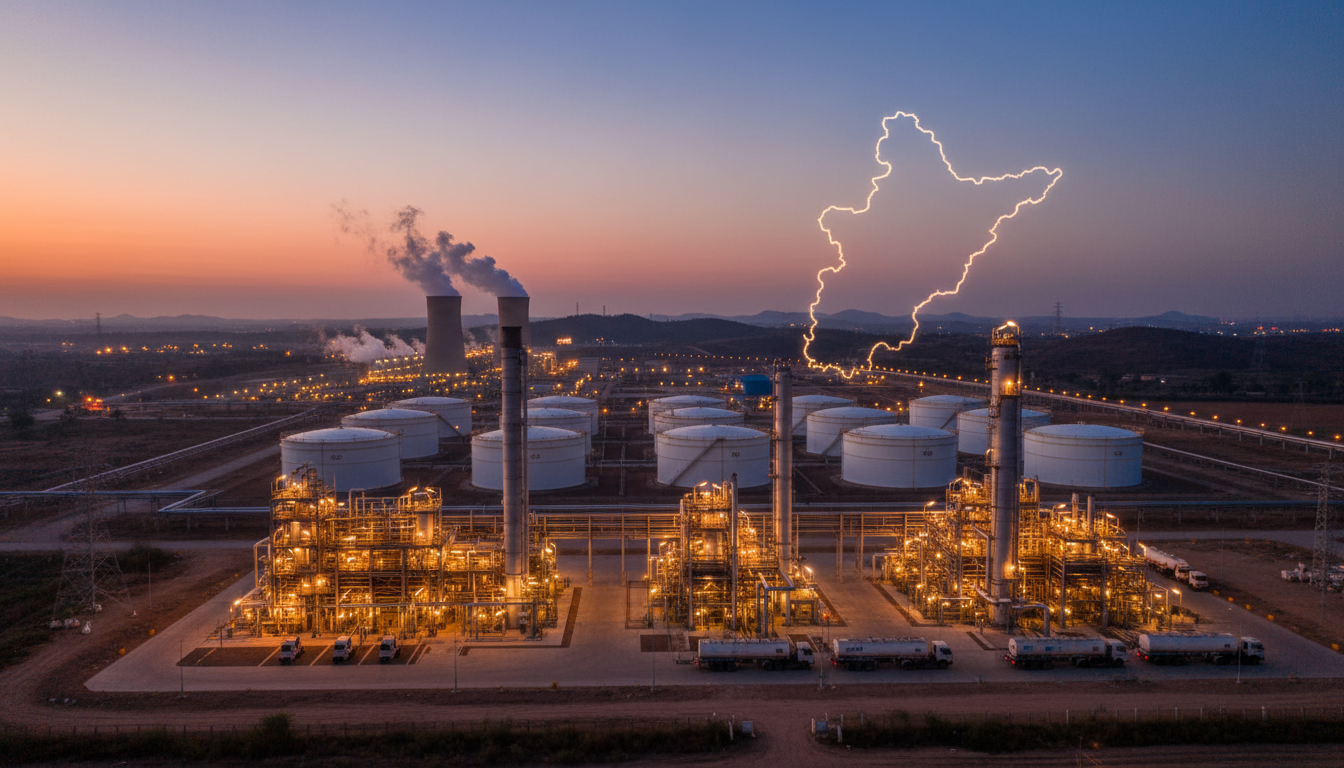
The global energy landscape is a complex tapestry where localized events, even if temporary, can offer significant insights into market dynamics and investor sentiment. A recent incident in Telangana, India, serves as a compelling case study on the immediate and profound impact of misinformation on downstream fuel operations, despite fundamentally robust supply chains. While the panic buying that swept through Hyderabad quickly subsided, it underscores the critical importance of transparent communication and strong logistical infrastructure in maintaining market stability. For energy investors, this event is a reminder that even in an era of sophisticated data analytics, consumer confidence remains a powerful, if sometimes irrational, driver of short-term market behavior.
Localized Panic vs. Global Market Realities: A Tale of Two Trends
The situation in Telangana unfolded rapidly, beginning Tuesday evening, as unfounded rumors of an impending fuel shortage triggered widespread panic buying. Motorists, fearing scarcity, swarmed petrol stations, leading to extensive queues and temporary stockouts at numerous retail outlets. This surge in demand was entirely sentiment-driven, not a reflection of actual supply disruptions. Contrast this localized, misinformation-fueled volatility with the broader crude market: as of today, Brent crude trades at $92.45, reflecting a -0.85% decline within a day range of $91.39 to $94.21. Similarly, WTI crude is at $88.73, down -1.05%, navigating a daily range of $87.64 to $90.71. These global benchmarks have also seen a downward trend over the past two weeks, with Brent moving from $101.16 on April 1st to $94.09 on April 21st, a notable decrease of over 7%. This divergence highlights a key lesson for investors: while global crude prices are influenced by macro-economic factors, geopolitical tensions, and supply-demand fundamentals, localized downstream markets can experience acute, short-lived disruptions driven purely by psychological factors. The Telangana event was a micro-burst of demand, distinct from the broader, more measured movements in the international oil markets.
Resilience in the Downstream: India’s Oil Marketing Companies Hold Firm
The rapid debunking of the shortage rumors was largely due to the robust fundamentals of India’s downstream sector. The Telangana Petroleum Dealers Association, in conjunction with major oil marketing companies (OMCs) such as Hindustan Petroleum Corporation Limited (HPCL), Indian Oil Corporation Limited (IOCL), and Bharat Petroleum Corporation Limited (BPCL), swiftly moved to reassure the public. These OMCs maintain substantial inventories, ensuring their supply chains operate without interruption. This collective reassurance was pivotal in stabilizing public perception. More concretely, M Stephen Raveendra, the Civil Supplies Department Commissioner, provided clear data: on Tuesday alone, 1,500 petrol and diesel tankers were dispatched across Telangana, demonstrating immense logistical capacity. Crucially, the state’s standing petrol reserves currently hover around 20,000 kiloliters, a volume deemed more than sufficient for daily requirements. For investors monitoring the Indian energy sector, this incident reaffirms the underlying strength and operational resilience of these OMCs, suggesting that their distribution networks are well-equipped to handle even significant, unexpected surges in demand, provided the supply chain remains uncompromised.
Government Intervention and Future Market Signals for Investors
The swift and decisive intervention by government authorities further underscored the strategic importance placed on uninterrupted fuel supply. Telangana Chief Minister A Revanth Reddy’s planned comprehensive review meeting, not only covering petrol and diesel but also LPG cylinders and urea, signals a proactive governmental approach to essential commodity availability. This level of oversight is a key indicator for investors regarding the stability and reliability of the energy sector’s regulatory environment. Hyderabad Police Commissioner V C Sajjanar’s public appeal for calm also played a role in de-escalating the situation. Investors are always seeking signals of market stability and predictability. While some investors are acutely focused on the immediate trajectory of WTI crude, asking whether it’s poised for an upward or downward trend, this Telangana case illustrates that strong governmental and industry response mechanisms can effectively buffer localized shocks, preventing them from spiraling into more systemic issues. This proactive stance helps to mitigate risks associated with regional volatility, offering a degree of assurance to those evaluating long-term investments in India’s energy infrastructure.
Beyond Localized Shocks: Upcoming Global Energy Data and Investor Focus
While the Telangana incident highlights the importance of localized market dynamics and consumer sentiment, the broader energy investment landscape remains heavily influenced by global data and upcoming events. Many investors are keenly interested in the longer-term outlook, with questions often surfacing about the predicted price of oil per barrel by the end of 2026. Such long-term forecasts are shaped by a confluence of factors, many of which will be illuminated by forthcoming reports. For instance, the EIA Weekly Petroleum Status Reports on April 22nd and April 29th will provide critical insights into U.S. crude inventories, refinery utilization, and demand indicators, which directly impact global benchmarks. Similarly, the Baker Hughes Rig Count, scheduled for April 24th and May 1st, offers a forward-looking view on upstream activity and potential future supply. Adding further depth, the EIA Short-Term Energy Outlook on May 2nd will present updated projections for global supply, demand, and prices. While the Telangana event was a sharp, localized reminder of human factors, these upcoming data releases provide the fundamental, quantifiable metrics that ultimately drive the macro-level investment decisions in the dynamic oil and gas sector.


