The global oil market is once again navigating treacherous waters, with geopolitical tensions in the Middle East acting as a potent catalyst for price volatility. While the recent surge in crude benchmarks captures headlines, driving a fresh wave of concern across Asian economies, a deeper dive into our proprietary data reveals a more nuanced picture. Investors are currently grappling with the immediate impact of supply fears stemming from the escalating conflict, alongside the broader implications for global inflation and economic growth. This analysis leverages OilMarketCap’s real-time market data, forward-looking event calendar, and direct insights into investor sentiment to provide a comprehensive outlook on crude’s trajectory and the strategic considerations for energy portfolios.
Geopolitical Risk Premiums Fueling Crude’s Ascent
The expanding conflict in the Middle East, particularly the heightened tensions involving Iran, has unmistakably injected a significant risk premium back into oil prices. The Strait of Hormuz, a critical maritime choke point through which approximately one-fifth of the world’s daily oil supply transits, remains a focal point of investor anxiety. Amid Iranian claims of complete naval control over the Strait and prior pledges from the U.S. to ensure safe passage and shipping insurance, the market is pricing in substantial uncertainty regarding future supply stability. As of today, Brent Crude trades at $94.09 per barrel, reflecting a 0.91% increase within the day’s range of $93.52-$94.21. Similarly, WTI Crude has climbed to $90.59 per barrel, up 1.03% with a day range of $89.71-$90.70. While these figures represent a clear upward momentum driven by the immediate crisis, it’s crucial to note the broader context. Our 14-day Brent trend data indicates that crude had previously reached a higher peak of $101.16 on April 1st, before a subsequent retrace. This suggests that while current geopolitical events are certainly driving a fresh rally, the market had already demonstrated its capacity for even higher prices earlier in the month, underscoring the structural tightness that underpins current supply concerns.
Asia’s Economic Vulnerability Amid Surging Energy Costs
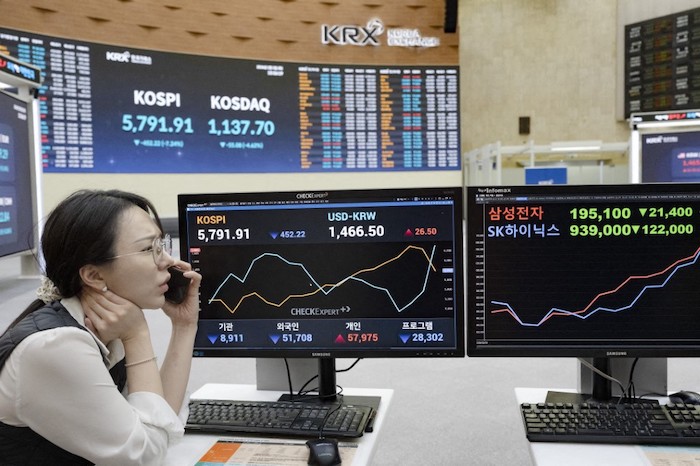
The ripple effects of rising oil prices are most acutely felt across Asia, where economies are heavily reliant on imported energy. The past week has seen significant turmoil in regional stock markets, with indices like South Korea’s Kospi experiencing a severe downturn, registering its worst two-day collapse since the 2008 financial crisis. This panic selling, particularly in the tech sector with giants like Samsung and SK Hynix seeing double-digit declines, underscores the deep structural dependency on affordable energy. For export-driven nations, an increase in crude costs is not merely an operational expense; it fundamentally recalibrates margins across manufacturing and logistics. Analysts highlight that when crude edges higher, the economic invoice lands hardest in Asia, threatening to fan inflation and complicating monetary policy decisions for central banks that were previously anticipating interest rate cuts. This inflationary pressure from energy costs could further dampen consumer spending and investment, creating a significant headwind for regional growth prospects and, by extension, global demand.
Decoding Crude’s Trajectory: Addressing Investor Concerns
OilMarketCap’s proprietary reader intent data reveals a clear focus from investors on crude’s immediate and long-term direction, with common questions revolving around whether WTI will move “up or down” and predictions for “the price of oil per barrel by end of 2026.” The current geopolitical tensions certainly lend credence to an upward bias in the short term, as evidenced by today’s price movements. However, a sustainable rally past previous highs, such as the $101.16 seen earlier this month, will depend on more than just the immediate crisis. Investors must weigh the potential for de-escalation against persistent supply constraints, global demand health, and the strategic decisions of major producers. While some analysts warn of Brent potentially reaching $100 per barrel in the near term given the current risk landscape, our analysis suggests that long-term price predictions for late 2026 remain highly sensitive to evolving macroeconomic conditions, the pace of the energy transition, and, crucially, the resolution or prolonged nature of Middle Eastern instability. The interplay of these factors creates a complex outlook, making agile portfolio management essential.
Upcoming Catalysts on the Horizon for Oil Investors
Beyond the immediate geopolitical headlines, several key data releases and events on our proprietary calendar in the coming weeks will offer crucial insights into the fundamental supply-demand picture and potential price catalysts. This Wednesday, April 24th, investors will closely monitor the EIA Weekly Petroleum Status Report for updates on U.S. crude oil and gasoline inventories, refinery utilization, and demand indicators. Unexpected draws or builds could significantly influence market sentiment. Following this, the Baker Hughes Rig Count on Friday, April 26th, will provide a snapshot of North American drilling activity, offering clues about future production trends. As we move into early May, the API Weekly Crude Inventory report on May 5th, followed by another EIA Weekly Petroleum Status Report on May 8th, will continue to shape the near-term supply narrative. Perhaps most critically for longer-term outlooks, the EIA Short-Term Energy Outlook on May 2nd will present updated forecasts for global supply, demand, and prices, providing a benchmark for market expectations through the remainder of 2026. These scheduled events will offer fundamental data points to either reinforce or challenge the current geopolitical risk premium, guiding investment decisions beyond the immediate crisis narrative.