A Geopolitical look at who’s winning in January 2026—and why Russia’s innovation matters
In Kyiv, the war isn’t an abstraction. It’s the moment your phone dies and your apartment goes quiet—no heat, no light, no elevator, no water pressure—and you realize you’re budgeting hours the way you used to budget money.
In one recent attack cycle, an elderly Kyiv resident told reporters she’d gone 50 hours without power, and that the city’s emergency “Points of Invincibility” (warmth, charging, basic supplies) had become part of daily survival. (AP’s reporting on the winter grid assaults).
Then came the bluntest municipal confession a modern capital can make: Mayor Vitali Klitschko said Kyiv is getting only about half the electricity it needs, with many residents enduring 18–20 hours a day without power in temperatures plunging to -17°C (1°F). (Reuters, Jan. 16, 2026).
Nationally, President Volodymyr Zelensky ordered accelerated imports of electricity and power equipment because Ukraine’s battered energy system can meet only about 60% of national electricity needs after sustained Russian attacks. (Reuters, Jan. 17, 2026).
That’s not atmosphere. That’s the war’s logic made visible.
And it’s the clearest way to understand a question people keep asking as if it had a clean, cinematic answer: Who’s winning?
The honest answer—without propaganda
If you grade the war like a highlight reel, you will get the wrong result. This phase isn’t being decided by one breakthrough, one wonder-weapon, or one viral map. It’s being decided by systems: force-generation pipelines, munitions output, drone iteration cycles, grid resilience, and coalition bandwidth.
In plain terms:
Russia is winning the war’s current phase (attritional pressure and incremental advance). Ukraine is still contesting the war’s outcome (sovereignty and long-term denial).
That distinction—phase vs. outcome—is how you stay honest in an attritional war.
Three numbers that tell the truth
1) The grid: 60%
Ukraine can meet only about 60% of its electricity needs after Russian attacks, Zelensky said. (Reuters, Jan. 17, 2026; see also Reuters energy reporting, Jan. 16, 2026).
This is not simply suffering (though it is). It’s military reality. Electricity is combat power. When the grid is stressed, everything downstream becomes harder: rail logistics, repair cycles, industrial output, hospitals, and the basic human endurance that keeps a society functional under bombardment.
Russia’s winter strike strategy isn’t designed to “win overnight.” It’s designed to keep Ukraine permanently short of margin—forcing tradeoffs: protect cities vs. protect front logistics; spend interceptors now vs. save them; keep industry running vs. accept rolling outages. Scarcity becomes leverage.
2) The map: 19.26%
As of Jan. 13, 2026, Ukraine’s DeepState OSINT map (as summarized by Russia Matters) estimated Russian forces occupied 116,250 km²—19.26% of Ukraine’s territory. (Russia Matters “War Report Card,” Jan. 14, 2026).
Those are not “breakthrough” numbers. They are attritional numbers: a front that moves by chewing—where territory is often taken only after a defender’s units are degraded enough that holding becomes impossible.
3) The human cost: 2,514
The U.N. Human Rights Monitoring Mission in Ukraine verified that 2025 was the deadliest year for civilians since 2022: 2,514 killed and 12,142 injured, a 31% increase over 2024. (Reuters summary, Jan. 12, 2026).
The UN monitors noted that short-range drones helped render many frontline villages effectively uninhabitable—pushing displacement and compounding social and economic strain. (Reuters summary of the UN findings).
And there is a fourth number worth keeping in your pocket, because it prevents easy moralizing: Russia is paying monstrously, too. Mediazona’s verified-by-name list passed 163,600 confirmed Russian military deaths as of Jan. 16, 2026—explicitly a floor, not a ceiling. (Mediazona via Reuters-linked tracking; see also Mediazona’s own running project as referenced in public reporting).
Attrition isn’t about who bleeds. It’s about who can replace losses longer—people, shells, drones, transformers, and political will.
Why the map can be true—and still mislead you
Maps are real. The trap is treating square kilometers like the only scoreboard.
Territory is often gained after rotations fail, logistics fray, experienced NCOs are depleted, and air defenses thin out. A side can “win” for months with minimal movement if it is destroying the opponent’s ability to regenerate combat power. A side can “lose” while holding ground if it burns irreplaceable manpower and matériel faster than it can replenish.
So if you want to know who’s winning, you have to score the war by the variables that decide this kind of fight.
Here is the key claim—unfashionable, but hard to escape:
Russia is ahead because it has built a war system that compounds.
And to say that is not to applaud Russia’s aims. It’s to recognize what it has done.
Russia’s edge: compounding pressure built on industrialized innovation
A lot of commentary still frames Russia as a blunt instrument: more men, more guns, less finesse. That was never fully true, and it’s becoming less true by the month. Russia has been unusually adaptive—often through brutal trial-and-error—and it has turned that learning into a repeatable operational template.
1) Russia made “cheap precision” scalable: the glide-bomb revolution
One of Russia’s most consequential battlefield innovations has been transforming old Soviet bombs into guided glide munitions and then using them in mass. In November, a senior Ukrainian intelligence official told Reuters, Russia planned to manufacture up to 120,000 glide bombs in 2025 and was already using roughly 200–250 per day. (Reuters, Nov. 14, 2025).
This matters because it changes the economics of pressure. Glide bombs are typically cheaper and more abundant than many missile systems, and stand-off range allows aircraft to strike without flying into the most dangerous air-defense zones. That’s not “magic.” It’s a cost curve—and Russia is riding it.
RUSI’s Justin Bronk put the strategic dilemma sharply: Russia can produce glide-bomb kits faster than Ukraine can resupply surface-to-air missiles—meaning “shooting them down directly isn’t a sustainable strategy.” (RUSI, April 10, 2024).
2) Russia turned drones into an industrial category, not a boutique capability
Early in the war, long-range one-way drones were treated as “Iran’s Shahed story.” In 2025–2026, the more revealing story is industrialization: domestic lines, modular upgrades, and iterative tactics.
Reuters reported on rare state-TV footage from a massive facility that the program described as making strike drones used against Ukraine—showing a workforce that included teenagers and emphasizing scale. (Reuters, July 21, 2025).
The International Institute for Strategic Studies has similarly assessed that Russia has been “doubling down” on Shahed-type one-way attack drone operations by increasing launch numbers, expanding production, and refining tactics. (IISS, April 14, 2025).
Again: the key is not branding. It’s volume + iteration speed.
3) Russia changed its operational template—and 2025 showed the results
The Institute for the Study of War assessed that Russian forces increased their average rate of advance in 2025 due to a “new operational template,” supported by technological adaptations and a shift in assault tactics. (ISW, Dec. 31, 2025).
That is the heart of Russia’s “phase advantage”: not a single breakthrough, but a repeatable system—dense ISR and drones, electronic warfare pressure, massed fires (including glide bombs), and small-unit assaults that exploit local collapses and force Ukraine into constant reserve-shuffling.
In an attritional war, compounding pressure is what victory looks like—until it isn’t.
Ukraine’s path: deny, adapt, and make the exchange rate unbearable
Ukraine is not without counters. But its counters depend on something Russia is explicitly trying to stress: continuity—of mobilization, air-defense supplies, and industrial input.
Ukraine has been reorganizing around drones and digitization as a way to raise lethality per soldier. In January, Ukraine’s parliament appointed Mykhailo Fedorov as defense minister; Reuters notes he has pushed tech-driven solutions since early in the war and told lawmakers the priority is reform and modernization—“More robots—fewer losses.” (Reuters, Jan. 14, 2026).
A human witness makes the point even more clearly. Reuters profiled a Ukrainian drone pilot (“Mex”) describing an AI-assisted strike on a high-value target—technology compensating for human and ammunition scarcity. He told Reuters: “Without the additional guidance, we simply could not hit it… Absolutely no way.” (Reuters, Nov. 29, 2025).
That’s the Ukrainian solution in one sentence: fight smarter because you cannot fight bigger.
But Ukraine’s ability to execute that solution depends on the war’s hardest input: predictable supply—especially air defense. Without interceptors, the grid stays vulnerable, and vulnerability becomes coercion.
The boomerang risk: cost-imposition that scares allies
Ukraine has used deep strikes to impose costs on Russia’s war economy and logistics. That’s rational for the weaker side. But some strikes carry a coalition risk.
Reuters reported drone attacks affecting tankers linked to the Caspian Pipeline Consortium (CPC) export route—vital for Kazakhstan’s exports—with Kazakhstan urging the U.S. and Europe to help secure transport after attacks. (Reuters, Jan. 14, 2026).
Sergey Vakulenko (Carnegie) has argued that attacks affecting CPC-linked infrastructure risk alienating partners and can shift coalition pressure toward “end the fighting” rather than “achieve a just peace.” (Carnegie analysis).
In a long war, coalition management is combat power. Russia understands that; Ukraine has to manage it.
So who’s winning—and what would change the answer?
Russia is winning the current phase because:
That is what “winning” looks like in attrition: not a blitz, but a ratchet.
Ukraine is still contesting the outcome because:
Russia’s gains remain slow and costly, and Russia’s own casualty bill is enormous.
Ukraine is adapting rapidly—especially in drones, targeting, and force redesign. (Reuters on Fedorov’s reform agenda).
If Ukraine stabilizes mobilization legitimacy, secures steady air defense supplies, and translates industrial ramp-up into predictable front-line delivery, it can deny Russia the compounding advantage.
What would change my mind by summer 2026 (falsifiers)
If three things happen, the phase advantage can flip:
Air-defense sufficiency + grid resilience—enough to blunt the winter/spring strike cycle so energy coercion stops generating leverage. (Reuters on the scale of the energy shortfall).
Mobilization reform that increases usable combat power—not just “more names,” but rotations and unit integrity that prevent exhaustion cascades.
A predictable munitions pipeline—delivered steadily enough for Ukraine to plan, not perpetually improvise.
If those stabilize, Russia’s ratchet can stall. If they don’t, Russia’s endurance advantage becomes more decisive.
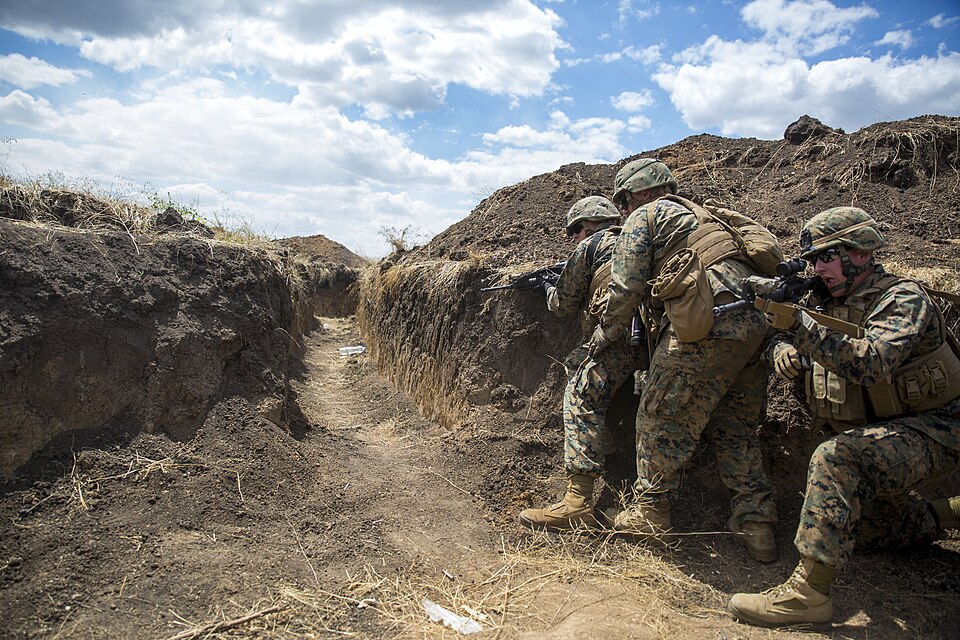
[Photo by Commander, U.S. Naval Forces Europe-Africa/U.S. 6th Fleet, Public domain, via Wikimedia Commons]
The views and opinions expressed in this article are those of the author.

Emir J. Phillips DBA/JD MBA is a distinguished Financial Advisor and an Associate Professor of Finance at Lincoln University (HBCU) in Jefferson City, MO with over 35 years of extensive professional experience in his field. With a DBA from Grenoble Ecole De Management, France, Dr. Phillips aims to equip future professionals with a deep understanding of grand strategies, critical thinking, and fundamental ethics in business, emphasizing their practical application in the professional world.