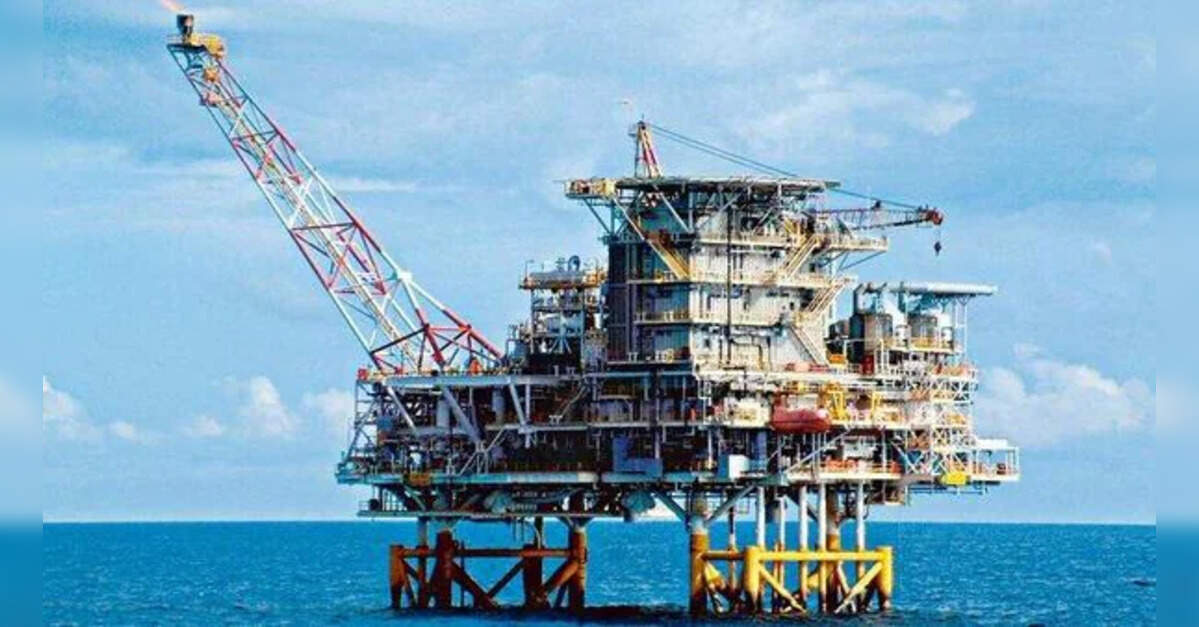
State-run Oil and Natural Gas Corporation (ONGC) has managed to arrest production decline from its ageing oil and gas fields and deliver incremental output gains at the country’s largest producing asset, Mumbai High, by bringing in global major BP as a technical service provider, Pankaj Kumar, director of production at ONGC, said at India Energy Week (IEW) 2026 on Thursday.
In an interaction on the sidelines of the event, he said that domestic crude oil production, which peaked around 2017–18, had seen a year-on-year decline thereafter, but ONGC has succeeded in stabilising output over the last three years despite operating almost entirely in mature fields.
“Globally, mature fields decline at around 6–8 per cent. At least we have been able to maintain production levels,” Kumar said, adding that output in 2022–23, 2023–24 and 2024–25 has remained broadly flat, with marginal variations of around 0.1 million tonnes. He expects production to remain in a similar range this year as well.
However, Kumar acknowledged that stabilisation alone is not sufficient as India’s energy demand and refining capacity continue to rise, increasing pressure on domestic oil and gas production.
To address this, the government has opened up nearly one million square kilometres of previously restricted “no-go” areas for exploration and announced the Samudra Manthan offshore exploration initiative, with ONGC expected to play a central role as the national oil company, he said.
Crude oil production from Mumbai High has increased by about 3,500–4,000 barrels per day, while gas output has risen by 2–2.5 million standard cubic metres per day, he said.
“In gas terms, 2.5 million cubic metres per day is a big number — almost a million tonnes per annum,” he said, adding that further upside is possible as seismic data reprocessing and surface facility debottlenecking exercises are still underway.
Encouraged by the results, ONGC has moved to the next phase of the strategy by inviting international oil companies to partner as technical service providers across the broader western offshore region, excluding Mumbai High. The tender follows the same model used for Mumbai High and is open only to select global players with experience in managing mature fields.
Data rooms will be opened after IEW 2026, and Kumar said participation is expected to improve after the visible results achieved at Mumbai High within just six to nine months.
The company has already begun transitioning parts of its offshore logistics from long-established bases near Mumbai to locations such as Pipavav and Surat, significantly cutting transit time for marine vessels and helicopters servicing offshore assets.