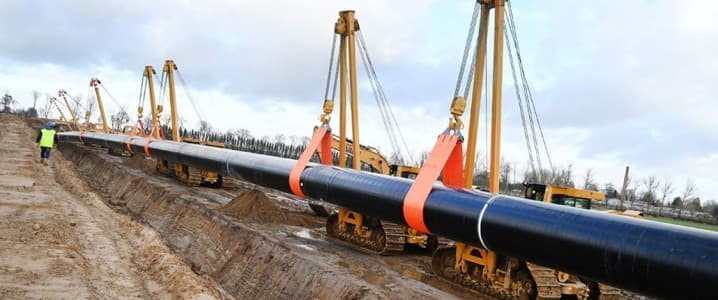
The global energy landscape continues its dynamic realignment, with Russia’s strategic pivot to Asian markets, particularly China, becoming a central theme for oil and gas investors. Amid Europe’s concerted efforts to reduce its reliance on Russian energy, Moscow is aggressively strengthening its eastern energy corridors. This year, the focus intensifies on natural gas exports to China, with pipeline volumes projected to surge by a significant 25% compared to 2024. This shift not only reshapes regional energy security but also presents a complex tapestry of opportunities and challenges for investors tracking global gas prices, infrastructure development, and geopolitical risk. Understanding the specifics of this growing energy partnership and its broader market implications is crucial for navigating the evolving investment climate.
Quantifying the Eastern Gas Shift: Pipeline and LNG Surges
Russia’s intensified focus on China as its primary gas export market is translating into substantial volume increases. For 2025, Gazprom is set to deliver between 38.6 and 38.7 billion cubic meters (bcm) of natural gas via the Power of Siberia pipeline to China. This represents a robust 25% increase over the 31 bcm shipped in 2024 and notably surpasses the pipeline’s originally planned annual capacity of 38 bcm, indicating either optimized operations or strong Chinese demand. This acceleration underscores the urgency of Russia’s pivot following Europe’s ongoing phase-out of Russian gas imports, including a recent agreement by the EU to further reduce dependence.
Beyond pipeline flows, Russia is also significantly boosting its liquefied natural gas (LNG) exports to China. November saw Russian LNG flows to China more than double year-over-year, reaching a record 1.6 million tons. This impressive growth firmly established Russia as China’s second-largest LNG supplier, trailing only Qatar. For investors, this dual-pronged approach highlights Russia’s commitment to diversifying its energy customer base and maximizing revenue streams. The increased volumes, both via pipeline and LNG, will inevitably influence Asian spot gas prices and global LNG market dynamics, creating ripples that extend to major LNG producers and traders worldwide. Companies with exposure to Asian gas markets or those involved in LNG infrastructure development should closely monitor these evolving trade patterns.
Power of Siberia 2: Long-Term Ambitions and Sticking Points
While the Power of Siberia 1 pipeline is operating at elevated levels, the long-term strategic vision for Russia-China gas cooperation hinges on the development of a second major pipeline, Power of Siberia 2. Earlier this year, both nations signed a legally binding memorandum to advance this project, which aims to transport gas from Russia’s vast Siberian fields to northern China via Mongolia. This marks a significant step forward after years of negotiations, signaling a deepened commitment from both sides.
However, critical hurdles remain. Key among these are the price China will agree to pay for the gas, a perennial sticking point in large-scale energy deals, and the complex question of financing the multi-billion-dollar project. A senior official from China’s state energy giant CNPC’s research division recently indicated that the construction of Power of Siberia 2 could take up to 10 years, citing the “tremendous work, jobs and negotiations” involved. For energy infrastructure investors, the Power of Siberia 2 project represents a colossal undertaking with potential for significant long-term returns, but also considerable development risk and geopolitical complexities. The timeline suggests that while the memorandum is a positive sign, actual cash flows from this second pipeline are a distant prospect, requiring careful consideration of capital allocation and geopolitical stability over the coming decade.
Navigating Volatility: Market Signals and Investor Focus
The broader energy market context surrounding Russia’s gas pivot is one of significant volatility. As of today, Brent crude trades at $90.38, reflecting a substantial 9.07% decline within a day range spanning $86.08 to $98.97. This sharp intraday movement follows a broader trend over the last 14 days, where Brent crude has contracted by 18.5%, falling from $112.78 on March 30th to $91.87 on April 17th. Similarly, WTI crude is down 9.41% today, trading at $82.59, and gasoline prices have seen a 5.18% drop to $2.93.
This market turbulence inevitably shapes investor sentiment. Our proprietary reader intent data reveals that investors are actively seeking clarity amidst this uncertainty. A prevalent question is, “what do you predict the price of oil per barrel will be by end of 2026?” alongside detailed inquiries into “OPEC+ current production quotas.” This indicates a strong focus on both immediate supply-demand dynamics and longer-term price projections. While the Russia-China gas narrative is specific to natural gas, its implications for global energy security and supply diversification are intertwined with the broader crude market. Sustained shifts in major energy flows can indirectly influence global demand for all hydrocarbons, affecting the investment calculus for integrated oil and gas companies.
Upcoming Catalysts and Strategic Outlook
The immediate future holds several critical events that could significantly influence energy market direction and investor strategies. This weekend, the OPEC+ Joint Ministerial Monitoring Committee (JMMC) and the full Ministerial meetings are scheduled for April 18th and 19th, respectively. Investors will be scrutinizing these gatherings for any signals regarding production policy, especially given the recent volatility in crude prices and the ongoing geopolitical landscape. Any adjustments to quotas could have an immediate impact on crude benchmarks.
Beyond OPEC+, a regular cadence of data releases will offer further insights into market fundamentals. The API Weekly Crude Inventory reports on April 21st and 28th, followed by the EIA Weekly Petroleum Status Reports on April 22nd and 29th, will provide crucial updates on U.S. crude, gasoline, and distillate stockpiles, influencing short-term trading decisions. The Baker Hughes Rig Count on April 24th and May 1st will offer an indication of North American drilling activity and future supply trends. For investors tracking the Russia-China gas story, these broader market indicators are vital context. While the long-term pivot to Asia is unfolding, short-term market reactions to these events will continue to shape the financial performance of energy companies, influencing everything from capital expenditure decisions on new projects to dividend policies and stock valuations.


