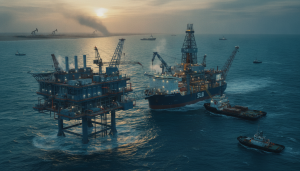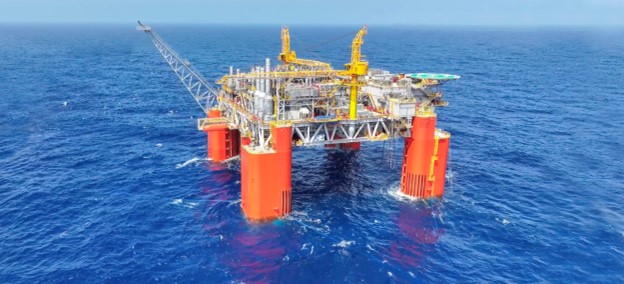
The US Gulf of Mexico is re-emerging as a pivotal battleground for global oil supply, challenging conventional wisdom that has long favored onshore shale plays. Recent developments signal a significant shift, with deepwater projects demonstrating remarkable productivity and technological advancement. This resurgence, spearheaded by innovative operators like Beacon Offshore Energy, backed by Blackstone Inc., is not merely about extracting more crude; it represents a strategic re-evaluation of long-term energy investment and supply stability in an increasingly volatile market.
The Deepwater Renaissance: A Counter-Narrative to Shale Plateauing
For years, the narrative of US oil production growth has been dominated by the rapid, flexible output of shale. However, as many onshore fields mature and face declining productivity, the spotlight is turning back to the enduring potential of the deepwater Gulf. Beacon Offshore Energy exemplifies this shift, bringing four new wells online between July and October that are collectively pumping an impressive average of 25,000 barrels per day. Significantly, the company asserts these are among the most productive wells in all of North America. This sustained, high-volume output from deepwater assets offers a stark contrast to the shorter decline curves typically seen in shale, positioning the Gulf as a crucial engine for future US production growth. Investors are increasingly recognizing the strategic value of these longer-lifespan, high-yield deepwater projects as a foundational element of a diversified energy portfolio.
Technological Breakthroughs Unlock Stranded Giants
The success of projects like Shenandoah is not merely a matter of finding oil; it is a testament to decades of relentless technological innovation. The Shenandoah prospect, initially discovered in 2009, was deemed too challenging for economic extraction at the time, left behind as the shale boom offered quicker returns. Operating in an environment where temperatures soar to 400°F and pressures can reach 20,000 pounds per square inch through over six miles of water and rock, required a new generation of sophisticated oilfield gear. Major players, including bp Plc, Chevron Corp., and Shell Plc, invested over a decade in developing the specialized equipment needed to conquer these extreme conditions. Beacon Offshore, stepping in as operator in 2020, leveraged these advancements, demonstrating how “stranded discoveries” can transform into highly profitable, lower-risk ventures once the technological hurdles are overcome. Industry analysts, like Vishnu Gopakumar of Enverus, anticipate a “modest boom” in the Gulf as operators can now revisit existing fields and unlock previously unattainable resources with this proven technology, signaling a new frontier for deepwater exploration and development.
Navigating Market Volatility: Deepwater’s Long-Term Value Proposition
The strategic importance of long-term deepwater projects like Beacon’s becomes even more apparent when viewed against the backdrop of current market dynamics. As of today, Brent crude trades at $90.55 per barrel, reflecting an 8.89% decline from its opening, with WTI crude similarly impacted at $83.07, down 8.88%. This daily volatility underscores a broader trend; the Brent benchmark has seen a substantial drop from $112.57 just two weeks ago on March 27th to $98.57 yesterday, April 16th, representing a 12.4% decrease. While such sharp price movements can create short-term uncertainty, deepwater investments offer a stabilizing anchor. Their multi-year development cycles and predictable, high-volume production once online provide a more consistent revenue stream, less susceptible to daily market swings. For investors concerned about the long-term trajectory of global crude supply and potential for future supply gluts, the sustained output from these technologically advanced deepwater wells provides a critical layer of stability and foresight, contrasting sharply with the often-unpredictable fluctuations of shorter-cycle onshore plays.
Investor Focus: Balancing Short-Term Signals with Long-Term Supply Security
Our proprietary reader intent data reveals a clear focus among investors on both immediate market drivers and future price predictions. Many are actively asking about “what do you predict the price of oil per barrel will be by end of 2026?” and “what are OPEC+ current production quotas?” These questions highlight a natural desire to anticipate market shifts. Coincidentally, the upcoming OPEC+ Joint Ministerial Monitoring Committee (JMMC) meeting today, April 17th, followed by the Full Ministerial meeting tomorrow, April 18th, will be critical in shaping near-term supply expectations. Additionally, forthcoming API and EIA weekly inventory reports on April 21st and 22nd, and the Baker Hughes Rig Count on April 24th, will provide further granular insights into supply-demand balances. However, these short-term indicators, while vital for tactical trading, should be balanced against the strategic, long-term implications of deepwater investments. Beacon’s commitment to bringing on roughly two new high-pressure wells per year for the foreseeable future, all integrated into a new floating production and storage (FPS) vessel, illustrates a deliberate strategy for sustained, predictable output. This long-term deepwater vision addresses the fundamental need for stable energy supply, offering a powerful counterpoint to the more reactive nature of short-cycle production and the immediate market’s focus on OPEC+ decisions and weekly inventory data.