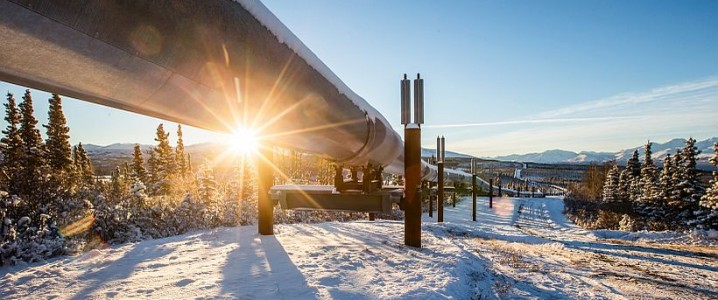
The recent decision by the Trump administration to reinstate oil and gas leasing across significant portions of the Arctic National Wildlife Refuge (ANWR) and the National Petroleum Reserve-Alaska (NPR-A) marks a pivotal moment for the U.S. energy landscape. This aggressive policy shift, which overturns prior restrictions and re-opens over 12 million acres to potential development, signals a determined push to revitalize Alaska’s role as a major domestic crude supplier. For investors, this move presents a complex tapestry of long-term opportunity, political uncertainty, and environmental challenges, all set against a backdrop of fluctuating global energy markets. Understanding the strategic implications requires a deep dive into the acreage, historical context, and the immediate market environment.
Market Dynamics and the Alaskan Reopening
The timing of this announcement comes as the global oil market navigates a period of significant volatility. As of today, Brent Crude trades at $90.38 per barrel, experiencing a notable daily decline of 9.07% and ranging from $86.08 to $98.97. Similarly, WTI Crude stands at $82.59, down 9.41% within a daily range of $78.97 to $90.34. This sharp downturn is particularly striking when we observe the 14-day Brent trend, which has seen prices plummet from $112.78 on March 30th to the current $90.38 – a substantial drop of $22.4, or nearly 20%. While gasoline prices have also seen a decrease to $2.93, down 5.18%, the broader crude market is clearly in flux. In such an environment, the prospect of unlocking new domestic supply sources like ANWR and NPR-A could be viewed differently. On one hand, sustained high prices make expensive Arctic development more economically viable. On the other hand, a sudden dip in prices, even if temporary, might prompt a re-evaluation of the investment calculus for projects with lengthy lead times and significant upfront capital requirements. However, the consistent demand for energy security and the long-term outlook for global crude consumption suggest that strategic additions to supply will remain critical, insulating producers to some extent from short-term price swings.
Unlocking the Arctic Frontier: Acreage and Production Potential
The scale of this policy reversal is substantial, with the Interior Department restoring the full 1.5-million-acre Coastal Plain within ANWR to leasing, alongside reinstating previously canceled leases held by the Alaska Industrial Development and Export Authority. This move is complemented by efforts to open new lease opportunities across 82% of the National Petroleum Reserve-Alaska (NPR-A), a vast 23-million-acre expanse that had previously faced significant restrictions. Combined, these twin rollbacks could re-open over 12 million acres for exploration and development, a staggering figure that underscores the administration’s commitment to boosting domestic energy output. Alaska’s historical role in U.S. oil production is a testament to its geological potential; output peaked at 2 million barrels per day in 1988, a stark contrast to its current contribution of barely 3% of total U.S. production. This decline has largely been attributed to aging fields, high operational costs, and, critically, limited access to new leasing opportunities for decades. The renewed push aims to reverse this trend, leveraging modern drilling technologies and a strategic imperative for energy independence, particularly as Asian buyers continue to signal robust interest in long-term crude and LNG supplies.
Investor Sentiment and Forward Catalysts
Our proprietary reader intent data reveals a clear focus among investors on future market direction, with common queries including, “What do you predict the price of oil per barrel will be by end of 2026?” and “What are OPEC+ current production quotas?” The ANWR reopening, while not an immediate supply shock, serves as a powerful signal regarding the future trajectory of U.S. crude production and its potential influence on global balances. For investors, this introduces a new variable into their long-term price models. The upcoming OPEC+ Joint Ministerial Monitoring Committee (JMMC) Meeting on April 19th and the subsequent OPEC+ Ministerial Meeting on April 20th will be crucial. These meetings will determine production quotas, and while the new Alaskan potential won’t directly impact OPEC+’s immediate decisions, the prospect of increased U.S. supply could factor into their longer-term strategy debates, particularly concerning market share. Furthermore, investors will closely monitor the API Weekly Crude Inventory reports on April 21st and April 28th, as well as the EIA Weekly Petroleum Status Reports on April 22nd and April 29th. These data points offer snapshots of current U.S. supply and demand dynamics, providing early indicators of any shifts in the domestic landscape that could be influenced by, or respond to, policies like the ANWR reopening. While the tangible barrels from ANWR are years away, the policy signal impacts investment decisions today, potentially attracting capital to companies with Alaskan footprints or expertise.
Navigating the Headwinds: Legal, Environmental, and Operational Complexities
While the economic case for revitalizing Alaskan oil production is strong, the path forward is anything but smooth. Environmental groups have vehemently condemned the decision, characterizing it as a direct assault on one of North America’s last untouched ecosystems. This opposition is likely to reignite decades-old legal battles centered on wildlife protection and Indigenous rights, creating significant regulatory and permitting uncertainties for any potential operators. For investors, this translates into elevated project risk and potentially extended timelines, as legal challenges can significantly delay or even halt development. Beyond legal hurdles, the operational realities of drilling in the Arctic present their own set of challenges. High upfront costs, extreme weather conditions, and the need for specialized infrastructure contribute to a higher cost basis compared to more conventional plays. This makes Arctic projects more sensitive to crude price fluctuations and requires a long-term commitment to capital deployment. The administration’s emphasis on advancing “key infrastructure” suggests an understanding of these challenges, but the implementation of such large-scale projects in a remote and environmentally sensitive region will demand significant resources and careful navigation of public and political sentiment. Ultimately, the success of this policy hinges not just on the geological potential, but on the ability to overcome these formidable operational, legal, and environmental headwinds.
Strategic Implications for U.S. Energy Independence
The reopening of ANWR and NPR-A is more than just an acreage expansion; it’s a strategic declaration of intent regarding U.S. energy independence and its role in global energy markets. With the U.S. consistently seeking to bolster its energy security, and with international buyers expressing renewed interest in stable crude and LNG supplies, unlocking Alaska’s vast potential could significantly diversify America’s energy portfolio. This move is as much a political statement as it is an economic one, signaling that America’s oil frontier, though often debated, remains a key component of its long-term energy strategy. For companies with existing Alaskan operations or those poised to enter the region, this policy provides a clearer, albeit still challenging, pathway for future growth. Investors eyeing the long game in energy need to recognize that while the immediate market impact will be limited, the long-term implications for U.S. production capacity, geopolitical influence, and the energy transition narrative are profound. The coming years will reveal whether this aggressive push can successfully balance the demands of energy security with environmental stewardship, ultimately reshaping the investment landscape for Arctic oil and gas.


